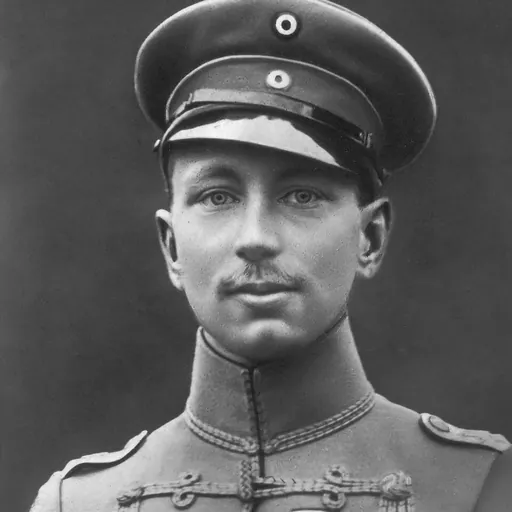
About Prince Joachim of Prussia
Lived 1890 – 1920 (aged 29). Prince Joachim of Prussia was a German military officer.
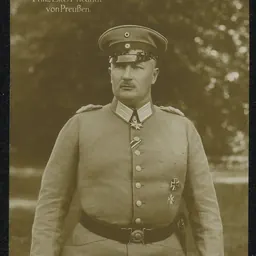
Prince Joachim Franz Humbert of Prussia (17 December 1890 – 18 July 1920) was the youngest son and sixth child of Wilhelm II, German Emperor, by his first wife, Augusta Victoria of Schleswig-Holstein. He died by suicide at age 29. Prince Joachim was educated as an officer and participated in the First World War. During the war, he was considered a candidate for several newly established monarchies in Europe.
His great-grandson is Grand Duke George Mikhailovich, the heir apparent to Maria Vladimirovna, a claimant to the disputed Headship of the Imperial Family of Russia.
Early life Birth and family Prince Joachim was born on 17 December 1890, two years after his father had become the German Emperor, at the Berlin Palace in central Berlin. He was the sixth and youngest son of Emperor Wilhelm II, and his first wife, Princess Augusta Victoria of Schleswig-Holstein.
Education Prince Joachim spent his childhood with his siblings at the New Palace in Potsdam, and his school days at the Prinzenhaus in Plön, in his mother's ancestral Schleswig-Holstein, as his brothers had been before him.
Marriage
On 11 March 1916 in Berlin, Joachim married Princess Marie-Auguste of Anhalt (10 June 1898 – 22 May 1983), the daughter of Eduard, Duke of Anhalt and his wife Princess Luise of Saxe-Altenburg (daughter of Prince Moritz of Saxe-Altenburg). He and Marie-Auguste had been engaged since 14 October of the previous year. The wedding was celebrated at Bellevue Palace, and was attended by Joachim's father and mother, the Duke and Duchess of Anhalt, as well as other relatives. They had a simple Lutheran ceremony.
The couple had one son, Prince Karl Franz Josef Wilhelm Friedrich Eduard Paul (15 December 1916 in Potsdam – 22 January 1975 in Arica, Chile). Their grandson, Prince Franz Wilhelm, married Maria Vladimirovna of Russia, a claimant to the Imperial Russian throne.
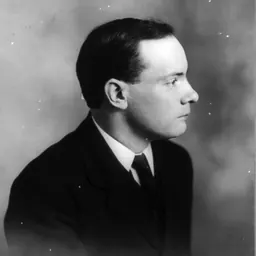
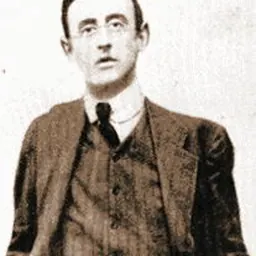
Candidate for thrones Ireland During the Easter Rising in Dublin in 1916, some republican leaders, including Patrick Pearse and Joseph Plunkett, contemplated giving the throne of an independent Ireland to Prince Joachim. Pearse and Plunkett thought that if the rising were successful and Germany won the First World War, an independent Ireland would be a monarchy with a German prince as king, like Romania and Bulgaria before it.
The fact that Joachim did not speak English was also considered an advantage, as he might be more disposed to learning and promoting the use of the Irish language.
In his memoirs, Irish revolutionary, politician, and poet Desmond FitzGerald wrote: "That would have certain advantages for us. It would mean that a movement for de-anglicisation would flow from the head of the state downwards, for what was English would be foreign to the head of the state. He would naturally turn to those who were more Irish and Gaelic, as to his friends, for the non-nationalist element in our country had shown themselves to be so bitterly anti-German. Such a ruler would necessarily favour the Irish language, for it would be impossible to make the country German-speaking, while it would be against his own interests to foster English. For the first generation or so it would be an advantage, in view of our natural weakness, to have a ruler who linked us with a dominant European power, and thereafter, when we were better prepared to stand alone, or when it might be undesirable that our ruler should turn by personal choice to one power rather than be guided by what was most natural and beneficial for our country, the ruler of that time would have become completely Irish."
Ernest Blythe recalled that in January 1915 he heard Plunkett and Thomas MacDonagh express support for the idea at an Irish Volunteers meeting. Bulmer Hobson, secretary of the Volunteers, was among the attendees. No objections were made by anyone and Blythe himself said he found the idea "immensely attractive".
Georgia After Georgia's declaration of independence following the Russian Revolution of 1917, Joachim was briefly considered by the German representative Count Friedrich Werner von der Schulenburg and Georgian royalists as a candidate for the Georgian throne.
Lithuania The Council of Lithuania declared Lithuania's independence on February 16, 1918, but the council was unable to form a government, police, or other state institutions due to the continued presence of German troops. The Germans presented various proposals to incorporate Lithuania into the German Empire, particularly Prussia.
One such proposal offered the crown of Lithuania to Joachim. The Lithuanians resisted this idea and hoped to preserve their independence by creating a separate constitutional monarchy. On 4 June 1918, they voted to offer the Lithuanian throne to the German noble Wilhelm Karl, Duke of Urach.
Divorce and death Following the German Revolution in November 1918, the Emperor was forced to abdicate, thus depriving Joachim of his titles, position and prospects for heading any newly established monarchies in Europe. Unable to accept his new status as a commoner, he fell into a deep depression. On 31 May 1918, Joachim was examined by the psychiatrist Robert Gaupp, who submitted a report concluding that he "was incurably ill, both mentally and physically ... was extremely easily emotionally and sexually aroused", and "was inclined to 'violent, uncontrollably exploding outbursts of anger in which all self-control [was] lost'".
Following the divorce, Joachim shot himself in Potsdam on 18 July 1920. One source reports that he had been in financial straits and suffered from "great mental depression". His own brother Prince Eitel Friedrich of Prussia commented that he suffered from "a fit of excessive dementia". Kaiser Wilhelm's reaction to the news of his son's suicide was one of fury, commenting that he was outraged "that the oaf should have done this, too, to us and especially to his mother!" à la suite, 4. Gardegrenadierlandwehrregiment (4th Reserve Regiment of Grenadier Guards)
Honours Prince Joachim received the following orders and decorations:
Ancestry
Portrayal in fiction Prince Joachim was played by American actor Jesse Plemons and portrayed as the main antagonist in the 2021 Disney fantasy adventure film Jungle Cruise.
Don’t just read it —
keep it.
Full-length biographies made to live with: read them, listen on the way to work, watch them tonight.
- E-book
- Audio
- Video
Instant download · yours to keep · every purchase keeps this site free
Important facts
Family & relationships
People in Prince Joachim of Prussia's life
Named in this biography and alive at the same time




Related people
Same field, nearest in time


Contemporaries
People whose lives overlapped Prince Joachim of Prussia's



Frequently asked questions
Who was Prince Joachim of Prussia?
Prussian prince (1890-1920)
When was Prince Joachim of Prussia born?
Prince Joachim of Prussia was born on 17 December 1890 in Berlin.
When did Prince Joachim of Prussia die?
Prince Joachim of Prussia died on 18 July 1920 in Potsdam.
What was Prince Joachim of Prussia's occupation?
Prince Joachim of Prussia was a military officer.
What nationality was Prince Joachim of Prussia?
Prince Joachim of Prussia was German.
Sources & further reading
· Wikipedia: Prince Joachim of Prussia
· DBpedia: Prince Joachim of Prussia
Cite this page
APA: Biography.guide. (2026). Prince Joachim of Prussia. https://biography.guide/prince-joachim-of-prussia/
MLA: "Prince Joachim of Prussia." Biography.guide, https://biography.guide/prince-joachim-of-prussia/.
Chicago: "Prince Joachim of Prussia." Biography.guide. https://biography.guide/prince-joachim-of-prussia/.
Data last updated: 2026-09-20 · Spot an error? Report a correction.
Portrait: Wikimedia Commons · author & licence
Page generated 2026-09-27 04:57 UTC