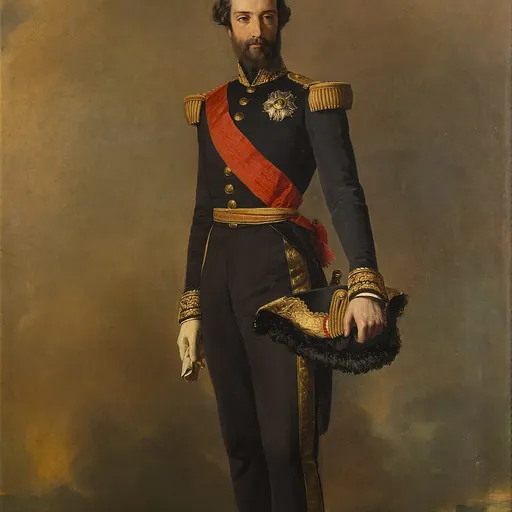
Prince François, Prince of Joinville
Admiral of the French Navy
About Prince François, Prince of Joinville
Lived 1818 – 1900 (aged 81). Prince François, Prince of Joinville was a French politician, writer, officer of the French Navy, naval officer and soldier.
François d'Orléans, Prince de Joinville (14 August 1818 – 16 June 1900) was the third son of Louis Philippe, King of the French, and his wife Maria Amalia of Naples and Sicily. An admiral of the French Navy, François was famous for bringing the remains of Napoleon from Saint Helena to France, as well as a talented artist, with 35 known watercolours. He married Princess Francisca of Brazil, daughter of Emperor Pedro I and sister of Emperor Pedro II. The dowry received by François upon the marriage became the Brazilian city of Joinville.
François and Francisca's grandson Jean went on to become the Orléanist claimant to the extinct French throne, a claim passed on to his son, grandson and now great-grandson Jean, Count of Paris, current Orléanist claimant to the French crown.
Early life and military career He was born François-Ferdinand-Philippe-Louis-Marie d'Orléans at the Château de Neuilly, in Neuilly-sur-Seine, France. Educated for the navy, he was commissioned lieutenant in 1836. His first conspicuous service was at the Bombardment of San Juan de Ulúa, in November 1838, commanding the corvette , when he headed a landing party and took the Mexican general Mariano Arista prisoner at Veracruz.
The Prince was promoted to captain of the frigate La , and in 1840 was entrusted with bringing the remains of Napoleon from Saint Helena to France.
Marriage to Francisca of Brazil
In 1838, François had made his first trip to Brazil, where he had been warmly hosted by Emperor Pedro II, son of Emperor Pedro I of Brazil and Archduchess Leopoldina of Austria, a Habsburg. During his time in the Brazilian court, François met Princess Francisca, Pedro's younger daughter, his first cousin once removed, then 14 years old.
In 1840, François again stopped in Brazil for two weeks on his way back from St. Helena, where he had headed the expedition entrusted with bringing the remains of Napoleon from Saint Helena to France. Three years later, François headed once again to Rio de Janeiro, in order to marry Princess Francisca. They married in that city on 1 May 1843.
François received as dowry an area of over 580 km2 in the South of Brazil, in the state of Santa Catarina, until then called Colônia Dona Francisca after its owner, the newly-wed princess, sister to the emperor. The area, near the coast and devoid of any populational settlements, therefore became the Brazilian part of the lands of the Prince of Joinville.
Exile and sale of the lands of Joinville In 1844 he conducted naval operations against Morocco, bombarding Tangier and occupying Mogador, and was rewarded with the rank of vice-admiral. In the following year he published in the Revue des deux mondes an article on the deficiencies of the French Navy which attracted considerable attention.
In 1848, François' father, King Louis Philippe, was deposed as the monarchy was abolished in France and the French Second Republic instaurated. Like his parents and siblings, François nominally lost all his properties and lands in France, including the French lands of the principality of Joinville, and hastily went with his wife and family to exile in England.
Having taken refuge with his family at Claremont, and with the Brazilian lands of Joinville as his only remaining property, François decided to make profits off those that were last remnants of his former principality. With the assistance of Hamburg Senator Christian Mathias Schroeder, with whom the gains were split, parts of the lands were sold to German-speaking immigrants, who started arriving in the Brazilian Joinville on 9 March 1851 and built the first facilities in the area, including a small royal palace. The titularity of the principality was negotiated with Heinrich Ferdinand Wiese, German-speaking noble-man from Schleswig-Holstein whose family was fleeing as the Danish troops invaded their territory during the First Schleswig War. It was agreed that the transferred title could only be used by Heinrich Ferdinand or his descendants after the passing of François and Francisca, who officially kept the titles of Prince and Princess of Joinville until their death.
Political career and service in the American Civil War
François was excluded from continuing a career in the Second Republic's navy. So in 1851, he announced his candidacy for the French presidential election to be held in 1852, hoping to pave the way for an eventual restoration of the monarchy. His plan to become a second "Prince-President" was preempted by the 2 December 1851 coup by which the first "Prince-President", Louis-Napoléon Bonaparte, effected his own ascension to the throne.
In 1861, upon the outbreak of the American Civil War, he went to the United States, and placed the services of his son and two of his nephews at the disposal of the government. President Lincoln appointed him and his nephews to the staff of Major General George B. McClellan. In June 1862, disagreements with the US position towards Mexico caused the prince to withdraw from the Union forces, and he returned to Europe.
François painted his own expedition to recover the remnants of Napoleon from Saint Helena and take them back to Paris.
With the overthrow of the Second Empire in 1870, François returned to France, only to be promptly expelled by the Government of National Defense. Returning incognito, he joined the army of general Louis d'Aurelle de Paladines, under the assumed name of "Colonel Lutherod", fought bravely in Orléans, and afterwards, making public his identity, formally sought permission to serve the French army. Gambetta, however, arrested him and sent him back to England.
In the elections of 1871 to the National Assembly, the prince was elected to sit for the Haute-Marne, the department of his former principality. By an arrangement with Adolphe Thiers, however, the prince did not take his seat until the latter had been chosen president of the provisional republic.
Deafness Starting at a young age, François became increasingly deaf, and surgery to cure his hearing loss was totally unsuccessful.
His increasing deafness prevented him from making many contributions to the National Assembly, and he resigned his parliamentary seat in 1876.
Later life and death In 1886, a new law against pretenders to the throne being part of the French armed forces deprived François of his rank as admiral.
François and Francisca lived their last decades of life together in Paris, at their home in avenue d'Antin. Francisca died in 1898, aged 73, and François outlived her by two years, dying at home on 16 June 1900, at the age of 81. Grand Cross of the Southern Cross Ernestine duchies: Grand Cross of the Saxe-Ernestine House Order, 1864 Beylik of Tunis: Husainid Family Order Grand Cross of St. Ferdinand and Merit Grand Cross of the Tower and Sword Grand Cordon of the Order of Leopold, 22 March 1842
Ancestry
Children François and Francisca's daughter, Françoise, was the mother of Prince Jean, pretender to the French throne. His own son and his grandson have been considered the legitimate claimants to the throne of France, and his great-grandson, Jean, Count of Paris, is the current claimant to the French crown.
François and Francisca's son, Pierre, entered the United States Naval Academy on 15 October 1861. He received an honorary appointment as an ensign in the United States Navy on 28 May 1863 and served on the frigate USS John Adams. He was granted a leave of absence from the Navy as of 1 January 1864 and resigned from the Navy on 30 May 1864. He returned to France in June of that year.
Don’t just read it —
keep it.
Full-length biographies made to live with: read them, listen on the way to work, watch them tonight.
- E-book
- Audio
- Video
Instant download · yours to keep · every purchase keeps this site free
Important facts
more
Francois Orleans Prince De Joinville, François d'Orléans, Francois Ferdinand Phillippe Louis Marie d'Orleans, François Ferdinand Philippe Louis Marie d'Orléans Joinville, Francois Ferdinand Phillippe Louis Marie d'Family & relationships
People in Prince François, Prince of Joinville's life
Named in this biography and alive at the same time

Related people
Same field, nearest in time


Contemporaries
People whose lives overlapped Prince François, Prince of Joinville's



Frequently asked questions
Who was Prince François, Prince of Joinville?
Admiral of the French Navy (1818-1900)
When was Prince François, Prince of Joinville born?
Prince François, Prince of Joinville was born on 14 August 1818 in Neuilly-sur-Seine.
When did Prince François, Prince of Joinville die?
Prince François, Prince of Joinville died on 16 June 1900 in Paris.
What was Prince François, Prince of Joinville's occupation?
Prince François, Prince of Joinville was a politician, writer, officer of the French Navy, naval officer and soldier.
What nationality was Prince François, Prince of Joinville?
Prince François, Prince of Joinville was French.
Sources & further reading
· Wikipedia: Prince François, Prince of Joinville
· DBpedia: François d'Orléans, Prince of Joinville
Cite this page
APA: Biography.guide. (2026). Prince François, Prince of Joinville. https://biography.guide/prince-francois-prince-of-joinville/
MLA: "Prince François, Prince of Joinville." Biography.guide, https://biography.guide/prince-francois-prince-of-joinville/.
Chicago: "Prince François, Prince of Joinville." Biography.guide. https://biography.guide/prince-francois-prince-of-joinville/.
Data last updated: 2026-09-27 · Spot an error? Report a correction.
Portrait: Wikimedia Commons · author & licence
Page generated 2026-10-05 02:14 UTC