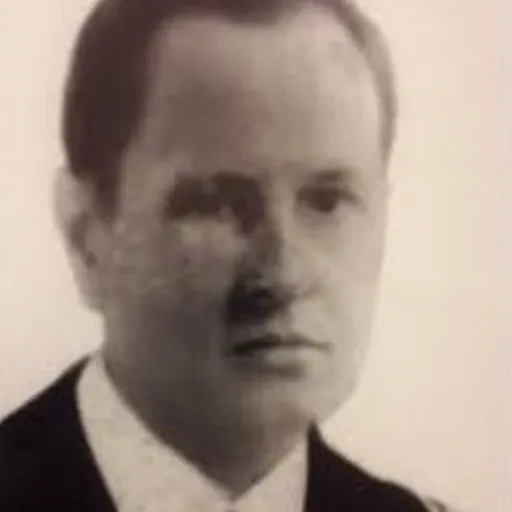
About Priamo Leonardi
Lived 1888 – 1984 (aged 95). Priamo Leonardi was an Italian military personnel.
Priamo Leonardi (2 October 1888 – 16 March 1984) was an Italian admiral during World War II.
Early life and career
Priamo Leonardi was born in Borgotaro, near Parma, in 1888, and entered the Italian Naval Academy at Livorno in 1907. He was commissioned as an ensign in 1911, and in the same year he participated in the Italo-Turkish War on board the armoured cruiser Amalfi.
After promotion to lieutenant, Leonardi participated in World War I, first serving on board the armoured cruiser Francesco Ferruccio, then on the battleship Duilio and later in the Albania Naval High Command. The landward defence perimeter, 50 km long, consisted of a chain of 30 coastal strongholds manned by two coastal battalions. Airborne troops also took part in the attack against Augusta and Syracuse in Operation Ladbroke. Admiral Leonardi tried to stem the British advance with tumultuary troops, but to little avail, as he had no artillery (Augusta, as mentioned, was only armed with coastal and anti-aircraft batteries: the former could be useful to repel an amphibious landing, and the latter against aircraft, but both were useless against a ground attack) or organic troops. While British forces steamrolled towards Syracuse and the interior, Leonardi tried to organize a counter-attack in co-operation with German units, but on the night between 10 and 11 July – while Leonardi was absent from Augusta, having gone in the backcountry to organize the counter-attack – many the troops that manned the Augusta defences, and especially the units of the Coastal Artillery Militia (MILMART, a Blackshirt branch tasked with coastal defense, whose personnel was recruited locally, and whose morale was particularly low because of the dire conditions of their families and their fear of being executed for being Fascist) abandoned their posts, blew up batteries and fortifications, disbanded and went home. When he was informed of this, Leonardi put together some units with second-line troops and dispersed soldiers and tried again to organize a defense together with German units; he "spent the next few days dashing from unit to unit, to bolster morale and to keep in touch with his disparate and dispersed forces", and at one point, on 12 July, he personally reactivated an abandoned MILMART battery and opened fire on the first British destroyer that entered Augusta harbour. These movements, however, also had the effect of preventing many subordinates from contacting him, causing further confusion. The abandonment and destruction of the coastal batteries enabled the Royal Navy to land troops directly in Augusta; despite fierce fighting in some areas, both Augusta and Syracuse fell by 13 July. Leonardi himself was captured by British forces six days later and sent to a POW camp in Great Britain, where he remained till November 1944.
The command of the Sixth Army, tasked with the defence of Sicily, held Leonardi responsible of the fall of the Augusta-Syracuse fortress and proposed a court-martial for him, but no trial was held. The Salò Republic, however, looking for scapegoats in the military to justify the defeat of Italy, branded Leonardi as a traitor and a coward, falsely accusing him of having ordered the destruction of the coastal batteries and having surrendered Augusta without a fight; he was tried and sentenced to death in absentia by a Fascist kangaroo court in May 1944. After the end of the war, in November 1945, a formal enquiry was held on Leonardi's behaviour; the enquiry concluded that the admiral had done everything he could during the invasion of Sicily, and in 1947 he was awarded a Silver Medal of Military Valor.
Having been promoted to Vice Admiral (Ammiraglio di Divisione) in 1945, Leonardi was placed in reserve in the following year; in 1958, he was promoted to full Admiral (Ammiraglio di Squadra), Reserve. He died in Parma on 16 March 1984.
Don’t just read it —
keep it.
Full-length biographies made to live with: read them, listen on the way to work, watch them tonight.
- E-book
- Audio
- Video
Instant download · yours to keep · every purchase keeps this site free
Important facts
Related people
Same field, nearest in time





Contemporaries
People whose lives overlapped Priamo Leonardi's


Frequently asked questions
Who was Priamo Leonardi?
Italian admiral
When was Priamo Leonardi born?
Priamo Leonardi was born on 2 October 1888 in Borgo Val di Taro.
When did Priamo Leonardi die?
Priamo Leonardi died on 16 March 1984 in Parma.
What was Priamo Leonardi's occupation?
Priamo Leonardi was a military personnel.
What nationality was Priamo Leonardi?
Priamo Leonardi was Italian.
Sources & further reading
Cite this page
APA: Biography.guide. (2026). Priamo Leonardi. https://biography.guide/priamo-leonardi/
MLA: "Priamo Leonardi." Biography.guide, https://biography.guide/priamo-leonardi/.
Chicago: "Priamo Leonardi." Biography.guide. https://biography.guide/priamo-leonardi/.
Data last updated: 2026-09-21 · Spot an error? Report a correction.
Portrait: Wikimedia Commons · author & licence
Page generated 2026-09-27 05:01 UTC