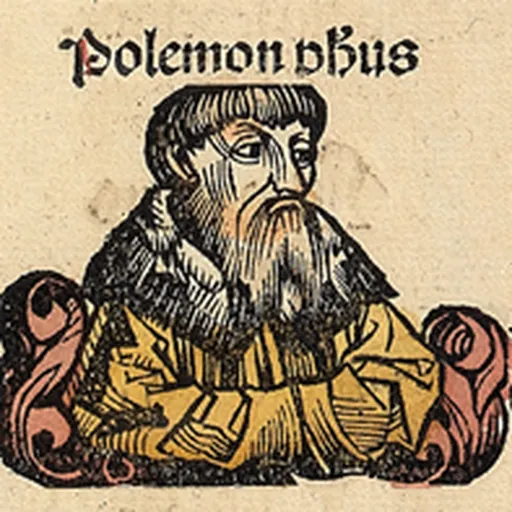
About Polemon
Lived 400 BC – 270 BC. Polemon was a Greek philosopher.
Polemon of Athens (, gen.: Πολέμωνος; d. 270/269 BC) was an eminent Greek Platonist philosopher and Plato's third successor as scholarch (i.e., head of the Academy) from 314/313 to 270/269 BC. A pupil of Xenocrates, he believed that philosophy should be practiced rather than just studied, and he placed the highest good in living according to nature.
Life Polemon was the son of Philostratus, a man of wealth and political distinction. In his youth, he was relatively irresponsible, but one day, when he was about thirty, on his bursting into the school of Xenocrates, at the head of a band of revelers, his attention was drawn to the sayings of Xenocrates, who continued on calmly in spite of the interruption; it just so happened that Xenocrates was discussing temperance. Polemon immediately tore off his garland and remained an attentive listener, and from that day he adopted a modest and restrained course of life, and continued to frequent the school. On the death of Xenocrates, he became the scholarch, in 315 BC.
His disciples included Crates of Athens, who was his eromenos, and Crantor, as well as Zeno of Citium and Arcesilaus. According to Eusebius (Chron.) he died in 270/269 BC (or possibly, as in some manuscripts, 276/275 BC). Diogenes Laërtius says that he died at a great age, and of natural decay. Crates was his successor in the Academy.
Philosophy Diogenes Laërtius reports that he was a close follower of Xenocrates in all things. He esteemed the object of philosophy to be to exercise people in things and deeds, not in dialectic speculations; his character was grave and severe; and he took pride in displaying the mastery which he had acquired over emotions of every sort. In literature he most admired Homer and Sophocles, and he is said to have been the author of the remark, that Homer is an epic Sophocles, and Sophocles a tragic Homer.
Writings According to Diogenes Laërtius, Polemon wrote several treatises, of which none were extant when the Suda was compiled. There is, however, a quotation made by Clement of Alexandria, either from Polemon or from another philosopher of the same name, "in Concerning the Life in Accordance with Nature" , and another passage, upon happiness, which agrees precisely with the statement of Cicero, that Polemon placed the summum bonum (highest good) in living according to the laws of nature.
Don’t just read it —
keep it.
Full-length biographies made to live with: read them, listen on the way to work, watch them tonight.
- E-book
- Audio
- Video
Instant download · yours to keep · every purchase keeps this site free
Important facts
People in Polemon's life
Named in this biography and alive at the same time
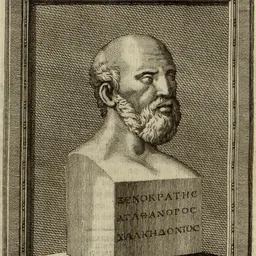
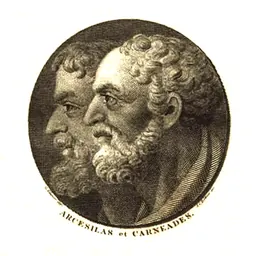

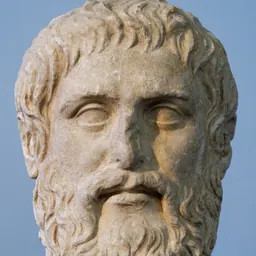

Related people
Same field, nearest in time



Contemporaries
People whose lives overlapped Polemon's


Frequently asked questions
Who was Polemon?
Greek philosopher and scholarch (died 270/269 BC)
When was Polemon born?
Polemon was born in 400 BC in Athens.
When did Polemon die?
Polemon died in 270 BC in Classical Athens.
What was Polemon's occupation?
Polemon was a philosopher.
What nationality was Polemon?
Polemon was Greek.
Sources & further reading
Cite this page
APA: Biography.guide. (2026). Polemon. https://biography.guide/polemon-philosopher/
MLA: "Polemon." Biography.guide, https://biography.guide/polemon-philosopher/.
Chicago: "Polemon." Biography.guide. https://biography.guide/polemon-philosopher/.
Data last updated: 2026-09-21 · Spot an error? Report a correction.
Portrait: Wikimedia Commons · author & licence
Page generated 2026-09-27 05:00 UTC