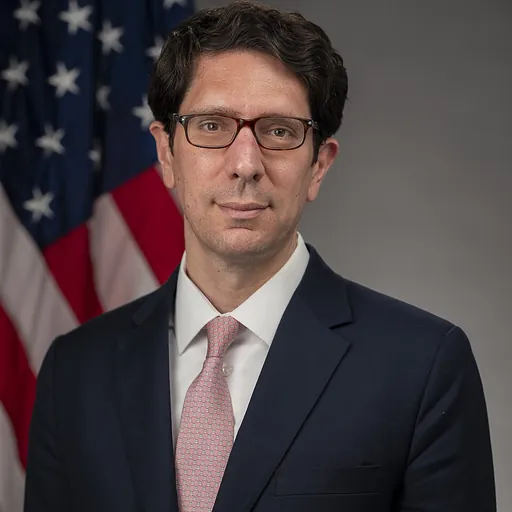
About Pierre Yared
Born 1979. Pierre Yared is an American economist.
Pierre Yared is a Lebanese-American economist, academic, and U.S. government official, known for his work on macroeconomic policy and political economy. He served as the acting chairman of the Council of Economic Advisers (CEA) in the Executive Office of the President of the United States from September 2025 to July 2026. He was a member and vice chair from February 2025 until his appointment as acting chair. He holds the title of Mitsubishi UFJ Trust and Banking (MUTB) Professor of International Business at Columbia Business School. Throughout his tenure at Columbia, he served in several senior administrative roles, including senior vice dean for faculty affairs and vice dean for executive education.
Yared is a research associate at the National Bureau of Economic Research, and a member of the Council on Foreign Relations and the Economic Club of New York.
Early Life and education Yared was born in Beirut in 1979 during the Lebanese Civil War and was raised in Cleveland, Ohio, where he attended University School. His father, Jean-Pierre Yared, is the director of the Center for Critical Care Medicine in the Heart and Vascular Institute and a staff anesthesiologist in the Anesthesiology Institute at the Cleveland Clinic. His mother, Sana Yared, is a French teacher and docent at the Cleveland Museum of Art.
Personal life Yared married visual artist Lucy Phillips in 2016.
In 2015, he became co-director of the Richman Center for Business, Law, and Public Policy, a position which he continues to hold. He was named the Mitsubishi UFJ Trust and Banking (MUTB) Professor of International Business in 2019.
Yared has held editorial positions at several peer-reviewed journals. He worked as an associate editor of the American Economic Review (2018–2024), Journal of Monetary Economics (2018–2020), International Economic Review (2013–2018), and Journal of the European Economic Association (2010–2016), and as a foreign editor of the Review of Economic Studies (2014–2020).
Research focus Yared's research spans three main trajectories in macroeconomics: government debt and fiscal policy, the international role of the U.S. dollar and military power, and central banking and inflation. His academic work is closely aligned with his public commentary and policy engagement, particularly on the subject of U.S. fiscal sustainability.
Government debt and fiscal policy Yared has written extensively on the political economy of fiscal policy. In his 2019 article “Rising Government Debt: Causes and Solutions for a Decades-Old Trend,” he examined the growth of public debt in advanced economies since the 1980s, arguing that it stems from rising government spending. In the United States, he identified the expansion of entitlement programs, such as Medicare and Social Security, as the primary driver of debt growth, rather than tax cuts, and he noted similar patterns in other advanced economies. Yared argued that normative macroeconomic theories cannot explain these patterns. He linked these patterns to demographic and political forces, resulting in rising political polarization and electoral uncertainty, which makes spending restraint more difficult.
Yared has also argued that mounting debt inhibits the United States’ ability to respond to global crises, potentially undermining the dollar's reserve currency status and posing significant long-term risks to global leadership. He has advocated for gradual reforms that simultaneously incorporate entitlement restructuring and broadening the tax base, citing Sweden's fiscal adjustment in the 1990s as an example. while later work examined optimal fiscal rules with threshold-based penalties under limited enforcement.
Dollar and military dominance In a 2024 article, Yared presented a game-theoretic framework that he has developed with University of Chicago professor Carolin Pflueger, which shows that military power and the financial privilege of a dominant currency reinforce one another. The model demonstrates that militarily dominant countries benefit from a funding advantage in the form of lower government bond yields, which helps those hegemonic countries to sustain their power advantage and win wars. In the case of the United States, its military strength reassures investors about asset safety, supporting the dollar's reserve currency status and enabling lower borrowing costs. In turn, the U.S. financial dominance allows for a more efficient defense financing. The authors argued that this dynamic contributes to the U.S.'s exorbitant privilege in the global market. However, they also warned of the system's fragility, noting that rising debt, fiscal gridlock, or alternative reserve currencies could weaken the U.S. position.
Yared connected this analysis to broader fiscal policy concerns, arguing that debt sustainability affects national security. The authors argued that the disinflationary environment of the late 20th and early 21st centuries was supported by structural forces associated with the Washington Consensus, such as globalization, market liberalization, de-unionization, and fiscal restraint, combined with reforms that enhanced central bank independence and inflation targeting. The authors used a dynamic New Keynesian model to analyze these mechanisms, incorporating political economy frictions. It also warns that political constraints may lead to greater inflation volatility in the coming years. He served as acting chairman from September 2025 until July 2026, following the leave of absence of Chairman Stephen Miran, who was appointed at the Federal Reserve’s Board of Governors to succeed Adriana Kugler. Yared was also considered to succeed Gita Gopinath as First Deputy Managing Director of the International Monetary Fund.
On June 30, 2026, President Donald Trump announced that Yared was stepping down to return to his teaching post at Columbia Business School and thanked him for his service, referring to him as a "STAR" and a leader of his "team of 'brainiacs.'" Yared is expected to be succeeded by the president's nominee and University of Minnesota economics professor, Christopher Phelan.
Don’t just read it —
keep it.
Full-length biographies made to live with: read them, listen on the way to work, watch them tonight.
- E-book
- Audio
- Video
Instant download · yours to keep · every purchase keeps this site free
Important facts
People in Pierre Yared's life
Named in this biography and alive at the same time




Related people
Same field, nearest in time


Contemporaries
People whose lives overlapped Pierre Yared's



Frequently asked questions
Who is Pierre Yared?
economist (Columbia University)
When was Pierre Yared born?
Pierre Yared was born in 1979 in Beirut.
What is Pierre Yared's occupation?
Pierre Yared is an economist.
What nationality is Pierre Yared?
Pierre Yared is American.
Sources & further reading
Cite this page
APA: Biography.guide. (2026). Pierre Yared. https://biography.guide/pierre-yared/
MLA: "Pierre Yared." Biography.guide, https://biography.guide/pierre-yared/.
Chicago: "Pierre Yared." Biography.guide. https://biography.guide/pierre-yared/.
Data last updated: 2026-09-20 · Spot an error? Report a correction.
Portrait: Wikimedia Commons · author & licence
Page generated 2026-09-27 04:57 UTC