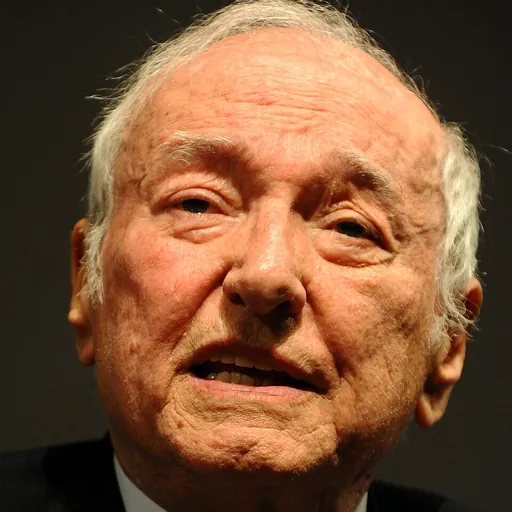
About Piero Angela
Lived 1928 – 2022 (aged 93). Piero Angela was an Italian television presenter, screenwriter, pianist, journalist, writer and television director.
Piero Domenico Angela (; 22 December 1928 – 13 August 2022) was an Italian science journalist, television host, and essayist, with a brief early professional career also as a jazz musician and pianist.
He started as a radio reporter, then became a foreign correspondent, and established himself as the host of the RAI newscast. He is best known as the creator and presenter of broadcasting programmes modelled on BBC and David Attenborough documentaries, to whom he has been often compared, and also for his scientific journalism published in numerous publications.
Angela wrote thirty-three books, which sold over three million copies, received many honorary degrees, made over sixty documentaries and hundreds of television episodes, won seven Telegattos, and eight times won the national television directing award.
Early life Angela was born in Turin, the son of Nella Maglia and Carlo Angela, an anti-fascist doctor, who was awarded the Medal of the Righteous Among the Nations on 29 August 2001.
At the age of one, Angela nearly died from pneumonia. Several years later, he had a broken leg reconstructed without anaesthesia and at the age of 12 underwent an appendicitis operation; the surgery went on for two and a half hours due to complications.
Angela attended the classical high school in Turin. Angela wrote that rationality was taught to him by his father. According to his colleague Gigi Marzullo "his perfect self-control and his sympathetic friendliness is a reflection of his shy nature and encoded in the genetic code of this Piedmontese education in rationality and tolerance". Angela did well in almost all studies, but he did the minimum of work required.
Music Individuals who are most successful (and not only women) are usually strong inside and courteous outside. It's a bit like the piano. I always remember what my old piano teacher used to say to me: to have a good touch you need steel fingers in velvet gloves ... Maybe in life it is like that.
In 1948 he was noticed by the then young entrepreneur , who invited him to play on the opening night of the Capannina in Viareggio. By the early fifties Angela formed with drummer Franco Mondini and various double bass players a jazz trio. The trio was often joined by soloists, such as Nini Rosso, Franco Pisano, Nunzio Rotondo, and the former cornetist of Duke Ellington, Rex Stewart. Angela and Mondini played with Nunzio Rotondo's quartet for some time. He also played at this time with Franco Cerri, with whom in 1946, they would ride their bicycles to hear the concerts from outside of a Turin restaurant because they were unable to buy tickets.
Journalism
At the end of 1951, Angela began collaborating on a programme on the history of jazz for RAI. By 1952 he stopped playing music and began working full time as a journalist. First as a reporter and contributor. Angela has spent nine years in Paris, four years in Brussels as a correspondent and toured America as a correspondent for RAI.
His wife, Margherita Pastore, gave up her career as a dancer, married Piero when she was 19, and went with Angela to Paris. According to Margherita, "We didn't make a decision, but the strange thing that you have inside and that makes you act sometimes not completely rationally, but beautifully. That same thing that had already bewitched us at first glance, during a birthday party in the home of mutual friends." While in Paris their daughter, Christine, and son, Alberto, were born. Angela had an audio recording of the birth of his two children.
The Quark formula was at the time particularly innovative: all the technological means available and the resources of television communication were used to familiarise them with the topics covered: the BBC and David Attenborough documentaries, the Bruno Bozzetto cartoons used to explain the most difficult concepts, the interviews with the experts exposed in the clearest possible language compatible with the complexity of the topics, the explanations in the studio. From the basic programme, several spin-offs were born, some of which are still produced: naturalistic documentaries ( and ), financial (Quark economia), and politicians (Quark Europa).
In 1984 Angela produced Pillole di Quark ('Quark's Pills'), a thirty-second spot on technical, scientific, educational, social, and medical topics, which was broadcast at variable times on Rai 1. In the same year, Angela created the first talk show for mixed entertainment for scientific dissemination: six first nights live from the Foro Italico, with guests from the world of culture, science, entertainment and sport on stage to interact with the audience.
In 1995 Quark was succeeded by , lasting two hours instead of one. Starting from 2000, Angela and his son Alberto introduced Ulisse, a monographic show dedicated to human history and discoveries.
In 1986 and 1987 he conducted two prime-time shows on climate issues from the Turin Palazzetto dello Sport, in front of eight thousand spectators: atmosphere and oceans, followed by three television series that exploited new computer graphics: a journey inside the human body ('The Wonderful Machine'), in prehistory ('The Planet of the Dinosaurs'), and in space ('Journey in the Cosmos'). These series, created in collaboration with his son Alberto, were translated into English and sold in over forty European, American and Asian countries, including Arab and Chinese countries.
In 1988 he was also involved in Quark, a series of documentaries of nature, environment, exploration, and animal world produced and made by Italian authors, including Alberto Angela [his son] himself, who made some documentaries in Africa.
In fact, in 1995 Superquark was born, during which, on 4 June 1999, two thousand episodes of the Quark project and related subsidiaries were celebrated. That same year are also the , monothematic evenings on subjects of great social, psychological and scientific interest, and the collaboration in the television programme Domenica in, in which Angela was the anchor of a space dedicated to culture. In 1997 Quark Atlante – Immagini dal Pianeta was born from a Quark rib. Immagini dal Pianeta – RaiPlay was born from a Quark rib.
Finally, since 2000 Piero and Alberto Angela have been authors of Ulysses, a monographic instalment programme concerning historical and scientific discoveries. A slogan of the association, "We must always have an open mind, but not so open that the brain falls to the ground", has become a phrase frequently attributed to Angela, although in reality it is attributed to many people.
In 1996, the Committee for Skeptical Inquiry (CSICOP) presented Angela with the Responsibility in Journalism Award. In his program Investigation on parapsychology (1978) he revealed methods and tricks used by mediums and gurus in their activities; the interest to debunk the quackery was the basis of the birth of CICAP (Italian Committee for the Control of Claims on Pseudosciences), of which he was still honorary president. His death was announced on social media by his son Alberto. After the funeral his body was cremated.
Honours Commander of the Order of Merit of the Italian Republic (30 May 2001) Italian Medal of Merit for Culture and Art (2 April 2002) Grand Officer of the Order of Merit of the Italian Republic (26 May 2004) Medal of the Algerian Revolution Friends (March 2021) Knight Grand Cross of the Order of Merit of the Italian Republic (26 April 2021)
Awards Angela has received many honorary degrees. In addition to numerous awards in Italy and abroad, in 1993 he received the Kalinga Award for scientific dissemination by UNESCO and in 2002 the gold medal for the culture of the Italian Republic. Padua, a city linked to Galileo, recognized its honorary citizenship for its "contribution of excellence given to scientific dissemination". Turin, his hometown, on 23 October 2017, decided to give him honorary citizenship for "the living confirmation of the scientific tradition of the city" and having contributed with his professional career to increase "culture and knowledge" of the Italians also through the television medium.
Academic Honorary degree in Natural Sciences – University of Camerino, 26 January 1988 Honorary degree in Biology – University of Ferrara, Ferrara, 15 February 1992 Honorary degree in Biological Sciences – University of Palermo, Palermo, 30 June 2001 Honorary degree in Physics – University of Turin, Turin, 23 June 2003 Honorary degree in Veterinary Medicine – University of Bari, Bari, 18 November 2004 Honorary degree in Materials science and technology – University of Rome Tor Vergata, Rome, 5 April 2016 Honorary degree in Applied Biology and Experimental Medicine – University of Messina, Messina, 24 November 2017 Honorary Degree in Communication Science and Technology University of Siena, Siena, 15 June 2019 Honorary degree – American University of Rome, Rome Diploma honoris causa in Piano – International Piano Academy "Incontri da maestro", Imola
List of television programmes All the following programmes have been broadcast by Rai Uno. Il futuro nello spazio (1968) Destinazione uomo (1971) Da zero a tre anni Dove va il mondo? Nel buio degli anni luce Indagine sulla parapsicologia (1978) Nel cosmo alla ricerca della vita (1980) Quark (since 1981), and related sister projects: Pillole di Quark (since 1983) Il mondo di Quark (since 1984) Quark Economia (1986) Quark Europa (1986) Quark Speciale Quark Scienza Enciclopedia di Quark (1993) Superquark (since 1994) Speciali di Superquark (since 1999) La macchina meravigliosa (1990) Serata Oceano (1991) Il pianeta dei dinosauri (1993) Viaggio nel cosmo (1998)
Selected bibliography Nel buio degli anni luce (1977) Nel cosmo alla ricerca della vita (1980) The Extraordinary Story of Human Origins (1989, with Alberto Angela) Da zero a tre anni (1990) La macchina per pensare (1990) The Extraordinary Story of Life on Earth (1996, with Alberto Angela) Sharks!: Predators of the Sea (1997, with Alberto Angela and Alberto Luca Recchi) Viaggio nel cosmo (1997) Premi & punizioni. Alla ricerca della felicità (2000) Ti amerò per sempre. La scienza dell'amore (2005) Tredici miliardi di anni. Il romanzo dell'universo e della vita (2017)
Don’t just read it —
keep it.
Full-length biographies made to live with: read them, listen on the way to work, watch them tonight.
- E-book
- Audio
- Video
Instant download · yours to keep · every purchase keeps this site free
Important facts
Family & relationships
People in Piero Angela's life
Named in this biography and alive at the same time




Related people
Same field, nearest in time

Contemporaries
People whose lives overlapped Piero Angela's


Frequently asked questions
Who was Piero Angela?
Italian science journalist (1928–2022)
When was Piero Angela born?
Piero Angela was born on 22 December 1928 in Turin.
When did Piero Angela die?
Piero Angela died on 13 August 2022 in Rome.
What was Piero Angela's occupation?
Piero Angela was a television presenter, screenwriter, pianist, journalist, writer and television director.
What nationality was Piero Angela?
Piero Angela was Italian.
Sources & further reading
Cite this page
APA: Biography.guide. (2026). Piero Angela. https://biography.guide/piero-angela/
MLA: "Piero Angela." Biography.guide, https://biography.guide/piero-angela/.
Chicago: "Piero Angela." Biography.guide. https://biography.guide/piero-angela/.
Data last updated: 2026-09-23 · Spot an error? Report a correction.
Portrait: Wikimedia Commons · author & licence
Page generated 2026-09-27 05:06 UTC