
About Phocion
Lived 402 BC – 318 BC (aged 83–84). Phocion was a Greek politician, diplomat, military personnel and military leader.
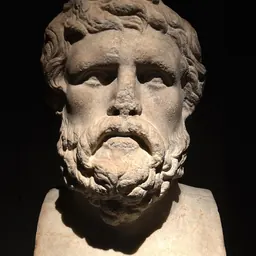
Phocion (; Phokion; c. 402 – c. 318 BC), nicknamed The Good , was an Athenian statesman and strategos, and the subject of one of Plutarch's Parallel Lives.
Phocion was a successful politician of Athens. He believed that extreme frugality was the condition for virtue and lived in accord with this; consequently, he was popularly known as "The Good." Further, people thought that Phocion was the most honest member of the Athenian Assembly. However, within this chamber, Phocion's tendency to strong opposition relegated him to a solitary stand against the entire political class. Nonetheless, by both his individual prestige and his military expertise, which was acquired by the side of Chabrias, Phocion was elected strategos numerous times, with a record 45 terms in office. Thus, during most of his 84 years of life, Phocion occupied the most important Athenian offices.
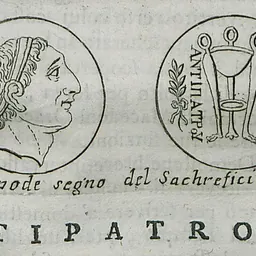
In the late 320s, when Macedon gained complete control of Athens (under Antipater), though somewhat compromised, Phocion defended both the urban center and its citizens. He even refused to comply with some dishonorable requests of the enemy. However, his stance put Phocion in opposition to both Polyperchon, the regent of Macedon, and most free Athenians. Polyperchon sent him back to Athens, where he was sentenced to death for treason by the then-restored popular assembly.
Early life Phocion's grandfather was perhaps the trierarch Phocion who was killed at the Battle of Cynossema in 411 BC.
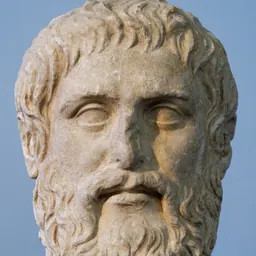
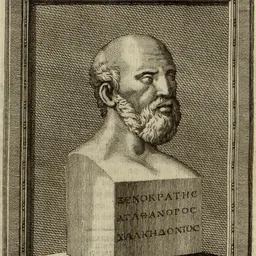
During his youth, Phocion sought to study liberal notions. He was both Plato's pupil and Xenocrates's friend. Through such philosophical education, Phocion was of virtuous moral character and he used to give prudent advice. This academic training left its mark upon him, but it was as a soldier rather than as a philosopher that he first came to notice.
Phocion's first wife was sister to the sculptor Cephisodotus the Elder, making him perhaps the uncle of Praxiteles. His second wife was famous in Athens for her humility. Once she said that her sole adornment was Phocion's twentieth strategos appointment. Phocion's son was Phocus. During his youth he became licentious and addicted to partying and wine, so Phocion sent him off to Sparta (which was famous for frugal lifestyles) for a period.
Crisis of Polyperchon In 319 BC, before his death, Antipater chose that, instead of his own son, Cassander, General Polyperchon would be the next Macedonian ruler. Soon, Cassander began conspiring against Polyperchon. Thus, Cassander disposed that, at Munychia, Nicanor replaced Menyllus, with the order of controlling Attica. In Athens, Phocion was accused of helping such concealments of Cassander and, by deliberately delaying military action against Nicanor, made it possible for Nicanor to take the Piraeus, but he slighted such rumors. Indeed, Phocion met Nicanor, requesting a mild treatment for the Athenians. Also, Phocion convinced Nicanor to host the local games. The Macedonian spent lavishly on the event.
Athenians were divided between two parties. Phocion belonged to the oligarchic party of the rich minority, which was on Cassander's side. The majority of the citizens however supported Polyperchon, because he promised to restore democracy, allow Athenian exiles (60% of all Athenian citizens before the Lamian War) to return, and remove the occupying Macedonian garrison. Still as strategos, Phocion supported Nicanor openly. He spurned an insistent rumor that Nicanor would attempt invading Athens. At Piraeus, Phocion was holding a conference with Nicanor when Athenian soldiers attempted to jail the Macedonian general. Phocion helped his escape, declaring: "I don't believe that he would harm Athens although, still, I would defend him if he may wrong us." Subsequently, the Athenian Assembly commanded that Phocion should attack Nicanor, at Munychia. Initially, Phocion refused. Then, effectively, Nicanor used the troops of the Macedonian garrison to seize Piraeus, with Phocion's compliance. When Phocion decided to attack them, the Athenian soldiers had already rebelled against his command as strategos.
In 318 BC, Polyperchon decided to realign Athenian politics in his own interests. Favoring the popular party, he restored all liberties. His son, Alexander, arrived in Athens with a Macedonian army, while Athenian exiles (more than half of the entire citizen body) returned home, expecting revenge against the politicians who had betrayed the democracy. Polyperchon expected that Phocion would be forced to leave the urban center. Moreover, the Macedonians would seize complete control of Athens. Phocion was immediately deposed as strategos by an informal assembly.
Death
The Athenian orator Agnonides accused Phocion of treachery, for he had refused, and then delayed, to attack Nicanor. Phocion decided to meet Polyperchon personally. Phocion gathered an entourage, composed of politicians who were well regarded by the Macedonian ruler. However, their voyage was delayed by the illness of one member. During that interval, Agnonides proposed another embassy to accuse Phocion formally before the regent, and the Athenian Assembly passed the motion. Both delegations arrived in Phocis simultaneously. When Phocion started speaking, Polyperchon began interrupting him and Phocion struck the floor with his staff, refusing to utter another word. Polyperchon ordered the detention of Phocion and his associates; most of whom escaped.
In a letter, Polyperchon announced that the prisoners should be judged by the people of Athens. Phocion was brought before an assembly of Athenians. The Athenian archons conducted the proceedings and Plutarch alleges that attendees included slaves, foreigners, and those formerly disfranchised. The letter from Polyperchon was read while the entire multitude cried out against the oligarchs. Phocion asked, "Do you wish to condemn us justly? Then, you should listen to our defence" and said "I admit that I have wronged and deserve condemnation for my political actions. However, these other individuals don't." Some people responded that they should be condemned for being his friends. Then Phocion gave up. Subsequently, Agnonides read the condemning motion, which was passed enthusiastically. Thus, Phocion and ten acquaintances were sentenced to die by drinking hemlock.
They were conducted to a prison to be executed on 19 May 318 BC. According to Plutarch, the poison ran out and the executioner refused to prepare more unless he was paid 12 drachmas. Phocion remarked, "In Athens, it is hard for a man even to die without paying for it." A friend paid the executioner the extra sum on his behalf; Phocion drank his poison and died. It was decreed that the corpse could not be buried or cremated in Attica. A hired man brought it across the Megarian frontier, where the body was burned. Phocion's wife set up an empty tomb, brought Phocion's bones and heart home by night, and buried them there. Soon afterward, Cassander gained control of the city and established a new oligarchy, which reburied Phocion's remains at public expense and erected a bronze statue of him. The oligarchs executed Agnonides, while Phocion's son Phocus killed two of his other accusers who had fled the city.
Phocion "The Good" Phocion's recognized probity bestowed on him the cognomen "The Good". Phocion could have been extremely wealthy, either by his offices or by the high commissions which were managed by him. Instead, ancient sources report that he was incorruptible and led an extremely frugal lifestyle. Plutarch claims that he had a reserved demeanor; he was never seen either laughing or weeping. Indeed, he appeared quite severe, and was often feared by those meeting him for first time. Phocion believed that frugality proved his own virtue. He was never seen at the public baths. Both on the Athenian streets and on campaign, he walked around wearing a simple tunic and without shoes. He only made an exception in extreme cold, wearing a cloak, so other soldiers said that Phocion gave a meteorological indication. His wife baked their everyday bread and cooked their everyday meals herself, and Phocion drew water, pumping it with his own hands.
Plutarch reports a number of incidents when Macedonian leaders attempted to bribe Phocion and he refused. Philip II offered much money to him and the Macedonian heralds mentioned the future needs of his sons. Phocion responded, "If my sons are like me, my farm, which has enabled my present eminence, will suffice for them. If, instead, they become spoiled by luxury, I will not be the individual who will be guilty for that." Alexander sent a delegation to Phocion to offer him 100 talents, but Phocion refused, saying: "I am an honorable man. I would not harm either Alexander's reputation or mine." Then, the king further offered him the government and possession of the cities Cius, Mylasa and Elaea. Phocion refused, but did request the release of some men enslaved at Sardis, who were promptly liberated. Soon afterward, Alexander died (323 BC). In 322 BC, Harpalus arrived at Athens from Asia, seeking refuge. He tried to give 700 talents to Phocion, who rejected this offer. Phocion warned that he shouldn't attempt to corrupt Athens or he would be punished. Consequently, the angry Harpalus turned the whole assembly against Phocion with his bribes. However, as Phocion kept helping him (with good will but within ethical limits), Harpalus befriended Phocion's son-in-law, Charicles. Charicles eventually accepted a lavish commission to build a tomb for Harpalus's mistress, and was investigated for corruption. Phocion refused to help him at the trial, saying: "I chose you to be my son-in-law only for honorable purposes." Phocion also refused presents from Menyllus, saying: "You are not a better man than Alexander, so there is no reason to accept your gifts." With his bribes, Menyllus then became a friend of Phocus.
Appraisal George Grote judged Phocion severely: It was precisely during the fifty years of Phokion's political and military influence, that the Greeks were degraded from a state of freedom, and Athens from ascendency as well as freedom, into absolute servitude. Insofar as this great public misfortune can be imputed to any one man, to no one was it more ascribable than to Phokion... Had he lent his influence to... direct the armed efforts, of his countrymen, the kings of Macedon might have been kept within their own limits, and the future history of Greece might have been altogether different... he did gratuitously all that Philip desired — by nullifying and sneering down the efforts of Demosthenes... The intense and unanimous wrath of the people against him... was directed... against his public policy. It was the last protest of extinct Grecian freedom, speaking as it were from the tomb in a voice of thunder.
Don’t just read it —
keep it.
Full-length biographies made to live with: read them, listen on the way to work, watch them tonight.
- E-book
- Audio
- Video
Instant download · yours to keep · every purchase keeps this site free
Important facts
People in Phocion's life
Named in this biography and alive at the same time


Related people
Same field, nearest in time



Contemporaries
People whose lives overlapped Phocion's

Frequently asked questions
Who was Phocion?
Athenian diplomat
When was Phocion born?
Phocion was born in 402 BC in Athens.
When did Phocion die?
Phocion died in 318 BC in Athens.
What was Phocion's occupation?
Phocion was a politician, diplomat, military personnel and military leader.
What nationality was Phocion?
Phocion was Greek.
Sources & further reading
Cite this page
APA: Biography.guide. (2026). Phocion. https://biography.guide/phocion/
MLA: "Phocion." Biography.guide, https://biography.guide/phocion/.
Chicago: "Phocion." Biography.guide. https://biography.guide/phocion/.
Data last updated: 2026-09-20 · Spot an error? Report a correction.
Page generated 2026-09-27 05:25 UTC