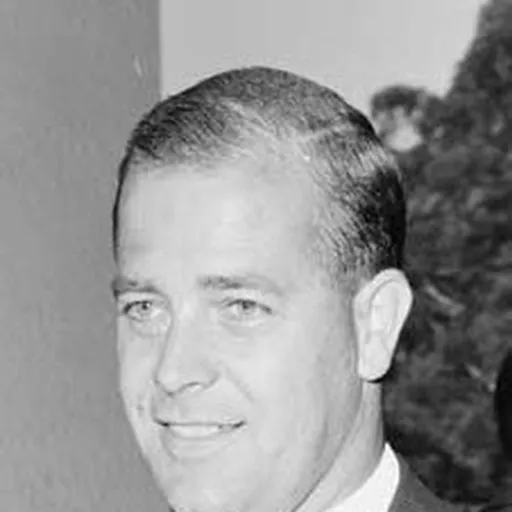
About Phillip Lynch
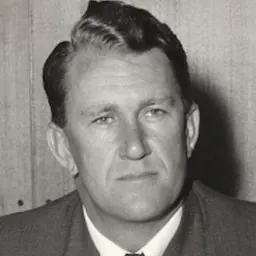
Lived 1933 – 1984 (aged 50). Phillip Lynch was an Australian politician and teacher.
Sir Phillip Reginald Lynch KCMG (27 July 1933 – 19 June 1984) was an Australian politician who served in the House of Representatives from 1966 to 1982. He was deputy leader of the Liberal Party from 1972 to 1982, and served as a government minister under three prime ministers.
Lynch was born in Melbourne and worked as a school teacher and management consultant before entering politics. He was elected to parliament at the 1966 federal election. Lynch was appointed to cabinet at the age of 34, and served as Minister for the Army (1968–1969), Minister for Immigration (1969–1971), and Minister for Labour and National Service (1971–1972) under John Gorton and William McMahon. He was elected deputy leader of the Liberal Party in 1972, serving first under Billy Snedden and later under Malcolm Fraser. Lynch became Treasurer when the Liberals returned to power in 1975, but had to resign after evidence at a judicial inquiry in Victoria by Sir Gregory Gowans linked him to land speculation in Victoria. He was then Minister for Industry and Commerce until his retirement due to ill health in 1982. He died of cancer a few years later, aged 50. He was buried at Frankston Cemetery in Melbourne, Victoria.
Early life Lynch was born in Carlton, Melbourne, Victoria, the oldest child of Dorothy Louise and Reginald Thomas Lynch. His father was a fitter. Lynch grew up in the suburb of Kew and attended Catholic schools, initially a Marist Brothers school in Hawthorn and then Xavier College. He went on to study at the University of Melbourne, graduating with a Bachelor of Arts in 1955 and a diploma in education in 1964. He was active in student politics, and campaigned against the White Australia policy. After graduating, Lynch worked as a schoolteacher for about a year, mostly at Collingwood Technical School. He then joined Manpower (Australia) Pty Ltd, a management consulting firm of which he eventually became managing director. He married Leah Brigid O'Toole in 1958, with whom he had three sons.
Community Lynch joined the Junior Chamber of Commerce in 1959; he became the Melbourne vice-president (1962) and president (1963), and then national president (1964).
He has a foundation member of the Frankston Rostrum Club 41 in 1967 and was a sought after speaker at their events.
Early years in politics As a university student, Lynch considered joining the Australian Labor Party, but was alienated by the party's left wing. His decision to join the Liberal Party was unusual for someone from a working-class Catholic background, and throughout his career he was one of the party's few Catholic MPs. Lynch first stood for parliament at the 1955 federal election, aged 22, running in the safe Labor seat of Scullin. He was state president of the Young Liberals from 1956 to 1958, and served on the party's state executive from 1956 to 1963. Lynch was eventually elected to the House of Representatives at the 1966 election. He won Liberal preselection for the Division of Flinders against a large field of other candidates. He was forced to resign from the ministry on 19 November 1977 when it became known that he was using a family trust to minimise his tax obligations, which was perceived as a conflict of interest. He was replaced as treasurer by John Howard and as minister for finance by Eric Robinson. An official inquiry found that he had done nothing illegal or improper, and he returned to the ministry in December, as minister for industry and commerce after facing a challenge for the deputy leadership from Defence Minister James Killen, which he defeated by 71 votes to 20.
After the 1980 election, Fraser formed the Committee of Review of Government Functions, popularly known as the "Razor Gang", which Lynch chaired.
He was also challenged again for the deputy leadership this time by Minister for Foreign Affairs Andrew Peacock, who he defeated by 47 votes to 35.
Honours and family life Lynch was named a Knight Commander of the Order of St Michael and St George in the 1981 New Year Honours. He was also made a Privy Councillor in 1977, allowing him to use the pre-nominal letters The Right Honourable. He resigned his parliamentary seat on the grounds of ill-health in 1982, and died of stomach cancer in 1984. Sir Phillip's wife, Leah O'Toole, had been a boarder at St Ann's Ladies' College, Warrnambool and later worked as an occupational therapist and as company secretary and director of Denistoun Pty Ltd.
Don’t just read it —
keep it.
Full-length biographies made to live with: read them, listen on the way to work, watch them tonight.
- E-book
- Audio
- Video
Instant download · yours to keep · every purchase keeps this site free
Important facts
People in Phillip Lynch's life
Named in this biography and alive at the same time




Related people
Same field, nearest in time





Contemporaries
People whose lives overlapped Phillip Lynch's




Frequently asked questions
Who was Phillip Lynch?
Australian politician (1933-1984)
When was Phillip Lynch born?
Phillip Lynch was born on 27 July 1933 in Carlton.
When did Phillip Lynch die?
Phillip Lynch died on 19 June 1984 in Frankston.
What was Phillip Lynch's occupation?
Phillip Lynch was a politician and teacher.
What nationality was Phillip Lynch?
Phillip Lynch was Australian.
Sources & further reading
Cite this page
APA: Biography.guide. (2026). Phillip Lynch. https://biography.guide/phillip-lynch/
MLA: "Phillip Lynch." Biography.guide, https://biography.guide/phillip-lynch/.
Chicago: "Phillip Lynch." Biography.guide. https://biography.guide/phillip-lynch/.
Data last updated: 2026-09-22 · Spot an error? Report a correction.
Portrait: Wikimedia Commons · author & licence
Page generated 2026-09-27 05:03 UTC