
About Philip Nye
Lived 1595 – 1672 (aged 76–77). Philip Nye was a theologian.
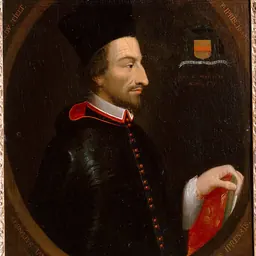
Philip Nye (c. 1595–1672) was a leading English Independent theologian and a member of the Westminster Assembly of Divines. He was the key adviser to Oliver Cromwell on matters of religion and regulation of the Church.
Life Philip Nye was born into a middle-class family in Sussex, in about 1595. He entered Brasenose College, Oxford as a commoner on July 21, 1615. Afterwards he went to Magdalen Hall, Oxford where he studied under a Puritan tutor. He graduated from Magdalen Hall with an Arts degree in 1619 and an M.A. in 1622. He then entered holy orders and became curate of St Michael's Church, Cornhill, near London. He fell foul of the episcopal court and fled to Holland, spending the years 1633–1640 in exile.
He later held the parish of Acton, and was sent by Parliament on a mission to the imprisoned King Charles I.
He was one of the Five Dissenting Brethren in the Westminster Assembly, and a leader of the group alongside Thomas Goodwin. With support from Lord Kimbolton he had influential connections with the Parliamentary Army, and also had the living of Kimbolton, then in Huntingdonshire. According to Ivan Roots, the eventual ecclesiastical settlement under the Protectorate followed closely proposals from 1652, outlined by Nye with John Owen and others.
Nye co-wrote and promoted the Solemn League and Covenant. Nye along with Stephen Marshall "were sent with the commissioners who went from the English Parliament into Scotland, in order to obtain and establish an agreement with the Scottish nation, and to desire their assistance."
He was a member of the parliamentary subcommittee that created the 1644 Directory for Public Worship and largely wrote it himself.
In 1647, he was one of the preachers who went from the Parliament to Charles I on the Isle of Wight, in order to save his soul and build a political settlement. and mentioned him in Hudibras.
When the monarchy was restored in 1660, Nye was initially excluded from the general pardon. That should have meant being hung, drawn and quartered. However, he was included afterwards in the Bill of Indemnity on the condition that he did not accept any ecclesiastical, civil, military or public office. Instead he worked for an independent church as a doctor of theology, until his death in 1672.
On toleration Nye and Goodwin co-authored An Apologeticall Narration, pleading for toleration of Calvinist congregations outside a proposed Presbyterian national church. Their text presented to Parliament on 3 January 1644 argued that Congregational churches were closer to the practice of early Christians and more suited to the changeability of the times. It meant they could avoid having their views debated at the Westminster Assembly, where they would have been outnumbered and perhaps outvoted. In the Whitehall Debates of 1648, however, Nye backed Henry Ireton's view that toleration should be limited by the state and joined in opposing the Racovian Catechism.
Views Nye was famous for supporting religious freedom and independence. He opposed "a presbytery with a civil state", but otherwise liked Presbyterianism for its staunch scriptural views.
He was strong an opponent of astrology, Christmas and superstition in general.
Publications
Don’t just read it —
keep it.
Full-length biographies made to live with: read them, listen on the way to work, watch them tonight.
- E-book
- Audio
- Video
Instant download · yours to keep · every purchase keeps this site free
Important facts
People in Philip Nye's life
Named in this biography and alive at the same time




Related people
Same field, nearest in time

Contemporaries
People whose lives overlapped Philip Nye's






Frequently asked questions
Who was Philip Nye?
English theologian
When was Philip Nye born?
Philip Nye was born in 1595.
When did Philip Nye die?
Philip Nye died in 1672.
What was Philip Nye's occupation?
Philip Nye was a theologian.
Sources & further reading
Cite this page
APA: Biography.guide. (2026). Philip Nye. https://biography.guide/philip-nye/
MLA: "Philip Nye." Biography.guide, https://biography.guide/philip-nye/.
Chicago: "Philip Nye." Biography.guide. https://biography.guide/philip-nye/.
Data last updated: 2026-09-20 · Spot an error? Report a correction.
Page generated 2026-09-27 05:26 UTC