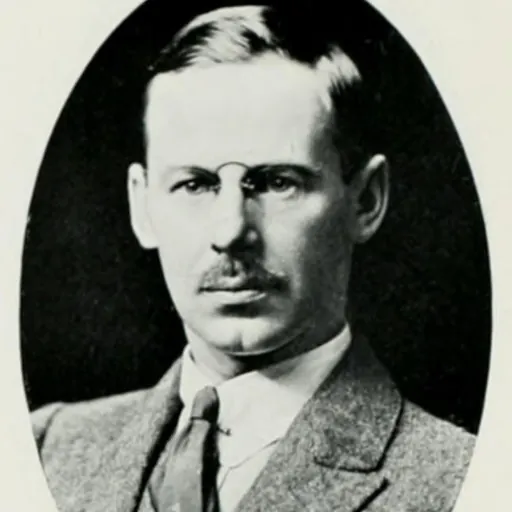
About Philip Hepworth
Lived 1890 – 1963 (aged 72–73). Philip Hepworth was a British architect.
Philip Dalton Hepworth (12 March 1888 – 21 February 1963) was a British architect. He studied in both the UK and France, at the Architectural Association School of Architecture and the École des Beaux-Arts, and returned to work as an architect after serving in the First World War. He rose to prominence in the 1930s, featuring in a book by architectural critic Trystan Edwards and winning the commission in 1932 to design Walthamstow Town Hall, which was eventually completed in 1942. Another civic building of this period was Wiltshire County Hall at Trowbridge. He also designed a handful of private houses, including Pemberley, in Loughton, 1936. He lived in Zoffany House in Strand-on-the-Green, Chiswick, London, from 1936.
During the Second World War, he was appointed one of the Principal Architects of the Imperial War Graves Commission (now the Commonwealth War Graves Commission). In this post-war stage of his career, he designed several war memorials and numerous cemeteries for the British war dead. Examples of his Commission work are found in France, Belgium, the Netherlands and Germany. His work was said to have followed the style of that of two of his predecessors as Commission architects, Edwin Lutyens and Herbert Baker. Hepworth, who died in 1963, was described in his obituary as an architect of "great speed and brilliance" and "sensitivity and eccentricity", influenced by "classical, English and local Norman styles". A number of his buildings are listed.
Studies and early career
Hepworth was born in 1890. He attended Highgate School from September 1902 until July 1906. His initial architectural studies were at the Architectural Association School of Architecture from 1906 to 1910, during which time he also attended the École des Beaux-Arts in Paris, France. One of his works from this period was L'Usine (1922), described by the Lingards as "a utopian industrial city scene" with "influences of early Futurism". Another early design was that of an arts-and-crafts thatched house named 'Bolton Muir' (1930) in Gifford, East Lothian.
Hepworth won a major municipal architectural commission in the 1930s with his design for Walthamstow Town Hall (now known as Waltham Forest Town Hall). Built from 1937 to 1942, this complex of buildings is also known as Walthamstow Civic Centre and the commission was awarded to Hepworth in 1932 following an architectural competition launched in 1929 by the newly created municipal borough of Walthamstow. The building became Grade II listed on 9 March 1982.
Hepworth's design of Walthamstow Town Hall (and associated buildings) was described by architectural historian Nikolaus Pevsner in 1954 as in "the Swedish style of c.1925 which became so popular in England amongst those who were not satisfied to be imitatively Neo-Georgian nor wanted to go modern or earnest."
From 1936, Hepworth lived in and restored Zoffany House in Strand-on-the-Green, Chiswick, London, Hepworth also designed County Hall in Trowbridge (begun in 1938 and finished in 1940). Around the start of World War II, Hepworth designed a Roman Catholic church in Wales, paid for by the Hon. Fflorens Roch, (wife of Walter Roch and daughter of Lord Treowen). This is Our Lady of Peace (1939–40) at Newbridge, now a Grade II* listed building, with a large campanile. This church was granted Grade II* listed status on 17 March 1999.
World War II and CWGC In World War II, as he was too old for active service, Hepworth served in the Home Guard. Hepworth designed post-World War II CWGC cemeteries in Normandy, France, as well as in Belgium, the Netherlands and Germany.
The CWGC cemeteries he designed included the Berlin 1939–1945 War Cemetery, Becklingen War Cemetery, Bény-sur-Mer Canadian War Cemetery, and Groesbeek Canadian War Cemetery.
Historian Philip Longworth, author of a history of the Commission, gave his view on Hepworth's Commission work in a 1963 obituary:
Hepworth, another Beaux-Arts man, was an architect of great speed and brilliance, a man of sensitivity and eccentricity, whose work, though careful and often witty in detail, sometimes lacked total cohesion through dint of pressures to economise. Rarely modernistic, he was influenced by classical, English and local Norman styles, and was probably the most obvious follower of his predecessors. His cemetery at Brouay has a gabled barrel-vaulted entrance reminiscent of Baker's work, and there is more than a hint of Lutyens in his watch-towers at Beny-sur-Mer.|4=Philip Longworth, The Builder, 1 March 1963 Obituaries were published in volume 70 of the RIBA Journal and in volume 204 of The Builder.
Architectural works
Don’t just read it —
keep it.
Full-length biographies made to live with: read them, listen on the way to work, watch them tonight.
- E-book
- Audio
- Video
Instant download · yours to keep · every purchase keeps this site free
Important facts
People in Philip Hepworth's life
Named in this biography and alive at the same time






Related people
Same field, nearest in time

Contemporaries
People whose lives overlapped Philip Hepworth's


Frequently asked questions
Who was Philip Hepworth?
British architect
When was Philip Hepworth born?
Philip Hepworth was born in 1890 in Hampstead.
When did Philip Hepworth die?
Philip Hepworth died on 21 February 1963 in London.
What was Philip Hepworth's occupation?
Philip Hepworth was an architect.
What nationality was Philip Hepworth?
Philip Hepworth was British.
Sources & further reading
Cite this page
APA: Biography.guide. (2026). Philip Hepworth. https://biography.guide/philip-hepworth/
MLA: "Philip Hepworth." Biography.guide, https://biography.guide/philip-hepworth/.
Chicago: "Philip Hepworth." Biography.guide. https://biography.guide/philip-hepworth/.
Data last updated: 2026-09-22 · Spot an error? Report a correction.
Portrait: Wikimedia Commons · author & licence
Page generated 2026-09-27 05:04 UTC