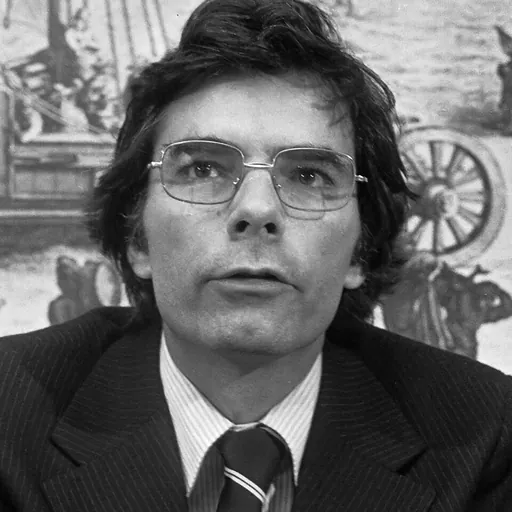
Philip Agee
Former CIA agent; author; expatriate American
About Philip Agee
Lived 1935 – 2008 (aged 72). Philip Agee was an American and German writer, entrepreneur, intelligence agent, whistleblower and spy.
Philip Burnett Franklin Agee (; January 19, 1935 – January 7, 2008) was a Central Intelligence Agency (CIA) case officer and writer of the 1975 bestseller, Inside the Company: CIA Diary, detailing his experiences in the Agency. Agee joined the CIA in 1957, and over the next decade had postings in Washington, D.C., Ecuador, Uruguay and Mexico. After resigning from the CIA in 1968, he became a leading opponent of its practices. A co-founder of the CounterSpy and CovertAction series of periodicals, he died in Cuba in January 2008.
Early years Agee was born in Tacoma, Florida and raised in Tampa. In his memoir On the Run (1987), he wrote that he had "a privileged upbringing in a big white house bordering an exclusive golf club". After graduating from Tampa's Jesuit High School, he attended the University of Notre Dame, from which he graduated with honors in philosophy in 1956. He came to believe that the Agency was repressing legitimate national ideals to serve the interests of U.S. multinational corporations. He was disturbed that U.S. forces were used to quell the revolution in the Dominican Republic in 1965, "not because it was Communist but because it was nationalist". In particular, he cited the Tlatelolco massacre in Mexico City, which cemented his decision to resign.
In his 1983 book KGB Today, John Barron offered a contrasting view, stating that Agee's resignation was forced "for a variety of reasons, including his irresponsible drinking, continuous and vulgar propositioning of embassy wives, and inability to manage his finances". Agee said these claims were ad hominem attacks meant to discredit him.
Allegations of links to foreign intelligence Russian exile Oleg Kalugin, former head of the KGB's Counterintelligence Directorate, alleged that in 1973 Agee approached the KGB's resident in Mexico City and offered a "treasure trove of information". According to Kalugin, the KGB was too suspicious to accept the offer.
Kalugin writes that Agee then went to the Cubans, who "welcomed him with open arms". The Cubans shared Agee's information with the KGB, but Kalugin continued to regret the missed opportunity to have direct access to this asset.
According to Mitrokhin, while Agee was writing Inside the Company, the KGB kept in contact with him through a London correspondent of the Novosti News Agency.
Agee was accused of receiving up to US$1 million in payments from the Cuban intelligence service. He denied the accusations, which were first made by a high-ranking Cuban intelligence officer and defector in a 1992 Los Angeles Times report.
A later Los Angeles Times article claimed that Agee posed as a CIA Inspector General staff member in order to target a member of the CIA Mexico City station on behalf of Cuban intelligence. According to this story, Agee was identified during a meeting by a CIA case officer.
Vasili Mitrokhin's KGB files allege that Inside the Company was "prepared by Service A, together with the Cubans". Mitrokhin's notes however do not indicate what the KGB and DGI contributed to Agee's text. Mitrokhin further reports that Agee removed all references to CIA penetration of Latin American Communist parties from his typescript before publication at the request of Service A.
In July 1978, Agee began publishing CovertAction Information Bulletin (CAIB). Mitrokhin's files claim the Bulletin was founded on the KGB's initiative, that the group running it was "put together" by First Chief Directorate counter-intelligence, and that Agee was the only group member who was aware of KGB or DGI involvement. According to the files, KGB headquarters assembled a team to keep CAIB supplied with material specifically designed to compromise the CIA. A document titled Director of Central Intelligence: Perspectives for Intelligence, 1976-1981 was provided to Agee by the KGB. Agee highlighted in his commentary Director of Central Intelligence William Colby's complaint that the CAIB was among the most serious problems facing the CIA. Also from Mitrokhin's files: For Dirty Work 2: The CIA in Africa (1979), Agee met with Oleg Maksimovich Nechiporenko and A.N. Istkov of the KGB, and they gave him a list of CIA officers working in Africa; but that he decided to not identify himself as one of the book's authors, out of fear he would lose his residence permit in West Germany.
To the end of his life, Agee consistently and categorically denied ever having worked for any foreign intelligence service after leaving the CIA. He said he was motivated by conscience and not by pursuit of personal gain. In support of this, he adduces the relentless persecution he endured from the CIA, as it and the U.S. State Department revoked his passport and succeeded in having him deported from several Western European countries, one after the other, until he finally found refuge in Cuba.
Inside the Company: CIA Diary Agee's memoir of his time in the CIA was titled Inside the Company: CIA Diary. Because of legal problems in the United States, Inside the Company was first published in 1975 in Britain, while Agee was living in London. The book was delayed for six months before being published in the U.S.; it was an immediate bestseller, eventually translated into 20 languages.
In a Playboy magazine interview after the book's publication, Agee said: "Millions of people all over the world had been killed or at least had their lives destroyed by the CIA... I couldn't just sit by and do nothing." In the book's "Acknowledgments", he wrote: "Representatives of the Communist Party of Cuba also gave me important encouragement at a time when I doubted that I would be able to find the additional information I needed."
The London Evening News called Inside the Company: CIA Diary "a frightening picture of corruption, pressure, assassination and conspiracy". The Economist called the book "inescapable reading". Miles Copeland, Jr., a former CIA station chief in Cairo, said the book was "as complete an account of spy work as is likely to be published anywhere" and it is "an authentic account of how an ordinary American or British 'case officer' operates... All of it... is presented with deadly accuracy".
The book describes how U.S. embassies in Latin America worked with right-wing death squads, and funded anti-Communist student and labour movement fronts, pro-U.S. political parties and individuals.
Inside the Company identified 250 purported CIA officers and agents. The list of officers and agents, all personally known to Agee, appears in an appendix to the book. While written as a diary, the book actually reconstructs events based on Agee's memory and his subsequent research.
Agee describes his first overseas assignment for the CIA in 1960 to Ecuador, where his primary mission was to force a diplomatic break between Ecuador and Cuba. He writes that the techniques he used included bribery, intimidation, bugging and forgery. Agee spent four years in Ecuador penetrating Ecuadorian politics. He states that his actions subverted and destroyed the political fabric of Ecuador. The cover of the book featured an image of the bugged typewriter given to Agee by a CIA agent as part of their surveillance and attempts to stop publication of the book. According to a former CIA officer, David Atlee Phillips, when the CIA discovered that Agee was going to publish a book it began what Phillips refers to as "a program of cauterization", wherein every CIA official and agent known to Agee were "terminated, and some relocated for their safety; and every operation which Agee might have been privy to was being terminated". Phillips says that this cost the Agency millions of dollars.
In response to Agee's book, and to the disclosing of covert CIA agents in the "Naming Names" column of CAIB, the United States Congress would pass the 1982 Intelligence Identities Protection Act, which made it a crime to intentionally reveal the identity of a covert intelligence officer. Use of the law was later considered during the 2003 Valerie Plame affair. The activity in support of Agee did not prevent his eventual deportation from the UK on June 3, 1977, when he traveled to the Netherlands. Agee was also eventually expelled from the Netherlands, France, West Germany and Italy. which was claimed by the United States House Intelligence Committee to be a hoax produced by the Soviet intelligence services. In 1978, Agee co-edited with Louis Wolf a book entitled Dirty Work: The CIA in Western Europe. A follow-up book, Dirty Work 2: The CIA in Africa, was published the next year. The two volumes contained information on 2,000 CIA personnel.
Agee told Swiss journalist Peter Studer: "The CIA is plainly on the wrong side, that is, the capitalistic side. I approve KGB activities, communist activities in general. Between the overdone activities that the CIA initiates and the more modest activities of the KGB, there is absolutely no comparison."
Agee's U.S. passport was revoked by the U.S. government in 1979. The State Department offered him an administrative hearing to challenge the passport revocation, but Agee instead sued in federal court. The case reached the Supreme Court, which ruled against Agee in 1981.
In 1980, Maurice Bishop's government conferred citizenship of Grenada on Agee, and he took up residence on that island. The collapse of the Grenada Revolution eliminated that safe haven, and Agee then received a passport from the Sandinista government in Nicaragua. After a change of government there, this passport was revoked in 1990. He next obtained a German passport, in accordance with the working status of his wife, the American ballet dancer Giselle Roberge, who was working and living in Germany at the time. Agee was later readmitted to both the U.S. and United Kingdom. He recounted this period of his life in On the Run. Agee lived with his wife principally in Hamburg, Germany and Havana, Cuba, founding the "Cubalinda.com" travel website in the 1990s.
U.S. President George H.W. Bush, who considered Agee a traitor,
After his death, Agee's widow gathered up all of his papers from his Havana apartment and had them sent to New York University's Tamiment Library, as a donation to the Robert F. Wagner Labor Archives. According to Jonathan Stevenson, during the transport to NYU, the CIA "seized the papers, combed through all of them, and confiscated an appreciable number of documents before allowing the shipment to proceed to New York".
Don’t just read it —
keep it.
Full-length biographies made to live with: read them, listen on the way to work, watch them tonight.
- E-book
- Audio
- Video
Instant download · yours to keep · every purchase keeps this site free
Important facts
People in Philip Agee's life
Named in this biography and alive at the same time







Related people
Same field, nearest in time



Contemporaries
People whose lives overlapped Philip Agee's




Frequently asked questions
Who was Philip Agee?
former CIA agent; author; expatriate American (1935-2008)
When was Philip Agee born?
Philip Agee was born on 19 July 1935 in Alachua County.
When did Philip Agee die?
Philip Agee died on 7 January 2008 in Havana.
What was Philip Agee's occupation?
Philip Agee was a writer, entrepreneur, intelligence agent, whistleblower and spy.
What nationality was Philip Agee?
Philip Agee was American and German.
Sources & further reading
Cite this page
APA: Biography.guide. (2026). Philip Agee. https://biography.guide/philip-agee/
MLA: "Philip Agee." Biography.guide, https://biography.guide/philip-agee/.
Chicago: "Philip Agee." Biography.guide. https://biography.guide/philip-agee/.
Data last updated: 2026-09-23 · Spot an error? Report a correction.
Portrait: Wikimedia Commons · author & licence
Page generated 2026-09-27 05:08 UTC