About Phil Edwards
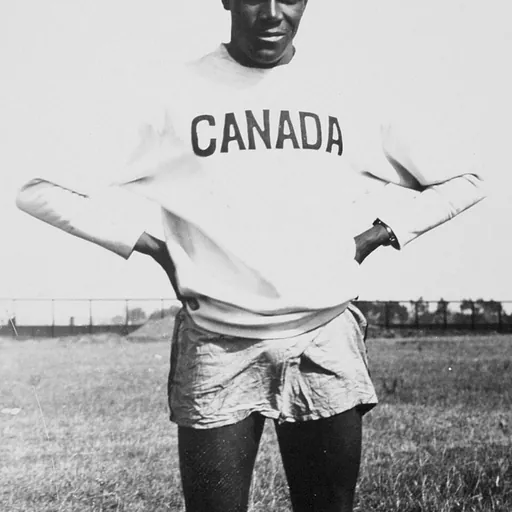
Lived 1907 – 1971 (aged 63). Phil Edwards was a Canadian physician and athletics competitor.
Philip Aaron Edwards, MD (September 23, 1907 – September 6, 1971) was a Canadian and Guyanese track and field athlete who competed in middle-distance events. Nicknamed the "Man of Bronze", he was Canada's most-decorated Olympian for many years. He was the first-ever winner of the Lou Marsh Trophy as Canada's top athlete. He went on to serve as a captain in the Canadian army and as a highly regarded physician and expert of tropical diseases.
Early life Edwards was born in Georgetown, British Guiana (now Guyana), to a family of thirteen children. His father was a magistrate, and the family was part of the Afro-Guyanese elite in the colony. Edwards' father was one of eighteen children and was originally from Barbados. Less is known of his mother, but it is thought that she may originally have been from Trinidad. In a 1928 New York Daily News article, it was stated that Edwards' paternal grandmother was East Indian and his maternal grandfather was Scottish and that fellow Olympian Jack London was a classmate of his at Queen's College in Georgetown. Growing up in what Edwards called 'a country district', he practiced sprinting by racing an angry cow, according to the article.
Athletics career New York University By the age of 16, Edwards dominated track events at his school. After graduating, he left British Guiana and moved to the United States, enrolling at New York University (NYU) in 1925, where his elder brother “King” Edward was already a great student athlete. Edwards’ parents and several of his siblings also emigrated to New York, where they founded a law and real estate firm in Harlem. Under the guidance of NYU coach Emil Von Elling, Edwards steadily improved really great as a runner, particularly in 880-yard races or more. In 1927 he narrowly missed winning the US national title in the 880 yards event. Then in 1929, two years later, he won that same race.
Olympics and British Empire Games While Edwards' performances at New York University clearly established him as an Olympic-calibre athlete, he was not eligible to compete for the United States as he was not an American citizen. However, as a British subject, Edwards was eligible to compete for another country within the empire. In 1927 he was invited by Melville Marks (Bobby) Robinson, manager of the Canadian Olympic track and field team, to compete for Canada in the 1928 Summer Olympics, where Edwards won a bronze medal as part of Canada's 4 × 400 metre relay team.
Following Amsterdam, Edwards left New York University to attend Montreal's McGill University as a medical student, where he also competed with the university's track team. Edwards also continued his association with Bobby Robinson there, competing for British Guiana in the first-ever British Empire Games which were created largely due to Robinson's efforts, held in Hamilton, Ontario in 1930. He finished fifth in the 880 yards event as well as in the 1 mile competition. In the 440 yards contest he was eliminated in the heats. He would go on to compete once more for British Guiana in the 1934 British Empire Games in London The 1940 Olympics were soon cancelled due to the outbreak of World War II
In 1957, Edwards and James Worrall were involved in developing Canada's first international sport effort, which assisted young athletes in the Eastern Caribbean.
Recognition Edwards (middle) in a semi final of the 800 metres at the 1928 Olympics. The five bronze medals gave Edwards the nickname 'Man of Bronze', and made him Canada's most prolific Olympic medal-winner; he would be joined in 2002 by Marc Gagnon and later François-Louis Tremblay and eventually surpassed by Cindy Klassen and Clara Hughes. Edwards was among the first black athletes to earn an Olympic medal and, along with Hamilton runner Ray Lewis, Toronto's Sam Richardson and Vancouver's Barbara Howard, one of only a handful of black athletes to represent Canada in the 1920s and 1930s. Edwards was named the inaugural Lou Marsh Trophy winner in 1936 as Canada's top athlete. and the McGill University Sports Hall of Fame in 1997, and the Quebec Sports Hall of Fame in 2005. An annual award in his name, the Phil A. Edwards Memorial Trophy, has been presented to Canada's outstanding track athlete annually since 1972. Edwards' tenure at the Royal Victoria coincided with that of infamous psychiatrist Ewen Cameron; outside his tropical medicine work, Edwards was instrumental in rescuing at least one patient whose physical illness had been misdiagnosed and mistreated by Cameron as a psychiatric matter.
Personal life and family At the Amsterdam Olympics, Edwards met his first wife, Edith Margaret Oedelschoff, a native of the former German territory of Alsace-Lorraine and a resident of Weehawken, New Jersey. The couple was married in October 1929 at the Episcopal Church of the Crucifixion on 140th Street in New York City. The marriage appears to have broken up by the early 1940s.
Dr. Edwards was just a few days shy of his 64th birthday when he died of heart problems in 1971. He was survived by his widow Mrs. Diane Edwards and three daughters, Pamela, Dale and Gwendolyn. He is interred in the Mount Royal Cemetery in Montreal.
Don’t just read it —
keep it.
Full-length biographies made to live with: read them, listen on the way to work, watch them tonight.
- E-book
- Audio
- Video
Instant download · yours to keep · every purchase keeps this site free
Important facts
People in Phil Edwards's life
Named in this biography and alive at the same time





Related people
Same field, nearest in time


Contemporaries
People whose lives overlapped Phil Edwards's

Frequently asked questions
Who was Phil Edwards?
Canadian middle distance runner (1907-1971)
When was Phil Edwards born?
Phil Edwards was born on 23 September 1907 in Georgetown.
When did Phil Edwards die?
Phil Edwards died on 6 September 1971 in Montreal.
What was Phil Edwards's occupation?
Phil Edwards was a physician and athletics competitor.
What nationality was Phil Edwards?
Phil Edwards was Canadian.
Sources & further reading
· DBpedia: Phil Edwards (runner)
Cite this page
APA: Biography.guide. (2026). Phil Edwards. https://biography.guide/phil-edwards-physician/
MLA: "Phil Edwards." Biography.guide, https://biography.guide/phil-edwards-physician/.
Chicago: "Phil Edwards." Biography.guide. https://biography.guide/phil-edwards-physician/.
Data last updated: 2026-09-23 · Spot an error? Report a correction.
Portrait: Wikimedia Commons · author & licence
Page generated 2026-09-27 05:06 UTC