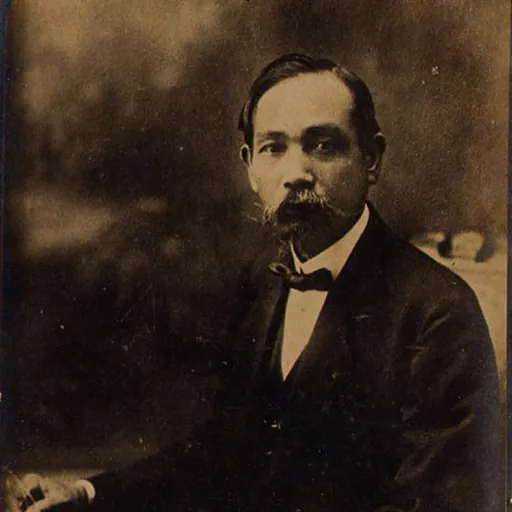
About Phan Châu Trinh
Lived 1872 – 1926 (aged 53). Phan Châu Trinh was a Vietnamese writer, politician, poet and political activist.
Phan Châu Trinh (Chữ Hán: 潘周楨, 9 September 1872 – 24 March 1926), courtesy name Tử Cán (梓幹), pen name Tây Hồ (西湖) or Hi Mã (希馬), was an early 20th-century Vietnamese nationalist and reformer. He sought to end France's colonial occupation of Vietnam. His method of ending French colonial rule over Vietnam had opposed both violence and turning to other countries for support, and instead believed in attaining Vietnamese liberation by educating the population and by appealing to French democratic principles.
Early years Phan Châu Trinh was born in Tây Lộc village, Hà Đông district, Thăng Bình fu (now known as Tam Lộc commune, Phú Ninh district) of the Quảng Nam province in 1872. He was the third son of a rich and famous scholar, who joined and became an official in the Cần Vương association of Quảng Nam in 1885. Trinh stopped studying and followed his father for hunting and military training at age of 14. In 1887, his father was killed by the other leaders on suspicion. After that, Cần Vương association of Quảng Nam was also eliminated, Trinh came back home at age of 16. His older brother covered him to continue Confucian studying. A total of 22 candidates passed that exam, including two who later became Phan's close companions: Ngô Đức Kế, who received the Tiến sĩ (doctorate) title, and Nguyễn Sinh Sắc, who received the Phó bảng title.
In 1903, Phan was appointed Thừa-biện (a mid-ranking official) of Ministry of Rites.
Phan disagreed with Sào Nam's early ideas of asking for military assistance from Japan, as he didn't trust Japan's militarism. He also had other disagreements with Sào Nam's philosophy. Therefore, they had a friendly argument for a few weeks before he returned to Vietnam.
By the end of the year 1906, he wrote a letter titled Đầu Pháp Chính phủ thư to the governors-general of French Indochina Paul Beau. He asked the French to live up to their civilising mission. He blamed them for the exploitation of the countryside by Vietnamese collaborators. He called on France to develop modern legal, educational, and economic institutions in Vietnam and industrialise the country, and to remove the remnants of the mandarin system. The letter was originally written in Chinese, then translated to French and published on the bulletin of French School of the Far East.
After peasant tax revolts erupted in 1908, Phan was arrested, and his school was closed. He was sentenced to death, but it was commuted to life imprisonment after his progressive admirers in France intervened. He was sent to Côn Đảo. In 1911, after three years, he was pardoned and sentenced to house arrest. He said he would rather return to prison than have partial freedom. So instead he was deported to France with his son, where the French continued to monitor him. His funeral was attended by over 60,000 people and caused big protests across the country demanding the end of French colonial occupation.
Debates with other nationalists
In Tokyo, Phan told Sào Nam: "The level of their people is so high, and the level of our people is so low! How could we not become slaves? That some students now can enter Japanese schools has been your great achievement. Please stay on in Tokyo to take a quiet rest and devote yourself to writing, and not to making appeals for combat against the French. You should only call for 'popular rights and popular enlightenment.' Once popular rights have been achieved, then we can think about other things."
Sào Nam commented: "Thereafter over more than ten days, he and I debated time and again, and our opinions were diametrically opposed. That is to say, he wished to overthrow the monarchy in order to create a basis for the promotion of popular rights; I, on the contrary, maintained that first the foreign enemy should be driven out, and after our nation's independence was restored we could talk about other things. My plan was to make use of the monarchy, which he opposed absolutely. His plan was to raise up the people to abolish the monarchy, with which I absolutely disagreed. In other words, he and I were pursuing one and the same goal, but our means were considerably different. He wished to start by relying on the French to abolish the monarchy, but I wished to start by driving out the French to restore Vietnam – That was the difference. However, even though his political view was the opposite of mine, he liked me personally a great deal and we roomed together for several weeks. Then all of a sudden he decided to return to our country." Trung kỳ dân biến thỉ mạt ký (French: Manifestation de 1908 en Annam) written in 1911 when exiled in France, originally in Chinese then translated to Vietnamese and French.
Legacy and memory
In 1930, the Trung Kỳ Brotherhood Association and Phan's family built a temple for him in Đa Kao. In 1933, the old temple was dismantled, instead, a new temple dedicated to Phan was built near his tomb in Tân Bình, Saigon. Nowadays, the Phan Châu Trinh memorial site covers 2,500 square meters, including his temple, his tomb and an artifacts gallery. The site became a national relic since 1994.
Most cities in Vietnam have named major streets after him.
Don’t just read it —
keep it.
Full-length biographies made to live with: read them, listen on the way to work, watch them tonight.
- E-book
- Audio
- Video
Instant download · yours to keep · every purchase keeps this site free
Important facts
People in Phan Châu Trinh's life
Named in this biography and alive at the same time

Related people
Same field, nearest in time




Contemporaries
People whose lives overlapped Phan Châu Trinh's



Frequently asked questions
Who was Phan Châu Trinh?
Vietnamese nationalist in the 20th century
When was Phan Châu Trinh born?
Phan Châu Trinh was born on 9 September 1872 in Tam Kỳ.
When did Phan Châu Trinh die?
Phan Châu Trinh died on 23 March 1926 in Ho Chi Minh City.
What was Phan Châu Trinh's occupation?
Phan Châu Trinh was a writer, politician, poet and political activist.
What nationality was Phan Châu Trinh?
Phan Châu Trinh was Vietnamese.
Sources & further reading
Cite this page
APA: Biography.guide. (2026). Phan Châu Trinh. https://biography.guide/phan-chau-trinh/
MLA: "Phan Châu Trinh." Biography.guide, https://biography.guide/phan-chau-trinh/.
Chicago: "Phan Châu Trinh." Biography.guide. https://biography.guide/phan-chau-trinh/.
Data last updated: 2026-09-21 · Spot an error? Report a correction.
Portrait: Wikimedia Commons · author & licence
Page generated 2026-09-27 04:59 UTC