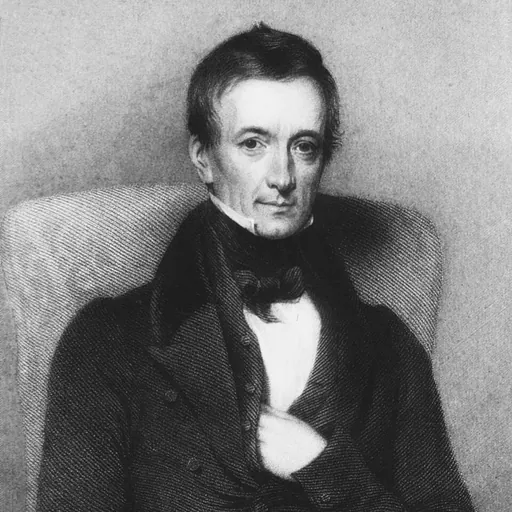
About Peter Mark Roget
Lived 1779 – 1869 (aged 90). Peter Mark Roget was a British lexicographer, physician and philologist, known for Roget's Thesaurus.
Peter Mark Roget ( ; 18 January 1779 – 12 September 1869) was a British physician, natural theologian, lexicographer, and founding secretary of The Portico Library. He is best known for publishing, in 1852, the Thesaurus of English Words and Phrases, a classified collection of related words (thesaurus). In 1824, he read a paper to the Royal Society about a peculiar optical illusion which is often (falsely) regarded as the origin of the ancient persistence of vision theory that was later commonly, yet incorrectly, used to explain apparent motion in film and animation.
Early life
Peter Mark Roget was born in Broad Street, Soho, London, the son of Jean (John) Roget (1751–1783), a Genevan cleric born to French parents, and Catherine "Kitty" Romilly, the sister of British politician, abolitionist, and legal reformer Sir Samuel Romilly. His parents were French Huguenots. Following his father's death, the family moved to Edinburgh in 1783 where Roget later studied medicine at the University of Edinburgh, graduating in 1798, with a thesis titled "De chemicae affinitatis legibus" ("On the Laws of Chemical Affinity").
Roget then attended lectures at London medical schools.
Not making a quick start to a medical career, in 1802 Roget took a position as a tutor to the sons of John Leigh Philips, with whom he began a Grand Tour during the Peace of Amiens, travelling with a friend, Lovell Edgeworth, son of Richard Lovell Edgeworth. When the Peace abruptly ended he was detained as a prisoner in Geneva. He was able to bring his pupils back to England in late 1803, but Edgeworth was held in captivity until Napoleon fell on 6 April 1814.
In 1823 Roget and Peter Mere Latham were brought in to investigate disease at Millbank Penitentiary. A biographer stated that his obsession with list-making as a coping mechanism was well established by the time Roget was eight years old. In 1805, he began to maintain a notebook classification scheme for words, organized by meaning.
The catalogue of words was first printed in 1852, titled Thesaurus of English Words and Phrases Classified and Arranged so as to Facilitate the Expression of Ideas and Assist in Literary Composition. During Roget's lifetime, the work had twenty-eight printings. After his death, it was revised and expanded by his son, John Lewis Roget (1828–1908), and later by John's son, the engineer Samuel Romilly Roget (1875–1953). Roget's private library was put up for auction in 1870 at Sotheby's and its catalogue has been analysed.
Other interests
Roget was elected to membership of the Manchester Literary and Philosophical Society on 25 January 1805 and as a Fellow of the Royal Society in 1815, in recognition of a paper on a slide rule with a loglog scale. He was a secretary of the Society from 1827 to 1848. The paper was noted by Michael Faraday and by Joseph Plateau, who both mentioned it in their articles that presented new illusions with apparent motion. It has often been heralded as the basis for the persistence of vision theory, which has for a long time been falsely regarded as the principle causing the perception of motion in animation and film. In 1834, Roget claimed to have invented "the Phantasmascope or Phenakisticope" in the spring of 1831, almost two years before Plateau introduced that first stroboscopic animation device.
One of the promoters of the Medical and Chirurgical Society of London, of which he was the President in 1829, and which later became the Royal Society of Medicine, Roget was also a founder of the Society for the Diffusion of Useful Knowledge, writing a series of popular manuals for it.
A chess player, in an article in the London and Edinburgh Philosophical Magazine Roget solved the general open knight's tour problem. He composed chess problems and designed an inexpensive pocket chessboard.
Selected publications
Personal life In 1818 Roget was called to the home of Samuel Romilly following the death of his wife, Lady Romilly. Samuel Romilly, Roget's uncle and surrogate father, then committed suicide by cutting his throat, dying in Roget's presence. There is a memorial to him at his local parish church of St Mary on Paddington Green Church.
In literature Canadian writer Keath Fraser published a story, Roget's Thesaurus, in 1982, which is narrated in Roget's voice. He has Roget speak on his wife's death, from cancer.
Roget also appears in Shelagh Stephenson's An Experiment with an Air Pump, set in 1799, as the only historical character. The play is set in the fictional household of Joseph Fenwick, and Roget is one of Fenwick's assistants.
A picture-book biography of Roget entitled The Right Word: Roget and His Thesaurus was published by Eerdmans Books in 2014. It was named a Caldecott Honor book for excellence in illustration and won the Sibert Medal for excellence in children's nonfiction.
Martin Luther King, Jr. cites Roget’s Thesaurus in the context of racism:
Don’t just read it —
keep it.
Full-length biographies made to live with: read them, listen on the way to work, watch them tonight.
- E-book
- Audio
- Video
Instant download · yours to keep · every purchase keeps this site free
Important facts
People in Peter Mark Roget's life
Named in this biography and alive at the same time



Related people
Same field, nearest in time



Contemporaries
People whose lives overlapped Peter Mark Roget's


Frequently asked questions
Who was Peter Mark Roget?
English physician and philologist (1779-1869)
When was Peter Mark Roget born?
Peter Mark Roget was born on 18 January 1779 in London.
When did Peter Mark Roget die?
Peter Mark Roget died on 12 September 1869 in Worcestershire.
What was Peter Mark Roget's occupation?
Peter Mark Roget was a lexicographer, physician and philologist.
What was Peter Mark Roget known for?
Peter Mark Roget was known for Roget's Thesaurus.
What nationality was Peter Mark Roget?
Peter Mark Roget was British.
Sources & further reading
Cite this page
APA: Biography.guide. (2026). Peter Mark Roget. https://biography.guide/peter-mark-roget/
MLA: "Peter Mark Roget." Biography.guide, https://biography.guide/peter-mark-roget/.
Chicago: "Peter Mark Roget." Biography.guide. https://biography.guide/peter-mark-roget/.
Data last updated: 2026-09-22 · Spot an error? Report a correction.
Portrait: Wikimedia Commons · author & licence
Page generated 2026-09-27 05:01 UTC