
About Péter Eötvös
Lived 1944 – 2024 (aged 80). Péter Eötvös was a Hungarian conductor, composer, university teacher, librettist and pianist.
Péter Eötvös (, ; 2 January 194424 March 2024) was a Hungarian composer, conductor and academic teacher.
After studies of composition in Budapest and Cologne, Eötvös composed film music in Hungary from 1962. He played with the Stockhausen Ensemble between 1968 and 1976. He was a founding member of the Oeldorf Group in 1973, continuing his association until the late 1970s. From 1979 to 1991, he was musical director and conductor of the Ensemble InterContemporain, and from 1985 to 1988 he was principal guest conductor of the BBC Symphony Orchestra, after which he conducted several other orchestras.
As a composer, Eötvös was known for the operas Love and Other Demons and Three Sisters, both of which were performed outside Hungary. He was open to influences from different cultures.
Life and career Péter Eötvös was born on 2 January 1944 in Székelyudvarhely, Transylvania, then part of Hungary, now Romania. leaving for Cologne following the examples of Kurtág and Ligeti.
In 1978, Boulez asked him to conduct the opening concert of IRCAM in Paris. He was then appointed musical director of the Ensemble InterContemporain, holding the position until 1991.
Jean-Pierre Brossman, director of the Opéra National de Lyon at that time, admired his ability to take into consideration the work of artists and directors, and commissioned an opera in 1986: Three Sisters, based on Chekhov's play. In 2008, Eötvös premiered two other operas, Lady Sarashina and Love and Other Demons. He served as a member of the jury of the Tōru Takemitsu composition competition in 2014.
His first opera to a Hungarian libretto, Valuska,
Eötvös founded the International Eötvös Institute for young conductors and composers in Budapest in 1991. He taught at the Hochschule für Musik Karlsruhe from 1992 to 1998 and later became a professor at the Hochschule für Musik und Tanz Köln. He returned to Karlsruhe in 2002, remaining in the position until 2007. His third marriage was to Mária Eötvösné Mezei. They lived in Cologne, Paris and Hilversum (Netherlands) for decades. In 2004, when Hungary joined the European Union, they moved back to Budapest, where Eötvös founded the Eötvös Contemporary Music Foundation the same year. after a serious illness.
Composing for film and theatre in his first large-scale compositions, Editio Musica Budapest, Ricordi and especially by Schott:
Stage works Eötvös was influenced by the music and theatre of Japan. He composed his first opera, Harakiri, in 1973, whilst working in Osaka. The opera is based on the seppuku death of Yukio Mishima. It was premiered at the in 1998 and was repeated at opera houses in Europe. The one-act opera Lady Sarashina was also based on Japanese tradition, the 11th-century diary of a lady-in-waiting; He composed Der goldene Drache (The Golden Dragon) in 2013/14 for Ensemble Modern, based on the play by Roland Schimmelpfennig. The one-act-opera Senza sangue (Without Blood) was composed to a libretto by Alessandro Baricco for two voices, as a work to be coupled with Bartók's Bluebeard's Castle. It was first played in Cologne in concert by the New York Philharmonic in 2015, and then on stage at the Festival d'Avignon in 2016. His opera Valuska was commissioned by the Hungarian State Opera; his first opera to a Hungarian libretto based on Krasznahorkai's novel, was premiered there in 2023 and was played in a German version, Valuschka, at Theater Regensburg in 2024.
Awards Prize Bartók-Pásztory (1997) Kossuth Prize (2002) Hungarian Order of Saint Stephen (2015) Grand Prix artistique (composition musicale) de la Fondation Simone et Cino Del Duca (2016) Ninth Roche Commission (2018) Goethe Medal (2018) BBVA Foundation Frontiers of Knowledge Award (2021) Royal Philharmonic Society Music Award (2002)
Memberships Member of the Academy of Arts, Berlin (1997) Member of the Széchenyi Academy of Literature and Arts (Széchenyi Iroldami és Művészeti Akadémia) Member of the Sächsische Akademie der Künste in Dresden Member of the Royal Swedish Academy of Music (2000)
Recordings As conductor Elliott Carter: What Next? (ECM 1817) Friedrich Cerha: Konzert für Violoncello und Orchester / Franz Schreker: Kammersymphonie (ECM 1887) Helmut Lachenmann: Schwankungen am Rand (ECM 1789) Béla Bartók: Viola Concerto / Eötvös: Replica for Viola and Orchestra / György Kurtág: Movement for Viola and Orchestra (with Kim Kashkashian and the Netherlands Radio Chamber Orchestra (RKO), 1999, ECM New Series 1711) Stravinsky: The Rite of Spring, Junge Deutsche Philharmonie, 2004, BMC Records Luciano Berio: Sinfonia for 8 voices and orchestra / Ekphrasis (Continuo II) for orchestra, Göteborgs Symfoniker, London Voices, 2005, Deutsche Grammophon – 0289 477 5380 3 GH
Don’t just read it —
keep it.
Full-length biographies made to live with: read them, listen on the way to work, watch them tonight.
- E-book
- Audio
- Video
Instant download · yours to keep · every purchase keeps this site free
Important facts
People in Péter Eötvös's life
Named in this biography and alive at the same time

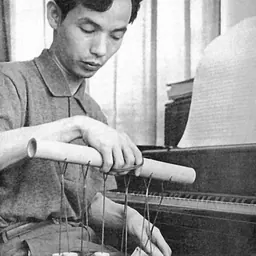

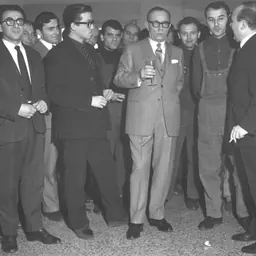
Related people
Same field, nearest in time
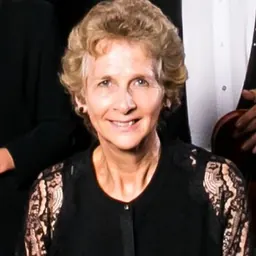


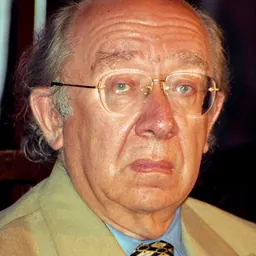


Contemporaries
People whose lives overlapped Péter Eötvös's



Frequently asked questions
Who was Péter Eötvös?
Hungarian composer and conductor (1944–2024)
When was Péter Eötvös born?
Péter Eötvös was born on 2 January 1944 in Odorheiu Secuiesc.
When did Péter Eötvös die?
Péter Eötvös died on 24 March 2024 in Budapest.
What was Péter Eötvös's occupation?
Péter Eötvös was a conductor, composer, university teacher, librettist and pianist.
What nationality was Péter Eötvös?
Péter Eötvös was Hungarian.
Sources & further reading
Cite this page
APA: Biography.guide. (2026). Péter Eötvös. https://biography.guide/peter-eotvos/
MLA: "Péter Eötvös." Biography.guide, https://biography.guide/peter-eotvos/.
Chicago: "Péter Eötvös." Biography.guide. https://biography.guide/peter-eotvos/.
Data last updated: 2026-09-25 · Spot an error? Report a correction.
Page generated 2026-09-27 05:13 UTC