
Pericles
Athenian statesman, orator and general
About Pericles
Lived 494 BC – 429 BC (aged 64–65). Pericles was a Greek politician, military personnel, statesperson, orator and army officer.
Pericles (; ; –429 BC) was a Greek statesman and general during the Golden Age of Athens. He was prominent and influential in Ancient Athenian politics, particularly between the Greco-Persian Wars and the Peloponnesian War, and was acclaimed by Thucydides, a contemporary historian, as "the first citizen of Athens". Pericles turned the Delian League into an Athenian empire and led his countrymen during the first two years of the Peloponnesian War. The period during which he led Athens as its preeminent orator and statesman, roughly from 461 to 429 BC, is sometimes known as the "Age of Pericles", but the period thus denoted can include times as early as the Persian Wars or as late as the following century.
Pericles promoted the arts and literature, and it was principally through his efforts that Athens acquired the reputation of being the educational and cultural centre of the ancient Greek world. He started an ambitious project that generated most of the surviving structures on the Acropolis, including the Parthenon. This project beautified and protected the city, exhibited its glory, and gave work to its people. Pericles also fostered Athenian democracy to such an extent that critics called him a populist. Pericles was descended, through his mother, from the powerful and historically influential Alcmaeonid family. He, along with several members of his family, succumbed to the Plague of Athens in 429 BC, which weakened the city-state during a protracted conflict with Sparta.
Early years Pericles was born , in Athens, Greece. He was the son of the politician Xanthippus, who, though ostracised in 485–484 BC, returned to Athens to command the Athenian contingent in the Greek victory at Mycale just five years later. Pericles's mother, Agariste, was a member of the powerful and controversial noble family of the Alcmaeonidae, and her familial connections played a crucial role in helping start his political career. Agariste was the great-granddaughter of the tyrant of Sicyon, Cleisthenes, and the niece of the Athenian reformer Cleisthenes.efn-lg|Plutarch says "granddaughter" of Cleisthenes, Pericles belonged to the Attic phyle (clan) of Acamantis. His early years were quiet; the introverted young Pericles avoided public appearances, instead preferring to devote his time to his studies.
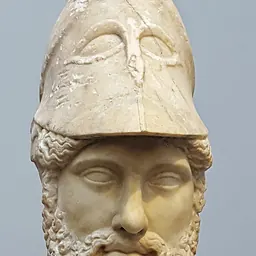
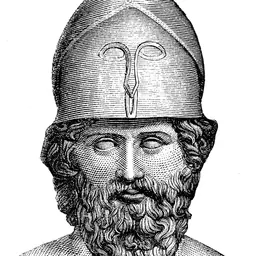
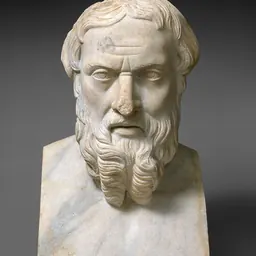
According to Herodotus and Plutarch, Agariste dreamed, a few nights before Pericles's birth, that she had borne a lion. Legends say that Philip II of Macedon had a similar dream before the birth of his son, Alexander the Great. One interpretation of the dream treats the lion as a traditional symbol of greatness, but the story may also allude to the unusually large size of Pericles's skull, which became a popular target of contemporary comedians (who called him "Squill-head", after the squill or sea-onion). Although Plutarch claims that this deformity was the reason that Pericles was always depicted wearing a helmet, this is not the case; the helmet was actually the symbol of his official rank as strategos (general).
His family's nobility and wealth allowed him to fully pursue his inclination toward education. He learned music from the masters of the time (Damon or Pythocleides could have been his teacher) and he is considered to have been the first politician to attribute importance to philosophy.
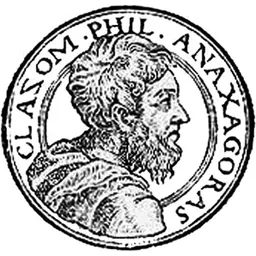
Pericles's manner of thought and rhetorical charisma may have possibly been in part products of Anaxagoras's emphasis on emotional calm in the face of trouble, and scepticism about divine phenomena.
Political career until 431 BC Entering politics
In the spring of 472 BC, Pericles presented The Persians of Aeschylus at the Greater Dionysia as a liturgy, demonstrating that he was one of the wealthier men of Athens. Simon Hornblower has argued that Pericles's selection of this play, which presents a nostalgic picture of Themistocles's famous victory at Salamis, shows that the young politician was supporting Themistocles against his political opponent Cimon, whose faction succeeded in having Themistocles ostracised shortly afterward.
Plutarch says that Pericles stood first among the Athenians for forty years. If this was so, Pericles must have taken up a position of leadership by the early 460s BC, which would be in his early or mid-thirties. Throughout these years he endeavoured to protect his privacy and to present himself as a model for his fellow citizens. For example, he would often avoid banquets, trying to be frugal.
In 463 BC, Pericles was the leading prosecutor of Cimon, the leader of the conservative faction who was accused of neglecting Athens's vital interests in Macedon. Although Cimon was acquitted, this confrontation proved that Pericles's major political opponent was vulnerable.
Ostracising Cimon Around 461 BC, the leadership of the democratic party decided it was time to take aim at the Areopagus, a traditional council controlled by the Athenian aristocracy, which had once been the most powerful body in the state. The leader of the party and mentor of Pericles, Ephialtes, proposed a reduction of the Areopagus's powers. The Ecclesia (the Athenian Assembly) adopted Ephialtes's proposal without opposition.
In 461 BC, Pericles achieved the political elimination of this opponent using ostracism. The accusation was that Cimon betrayed his city by aiding Sparta.
After Cimon's ostracism, Pericles continued to promote a populist social policy. His most controversial measure, however, was a law of 451 BC limiting Athenian citizenship to those of Athenian parentage on both sides.
Such measures impelled Pericles's critics to hold him responsible for the gradual degeneration of the Athenian democracy. The 19th century Greek historian Constantine Paparrigopoulos, argued that Pericles sought for the expansion and stabilisation of all democratic institutions. Accordingly, he enacted legislation granting the lower classes access to the political system and the public offices, from which they had previously been barred.
According to Samons, Pericles believed that it was necessary to raise the demos, in which he saw an untapped source of Athenian power and the crucial element of Athenian military dominance. (The fleet, backbone of Athenian power since the days of Themistocles, was manned almost entirely by members of the lower classes).
Cimon, in contrast, apparently believed that no further free space for democratic evolution existed. He was certain that democracy had reached its peak and Pericles's reforms were leading to the stalemate of populism. According to Paparrigopoulos, history vindicated Cimon, because Athens, after Pericles's death, sank into the abyss of political turmoil and demagogy. Paparrigopoulos maintained that an unprecedented regression descended upon the city, whose glory perished as a result of Pericles's populist policies. In contrast, Donald Kagan asserted that the democratic measures Pericles put into effect provided the basis for an unassailable political strength. After all, Cimon finally accepted the new democracy and did not oppose the citizenship law, after he returned from exile in 451 BC.
Leading Athens Ephialtes's murder in 461 BC paved the way for Pericles to consolidate his authority. Plutarch mentions other criticism of Pericles's leadership: "many others say that the people were first led on by him into allotments of public lands, festival-grants, and distributions of fees for public services, thereby falling into bad habits, and becoming luxurious and wanton under the influence of his public measures, instead of frugal and self-sufficing". According to King, by increasing the power of the people, the Athenians left themselves with no authoritative leader. During the Peloponnesian War, Pericles's dependence on popular support to govern was obvious. He based his military policy on Themistocles's principle that Athens's predominance depends on its superior naval power and believed that the Peloponnesians were near-invincible on land. Pericles also tried to minimise the advantages of Sparta by rebuilding the walls of Athens, which, it has been suggested, radically altered the use of force in Greek international relations.
During the Peloponnesian War, Pericles initiated a defensive "grand strategy" whose aim was the exhaustion of the enemy and the preservation of the status quo. According to Platias and Koliopoulos, Athens as the strongest party did not have to beat Sparta in military terms and "chose to foil the Spartan plan for victory". His strategy is said to have been "inherently unpopular", but Pericles managed to persuade the Athenian public to follow it. It is for that reason that Hans Delbrück called him one of the greatest statesmen and military leaders in history. Although his countrymen engaged in several aggressive actions soon after his death, Platias and Koliopoulos argue that the Athenians remained true to the larger Periclean strategy of seeking to preserve, not expand, the empire, and did not depart from it until the Sicilian Expedition.
Critics of Pericles's strategy, however, have been just as numerous as its supporters. A common criticism is that Pericles was always a better politician and orator than strategist. Donald Kagan called the Periclean strategy "a form of wishful thinking that failed", Barry S. Strauss and Josiah Ober have stated that "as strategist he was a failure and deserves a share of the blame for Athens' great defeat", and Victor Davis Hanson believes that Pericles had not worked out a clear strategy for an effective offensive action that could possibly force Thebes or Sparta to stop the war. Kagan criticises the Periclean strategy on four counts: first that by rejecting minor concessions it brought about war; second, that it was unforeseen by the enemy and hence lacked credibility; third, that it was too feeble to exploit any opportunities; and fourth, that it depended on Pericles for its execution and thus was bound to be abandoned after his death. Kagan estimates Pericles's expenditure on his military strategy in the Peloponnesian War to be about 2,000 talents annually, and based on this figure concludes that he would have only enough money to keep the war going for three years. He asserts that since Pericles must have known about these limitations he probably planned for a much shorter war. Others, such as Donald W. Knight, conclude that the strategy was too defensive and would not succeed.
In contrast, Platias and Koliopoulos reject these criticisms and state that "the Athenians lost the war only when they dramatically reversed the Periclean grand strategy that explicitly disdained further conquests". Hanson stresses that the Periclean strategy was not innovative, but could lead to a stagnancy in favour of Athens.
Oratorical skill
Modern commentators of Thucydides, with other modern historians and writers, take varying stances on the issue of how much of the speeches of Pericles, as given by this historian, do actually represent Pericles's own words and how much of them is free literary creation or paraphrase by Thucydides. Since Pericles never wrote down or distributed his orations,
Although Pericles was a main source of his inspiration, some historians have noted that the passionate and idealistic literary style of the speeches Thucydides attributes to Pericles is completely at odds with Thucydides's own cold and analytical writing style. This might, however, be the result of the incorporation of the genre of rhetoric into the genre of historiography. That is to say, Thucydides could simply have used two different writing styles for two different purposes.
Ioannis Kakridis and Arnold Gomme were two scholars who debated the originality of Pericles's oratory and last speech. Kakridis believes that Thucydides altered Pericles words. Some of his strongest arguments included in the Introduction of the speech, (Thuc.11.35). Kakridis proposes that it is impossible to imagine Pericles deviating away from the expected funeral orator addressing the mourning audience of 430 after the Peloponnesian war. According to Plutarch, he avoided using gimmicks in his speeches, unlike the passionate Demosthenes, and always spoke in a calm and tranquil manner. The biographer points out, however, that the poet Ion reported that Pericles's speaking style was "a presumptuous and somewhat arrogant manner of address, and that into his haughtiness there entered a good deal of disdain and contempt for others". In Menexenus, however, Socrates (through Plato) casts aspersions on Pericles's rhetorical fame, claiming ironically that, since Pericles was educated by Aspasia, a trainer of many orators, he would be superior in rhetoric to someone educated by Antiphon. He also attributes authorship of the Funeral Oration to Aspasia and attacks his contemporaries' veneration of Pericles.
Sir Richard C. Jebb concludes that "unique as an Athenian statesman, Pericles must have been in two respects unique also as an Athenian orator; first, because he occupied such a position of personal ascendancy as no man before or after him attained; secondly, because his thoughts and his moral force won him such renown for eloquence as no one else ever got from Athenians".
Ancient Greek writers call Pericles "Olympian" and extol his talents; referring to him "thundering and lightning and exciting Greece" and carrying the weapons of Zeus when orating. According to Quintilian, Pericles would always prepare assiduously for his orations and, before going on the rostrum, he would always pray to the gods, so as not to utter any improper word.
Pericles and the city gods Nothing was more alien to the Greeks than the notion of a separation between church and state. In Athens, the community provided a tight framework for religious manifestations while, symmetrically, religion was deeply embedded in civic life. Within this context, participation in the rituals was an action highly political in the broadest sense of the term.
To analyse Pericles's relations with gods, one has to position oneself at the intersection of the general and the particular, where what was personal and what was shared by the whole community came together. On the one hand, the career of the strategos will illuminate the Athenians' collective relationship to all that was divine. As a reelected strategos and a persuasive orator, Pericles was the spokesman of a civic religion that was undergoing a mutation. He was implicated in a policy of making constant offerings and of launching huge architectural religious works not only on the Acropolis but also throughout Attica; and, furthermore, he was engaged in such activities at a time when city was introducing profound changes into its religious account of its origins—that is, autochthony—within a context of strained diplomatic relations.
On the other hand, the ancient sources made it possible to glimpse the personal relations that Pericles had developed with gods. These were relations of proximity in the first place: he was sometimes depicted as a protégé of goddess Athena, but in Attic comedies he was also assimilated to god Zeus, in an analogy that was in no way flattering. But then, there were also relations that emphasized distance: some philosophical accounts presented him as a man close to the sophists or even as a freethinker. Finally, there were relations involving irreverence: some later and less trustworthy sources made much of several trials for impiety in which those close to him were involved, and this raises the question of religious tolerance in fifth-century Athens and, in particular, how far individuals enjoyed freedom of thought when faced with the civic community.
Legacy
Pericles's most visible legacy can be found in the literary and artistic works of the Golden Age, much of which survive to this day. The Acropolis, though in ruins, still stands and is a symbol of modern Athens. Paparrigopoulos wrote that these masterpieces are "sufficient to render the name of Greece immortal in our world". The promotion of such an arrogant imperialism is said to have ruined Athens. Pericles and his "expansionary" policies have been at the centre of arguments promoting democracy in oppressed countries.
Other analysts maintain an Athenian humanism illustrated in the Golden Age. The freedom of expression is regarded as the lasting legacy deriving from this period. Pericles is lauded as "the ideal type of the perfect statesman in ancient Greece" and his Funeral Oration is nowadays synonymous with the struggle for participatory democracy and civic pride.
In 1932, botanist Albert Charles Smith published Periclesia, a monotypic genus of flowering plants from Ecuador belonging to the family Ericaceae and named after Pericles.
Don’t just read it —
keep it.
Full-length biographies made to live with: read them, listen on the way to work, watch them tonight.
- E-book
- Audio
- Video
Instant download · yours to keep · every purchase keeps this site free
Important facts
People in Pericles's life
Named in this biography and alive at the same time
Related people
Same field, nearest in time



Contemporaries
People whose lives overlapped Pericles's

Frequently asked questions
Who was Pericles?
Athenian statesman, orator and general (c. 495 – 429 BC)
When was Pericles born?
Pericles was born in 494 BC in Athens.
When did Pericles die?
Pericles died in 429 BC in Athens.
What was Pericles's occupation?
Pericles was a politician, military personnel, statesperson, orator and army officer.
What nationality was Pericles?
Pericles was Greek.
Sources & further reading
Cite this page
APA: Biography.guide. (2026). Pericles. https://biography.guide/pericles-politician/
MLA: "Pericles." Biography.guide, https://biography.guide/pericles-politician/.
Chicago: "Pericles." Biography.guide. https://biography.guide/pericles-politician/.
Data last updated: 2026-09-20 · Spot an error? Report a correction.
Page generated 2026-09-27 05:27 UTC