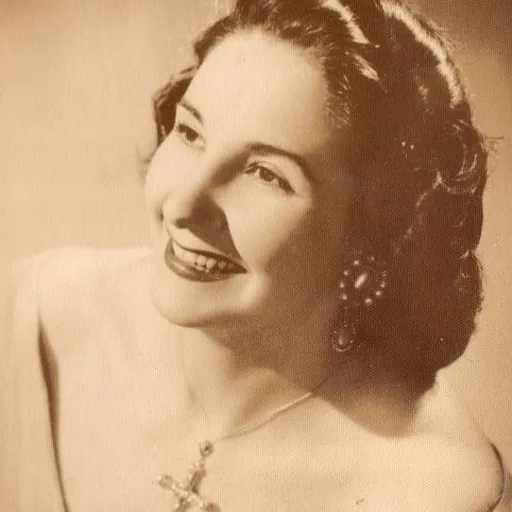
About Pepita Embil
Lived 1918 – 1994 (aged 76). Pepita Embil was a Spanish actor and opera singer.
Josefa "Pepita" Embil Echániz (; February 28, 1918 – August 28, 1994) was a Spanish Basque soprano who starred in zarzuela and operetta productions throughout Spain and Latin America. Known as the "Queen of Zarzuela," He also liked to play piano reductions of operatic music for enjoyment. He and his wife, Germana Echániz Ostolaza, had five children: Francisco, Sebastián, Josefa (Pepita), Agustina, and Angel María. He died at age 45 in January 1930, when his daughter Pepita was 11 years old. La Constancia, a traditionalist Catholic Integrist party newspaper, announced his death and mentioned the "irreparable loss" his family and "political brothers" experienced. a Basque choir directed by Olaizola. While the choir was in Barcelona for a celebration of the third anniversary of the Second Spanish Republic, she made her debut at the Liceu in a small part in Basque composer Jesús Guridi's opera, Amaya, on April 12, 1934. Only sixteen years old, she appeared with Olaizola, who had created the bass role of Miguel de Goñi in the opera's 1920 premiere. Afterwards, they again performed the opera in other theaters, including the Teatro Gayarre in Irun and the Teatro Arriaga in Bilbao. The latter performance with the Bilbao Symphony Orchestra was a success for the singers, including Embil, in front of a full house. Euzko-Abesbatza and another choir, the Juventud Vasca de Bilbao, both of which were involved in the growing Basque nationalist movement, organized the performance. In addition to her choral and operatic work, she also gave concerts. At one 1936 concert in Azpeitia with Olaizola, she sang a variety of music: a Basque number, an Italian song by Toselli, a Basque translation of Schubert's "Ständchen" ("Serenade"), and Siébel's aria, "Faites-lui mes aveux," in Italian from Gounod's opera, Faust. For the next few years she sang in various choirs, including the prestigious Orfeón Donostiarra, because as she later said, she needed to "work to live."
Just days before the fall of his government to Franco's forces in 1937, the president of the Basque autonomous government, José Antonio Aguirre, worked with Embil's teacher Olaizola to form the Basque national choir and ballet, , with the goal of keeping Basque musical culture alive. Embil joined the newly formed choir and toured extensively with the group outside of Spain, often singing as a choral soloist, until it disbanded two years later. Supported by members of the Basque government in exile in France and elsewhere, The two singers also appeared there in 1944 in the premiere of Jesús Romo's En el balcón de Palacio. It was only the composer's second zarzuela, coming two years after his promising El mesón del Pato Rojo. Embil sang the leading role, Lola la de Jerez, in the new zarzuela, which was an immediate hit. Her last world premiere in Spain occurred on November 22, 1944, in Guerrero's Tiene razón Don Sebastián at the Teatro Principal de Zaragoza. As a zarzuela written for two baritones—Medio and Domingo—it was considered a novelty. In May of the following year, she starred again in the farcical zarzuela at the Teatro Calderón.
Years in Mexico
After completing a series of tours around the Iberian Peninsula with the Ases líricos—appearing for example in La Gran Vía in Salamanca in 1946—she and her husband embarked on a tour of Latin America with a new zarzuela company Federico Moreno Torroba had recently formed. Soon after she first arrived in Mexico, a newspaper from Mexico City quoted one of Moreno Torroba's librettists, describing her as a "tall, young, and good looking" Basque with both a lyric and dramatic voice, who had shown herself to be a "grand figure" since she first appeared in Sor Navarra in Pamplona. While on tour, Moreno Torroba composed a Mexican zarzuela, El orgullo de Jalisco, that incorporated aspects of that country's music and traditions. In September 1947, Embil starred in the leading role of El orgullo de Jalisco to "warm and grateful" applause at its world premiere in Mexico City. The company's performances were popular among the publics of Puerto Rico, Cuba, Venezuela, and especially Mexico. In January 1949, Agustina brought the children to Mexico to be with their parents, who soon recruited them to appear in various small parts in their zarzuela productions. Although they primarily performed at the Teatro Arbeu and the Teatro Esperanza Iris in Mexico City, Embil and Domingo frequently went on tour in Mexico and many other countries in Latin America. and Franz Lehár's El conde de Luxemburgo (The Count of Luxembourg) and La viuda alegre (The Merry Widow).
One Mexican critic wrote in 1949 that Embil and her co-star, Florencio Calpe, "provoked delirious and very loving ovations" during a performance of the zarzuela, El dúo de la africana. In 1951, Cuban movie star and singer Rosita Fornés hired Embil to alternate with her in her own company's stage productions. Domingo also worked with Fornés' company. For over two decades, the couple appeared before the Mexican public as both entrepreneurs and singers. Embil also gave recitations and concerts, sometimes accompanied by her son, Plácido, on the piano. In the mid to late 1950s, she frequently performed in zarzuelas with her son, who was just beginning a singing career of his own. She and her husband had given him his first singing lessons at home.
Later life After years away, she and her husband accepted offers to perform again in Spain. In 1966, Embil and Domingo toured the Canary Islands and the north of Spain with José de Luna's zarzuela company. Her husband, Plácido Domingo Ferrer, died of a heart attack in 1987 at age 80. The following year, the Teatro de la Zarzuela paid homage to her by dedicating a performance of Moreno Torroba's to her. The theater's director, conductor Miguel Roa, wrote a poem to honor her on the occasion. Embil died on August 28, 1994, in Mexico City from a liver disease caused by a blood transfusion from twenty years earlier. She was 76 years old. She is buried next to her husband at the Panteón Español de México. In 2012, one Spanish reporter noted that she is "considered one of the most expressive voices of zarzuela."
In 1993, her son created the Pepita Embil Domingo Prize of Zarzuela in her honor, as part of his worldwide Operalia singing competition. Each year since then, a female singer has received the $10,000 prize for the quality of her performance during the zarzuela section of the competition. In 2002, the city of Pueblo, Mexico named one of its plazas, the Plaza Pepita Embil de Domingo, after her. A decade later Basque filmmaker Josu Venero created the Spanish-language documentary La reina de la zarzuela (The Queen of the Zarzuela) about Embil, Luis Mendoza López RCA-Victor Cat: MKL-1144 Genre: Zarzuela (selections) Origin: Mexico Digital download (2012): Sony/RCA; Title: Trozos inmortales de zarzuelas 1960 Canciones inolvidables Pepita Embil Gonzálo Cervera RCA-Camden Genre: Latin pop/musicals Origin: Mexico 1965 Fragmentos de operetas inmortales Pepita Embil Luis Mendoza López, Orquesta de Camara RCA-Victor Genre: Operetta Origin: Mexico Digital download (2012): Sony/RCA; Title: Pepita Embil
Don’t just read it —
keep it.
Full-length biographies made to live with: read them, listen on the way to work, watch them tonight.
- E-book
- Audio
- Video
Instant download · yours to keep · every purchase keeps this site free
Important facts
Family & relationships
People in Pepita Embil's life
Named in this biography and alive at the same time



Related people
Same field, nearest in time



Contemporaries
People whose lives overlapped Pepita Embil's




Frequently asked questions
Who was Pepita Embil?
Basque Mexican singer (1918-1994)
When was Pepita Embil born?
Pepita Embil was born on 28 February 1918 in Getaria.
When did Pepita Embil die?
Pepita Embil died on 28 August 1994 in Mexico City.
What was Pepita Embil's occupation?
Pepita Embil was an actor and opera singer.
What nationality was Pepita Embil?
Pepita Embil was Spanish.
Sources & further reading
Cite this page
APA: Biography.guide. (2026). Pepita Embil. https://biography.guide/pepita-embil/
MLA: "Pepita Embil." Biography.guide, https://biography.guide/pepita-embil/.
Chicago: "Pepita Embil." Biography.guide. https://biography.guide/pepita-embil/.
Data last updated: 2026-09-21 · Spot an error? Report a correction.
Portrait: Wikimedia Commons · author & licence
Page generated 2026-09-27 05:00 UTC