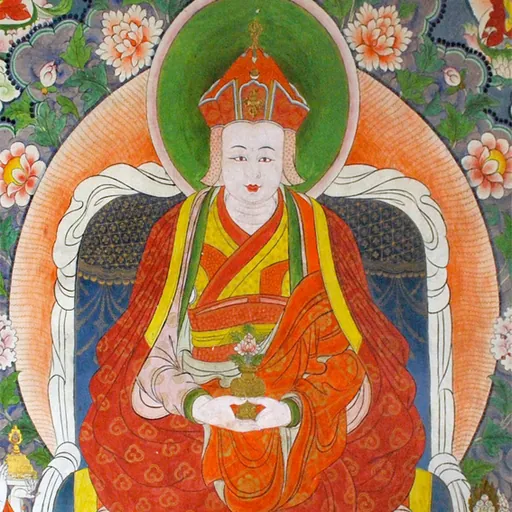
About Pema Lingpa
Lived 1450 – 1521 (aged 70–71). Pema Lingpa was a tertön and writer.
Pema Lingpa or Padma Lingpa (, March or April 1450 – February 1521) was a Bhutanese saint and siddha of the Nyingma school of Tibetan Buddhism. He is considered a terchen or "preeminent tertön" (, discoverer of spiritual treasures) and is considered to be foremost of the "Five Tertön Kings" . In the history of the Nyingma school in Bhutan, Pema Lingpa is second only in importance to Padmasambhava.
Biography
Pema Lingpa was born in March or April 1450 in Chel presently called Baribrang in Tang valley of Bumthang, part of the central Bhutanese region of Bumthang known as the “Wheel of Dharma.” His father was Lama Döndrup Zangpo of the Nyö clan, and his mother, Drogmo Pema Drolma, was bestowed with all the signs of a dakini. Their son was born among many miraculous signs. As an incarnation of the Omniscient One Drimé Ozer (Longchenpa), Pema Lingpa was extraordinary even as a child. He learned everything from reading and writing to ironwork and carpentry without receiving any instruction.
On the tenth day of the first month of autumn in a Monkey Year, Padmasambhava appeared before Pema Lingpa at the holy site of Yigé Drukma, blessed him, and placed in his hands an inventory of one hundred and eight major termas to be revealed. However, due to the karmic disposition of beings at that time, during his lifetime Pema Lingpa revealed only about half of the prophesied treasures. Nevertheless, the revealed treasures of Pema Lingpa contain the essence of all 108 treasures, which are summarized in the cycles of the three heart practices transmitted to Princess Pemasel by Guru Rinpoche: The Lama Jewel Ocean, The Union of Samantabhadra's Intentions, and The Great Compassionate One: The Lamp That Illuminates Darkness.
One well-known story of Pema Lingpa tells of his diving with a burning butter lamp into the Burning Lake in the Bumthang District of Bhutan. He told onlookers that if he was a false spirit his lamp would be extinguished. Disappearing into the bottom of the gorge and feared drowned, he emerged from the water with a statue the size of a fist and a treasure casket tucked under one arm, and the butter lamp still burning in the other.
Pema Lingpa was highly regarded by all four of the principal schools of Tibetan Buddhism. He spent his life revealing the precious treasures of Padmasambhava, giving empowerments and teachings, meditating in isolated locations, building and restoring monasteries, and establishing a tradition that endures to this day. He married twice. His first wife was Yum Tima (alias Sithar) and his second wife was Yum Bumdren.
Notable descendants of Pema Lingpa include the House of Wangchuck. The Pema Lingpa lineage of empowerments, transmissions and guidance continues today through the three lines of the Body, Speech, and Mind emanations of Pema Lingpa: the Gangteng, Sungtrul, and Tukse Rinpoches, all of whom traditionally reside in Bhutan.
Death When Tertön Pema Lingpa return to the Bumthang from Tibet in 1520, three Tsilung sculptures and the Tongwa Kundol sculptures were said to have weeped showing the bad omens. He entered into parinirvana at the age of seventy-one in February 1521, on the third day of the first month of the Iron Snake Year in the Bhutanese calendar. He died holding the hand of his heart son, Dawa Gyeltsen witnessed by many other devoted disciples. His body was left untouched for nine days, yet it showed no signs of decomposing. He was then cremated and the remains were placed in a reliquary stupa at Tamzhing Lhundrub Choling. – the present Peling Sungtrul or Lhalung Sungtrul Rinpoche
Peling Tukse incarnations The incarnations are: Tukse Dawa Gyaltsen (b. 1499) – son of Pema Lingpa Nyida Gyaltsen Nyida Longyang Tenzin Gyurme Dorje (1641 – ca. 1702) Gyurme Chogdrub Palzang (ca. 1708–1750) Tenzin Chokyi Nyima (ca. 1752–1775) Kunzang Gyurme Dorje Lungrig Chokyi Gocha (ca. 1780 – ca. 1825) Kunzang Zilnon Zhadpa-tsal Thubten Palwar (1906–1939) Tegchog Tenpa'i Gyaltsen (1951–2010)
Peling Gyalse (Gangteng Tulku) incarnations
The incarnations are: Gyalse Pema Tinley (1564–1642) Tenzin Lekpai Dondrup (1645–1726) Tinley Namgyal a.k.a. Kunzang Pema Namgyal (d. ca. 1750) Tenzin Sizhi Namgyal (1761? –1796) Orgyen Geleg Namgyal (d. 1842?) Orgyen Tenpai Nyima (1873–1900?) Orgyen Tenpai Nyinjed Orgyen Thinley Dorje Rigdzing Kunzang Padma Namgyal (b. 1955) – the present Gangteng Tulku Rinpoche
Family lineages Pema Lingpa's family line grew into a pre-eminent class of religious elites, known as Choje, who were pre-dominant in the Bhutanese religious and political sphere. The House of Wangchuck claims direct descent from Pema Lingpa, as do many other Himalayan religious elites.
Tamzhing Chöje This Chöje family, with its main seat at Tamzhing Monastery, began with Pema Lingpa's son, Drakpa Gyalpo, who died without leaving an heir. The family line continued through Pema Lingpa's youngest son, Sangda.
Prakhar Zhalno
Don’t just read it —
keep it.
Full-length biographies made to live with: read them, listen on the way to work, watch them tonight.
- E-book
- Audio
- Video
Instant download · yours to keep · every purchase keeps this site free
Important facts
Related people
Same field, nearest in time



Contemporaries
People whose lives overlapped Pema Lingpa's



Frequently asked questions
Who was Pema Lingpa?
Saint and siddha of the Nyingma school of Tibetan Buddhism
When was Pema Lingpa born?
Pema Lingpa was born in 1450.
When did Pema Lingpa die?
Pema Lingpa died in 1521.
What was Pema Lingpa's occupation?
Pema Lingpa was a tertön and writer.
What nationality was Pema Lingpa?
Pema Lingpa's recorded nationality: Bhutan.
Sources & further reading
Cite this page
APA: Biography.guide. (2026). Pema Lingpa. https://biography.guide/pema-lingpa/
MLA: "Pema Lingpa." Biography.guide, https://biography.guide/pema-lingpa/.
Chicago: "Pema Lingpa." Biography.guide. https://biography.guide/pema-lingpa/.
Data last updated: 2026-09-23 · Spot an error? Report a correction.
Portrait: Wikimedia Commons · author & licence
Page generated 2026-09-27 05:07 UTC