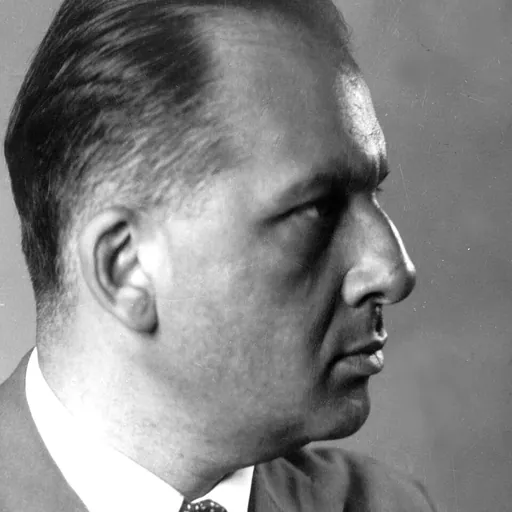
About Paweł Hertz
Lived 1918 – 2001 (aged 82). Paweł Hertz was a Polish poet, writer and opinion journalist.
Paweł Hertz (29 October 1918 – 13 May 2001) was a Polish writer, poet, translator and publisher.
Life He was born in a family of Polish Jews to Michał Hertz and Paulina nee Turower. He attended in Warsaw, dropped out on his own volition and never attempted the final exams. In 1935–1937 he traveled through Austria and Italy, sometimes accompanied by people such as Jarosław Iwaszkiewicz. Late 1937 he started living in Paris where he attended lectures on Écoles des Hautes Études Internationales.
In the summer of 1939, he returned to Poland. After the outbreak of World War II, he reached Lviv via the Stradecz estate. There, in January 1940, he was arrested and imprisoned by the Russians in the Zamarstyniv prison, and then sentenced to eight years in the camp, after which he was sent to the camp in Ivdel in Siberia through the prisons in Kherson and Dnepropetrovsk. After the Sikorski–Mayski agreement and the amnesty, he reached the Polish delegation in Almaty. In 1942, at the request of the delegation of the Polish Embassy, he started organizing Polish schools in Kyrgyzstan, and then became a representative of the Polish embassy. After the break of diplomatic relations between the Polish government and the Soviet authorities, he was arrested again. After his release, he went to Samarkand, where until the fall of 1944 he worked as a librarian of the Samarkand District Museum and a bibliographer at the A. Pushkin. He described his experiences from this period, among others in the book Sedan (1948). He returned to Poland in December 1945 and initially settled in Łódź, in 1949 he moved permanently to Warsaw, where he continued his creative work and worked as an editor.
Since 1945, he was a member of staff of a weekly „Kuźnica", and became a member of PPR (in 1948 renamed to PZPR). Soon he took an oppositional stance to the party. Czesław Miłosz based a character of Piotr Kwinto from the novel Zdobycie władzy (1955) on Hertz.
Private life Hertz left no diaries or autobiographies, and in his interview Sposób Życia published in 1997 he posed as a heterosexual, old-fashioned misanthrope, never using the word "homosexual" in any context in the book. Hertz was affiliated with Catholic Church for a long time, but became baptized only at the age of 60.
In gay circles he was sometimes called "the princess of Israel".
Career He debuted aged 16 with a poem Popiół (Ash) in „" (1934 issue 29), in the interwar period he published his poems also in „Skamander" magazine. His first volume of collected poems Nocna muzyka (Night music) was out when he was 17 (1935). Following years he published his poems in „Tygodnik Powszechny", „Nowa Kultura", „Kuźnica", „Więź", „Znaki czasu", „". His closest friends included Jarosław Iwaszkiewicz, Czesław Miłosz, Zygmunt Mycielski, Antoni Sobański, Stefan Kisielewski, Julian Stryjkowski, ; he kept in touch with the staff of Paris' "Kultura" – incl. Józef Czapski, , Konstanty Jeleński. In 1945–48 he belonged to staff of „Kuźnica".In the years 1949–52 he was the head of the editorial board of classical Russian literature at the State Publishing Institute, 1954–1959 he was a member of the editorial committee of the Dictionary of the Polish Language, and in the years 1955–1978 and 1979–1982 he co-edited "Rocznik Literacki", in 1978 he joined the editorial board of the journal " Res Publica" (then "Nowa Res Publica "), in 1990 he belonged to the editorial board of Tygodnik „Solidarność". In 1957 he was one of the initiators and members of the editorial board of the monthly "Europa" (the magazine was suspended by the authorities before the first issue was published). He prepared a monumental 7-volume anthology of 19th-century Polish poetry, Zbiór poetów polskich XIX-wieku (Collection of 19th-century Polish poets) (vol. I – VII, 1959–1979). He compiled Księga cytatów z polskiej literatury pięknej (Book of citations from Polish literature) (with Władysław Kopaliński, 1975), and edited numerous editions of Polish writers and poets (incl. Kazimiera Iłłakowiczówna, Jan Kasprowicz, Zygmunt Krasiński, Teofil Lenartowicz, Juliusz Słowacki). He initiated the reprinting of books valuable for Polish culture (he was a member of the Program Council for Reprinting at the Art and Film Publishing House – Rada Programowa do Spraw Reprintów przy Wydawnictwach Artystycznych i Filmowych). 1977 he initiated in Państwowy Instytut Wydawniczy series „Podróże", (travels) where he redacted and published 18 volumes of classic travel literature. He redacted polish anthologies of Fyodor Dostoevsky, Alexander Pushkin, Leo Tolstoy. He has been awarded many times for his translation work, which included translating Anna Achmatowa, Joseph Brodsky, Jacob Burckhardt, Anton Chekhov, Fyodor Dostoevsky, Hugo von Hofmannsthal, Pavel Muratov, Marcel Proust, Ivan Turgenev.
Works Poetry
Nocna muzyka (Night Music), Warszawa, Sfinks, 1935 Szarfa ciemności, Warszawa, F. Hoesick, 1937 Dwie podróże (Two Journeys), Warszawa, Czytelnik, 1946 Małe ody i treny (Small Odes and Laments), Warszawa, KiW, 1949 Nowy lirnik mazowiecki (New Mazovian Lyrist), Warszawa, Czytelnik, 1953 Wiersze wybrane (Selected Poems), Warszawa, PIW, 1955 Pieśni z rynku (Songs from the Market), Warszawa, PIW, 1957 Śpiewnik podróżny i domowy (Travel and Home Songbook), Warszawa, PIW, 1969 Poezje (Poems), Warszawa, PIW, 1983 Poezje wybrane (Selected Poems), Warszawa, LSW, 1992
Prose and essays Z naszej loży (From Our Lounge) (with J. Rojewski), Łódź, Poligrafika, 1946 Notatnik obserwatora (Notepad of an Observer), Łódź, W. Bąk, 1948 Sedan, Warszawa, Książka, 1948 Portret Słowackiego (Portrait of Słowacki), Warszawa, PIW, 1949 (last ed. Zeszyty Literackie, 2009) Dziennik lektury (Diary of a Lecture), Warszawa, PIW, 1954 Notatki z obu brzegów Wisły (Notes from Both Banks of Vistula), Warszawa, Czytelnik, 1955 Domena polska (Polish Domain), Warszawa, PIW, 1961 Słowacki. Romans życia (Słowacki. Romance of Life), Warszawa, PIW, 1961 Ład i nieład (Order and Disorder), Warszawa, PIW, 1964 Wieczory warszawskie (Warsaw Evenings), Warszawa, Czytelnik, 1974 Świat i dom (World and Home), Warszawa, PIW, 1977 Miary i wagi (Measures and Weights), Warszawa, PIW, 1978 Patrzę się inaczej (I Look Differently), Warszawa, Pavo, 1994 Gra tego świata (Game of This World), Warszawa, Więź, 1997 Sposób życia (Way of Life).Interview with Paweł Hertz by Barbara R. Łopieńska, Warszawa, PIW, 1997 Szkice warszawskie. (Warsaw Sketches) selected and redacted by Marek Zagańczyk. Warszawa, Muzeum Warszawy, 2016
Letters Letters to Czesław Miłosz, in: Czesław Miłosz, Zaraz po wojnie. Korespondencja z pisarzami 1945–1950, Kraków, Znak, 1998. Correspondence with Jarosław Iwaszkiewicz, in: „Zeszyty Literackie” nr 81, 101, 103. Correspondence with Aleksander Wat, in: Aleksander Wat, Korespondencja, volume I and II, Warszawa, Czytelnik, 2005. Paweł Hertz / Anna and Jarosław Iwaszkiewicz, Korespondencja, Warszawa, Zeszyty Literackie, 2015
Selected translations Ilya Ehrenburg Upadek Paryża (The Fall of Paris), Warszawa, Książka, 1946 Leo Tolstoy Dzieciństwo; Lata Chłopięce; Młodość (Childhood / Детство, Boyhood / Отрочество, Youth / Юность), Warszawa, Czytelnik, 1950 Ivan Turgenev Opowiadania wybrane, Warszawa, KiW, 1951 Anatole France Czerwona Lilia (Le Lys rouge / The Red Lily), Warszawa, Czytelnik, 1960 Anatole France Historia komiczna (Histoire comique / A Mummer's Tale), Warszawa, Czytelnik, 1962 Georges Lenôtre Ze starych papierów, Warszawa, Czytelnik, 1965 Marcel Proust Jan Santeuil (Jean Santeuil), t. I–II, Warszawa, PIW, 1969 Pavel Muratov Obrazy Włoch, t. I–II, Warszawa, PIW, 1972 (ostatnie wyd. Zeszyty Literackie, 2006–2012) Viktor Lazarev Dawni mistrzowie (Old Italian Masters / Старые итальянские мастера), Warszawa, PWN, 1984 Martin Buber Opowieści chasydów (Die Erzählungen der Chassidim), Poznań, W Drodze, 1986 (last edition Zeszyty Literackie, 2005) Jacob Burckhardt Czasy Konstantyna Wielkiego (Die Zeit Constantins des Großen), Warszawa, PIW, 1992 Astolphe de Custine Rosja w roku 1839 (La Russie en 1839), t. I–II, Warszawa, PIW, 1995 Hugo von Hofmannsthal Księga przyjaciół i szkice wybrane (Buch der Freunde, Aphorismen), Kraków, WL, 1997
Selected editorial work Alexander Pushkin Dzieła wybrane (Selected Works), t. I–VI, Warszawa, PIW, 1953–1954 Ivan Turgenev Z pism (From Writings), t. I–IX, Warszawa, PIW, 1953–1956 Fyodor Dostoevsky Z pism (From Writings), t. I–X, Warszawa, PIW, 1955–1964 Leo Tolstoy Dzieła (Works), t. I–XIV, Warszawa, PIW, 1956–1958 Zbiór poetów polskich XIX-wieku (Anthology of Polish Poets of 19th Century), t. I–VII, Warszawa, PIW, 1959–1979 Zygmunt Krasiński Dzieła literackie (Literary Works), t. I–III, Warszawa, PIW, 1973 Księga cytatów z polskiej literatury pięknej (Book of Quotes from Polish Literature) (with Władysław Kopaliński), Warszawa, PIW, 1975 Juliusz Słowacki Dzieła wybrane (Selected Works) (with Marian Bizan), t. I–III, Warszawa, PIW, 1986 Portret młodego artysty. Listy Józefa Rajnfelda do Jarosława Iwaszkiewicza (Letters by Józef Rajnfeld to Jarosław Iwaszkiewicz) (with Marek Zagańczyk), Warszawa, Tenten, 1997
Literary awards PEN Club award for translations of French literature (1971) Fundacja Alfreda Jurzykowskiego award (1972) PEN Club award for outstanding editorial work (1978) Literatura na Świecie award for translation work (1995) ZAiKS award for translation work (1996)
Orders and decorations Knight's Cross of Order of Polonia Restituta (1974) Commander's Cross of Order of Polonia Restituta (1996)
Don’t just read it —
keep it.
Full-length biographies made to live with: read them, listen on the way to work, watch them tonight.
- E-book
- Audio
- Video
Instant download · yours to keep · every purchase keeps this site free
Important facts
People in Paweł Hertz's life
Named in this biography and alive at the same time


Related people
Same field, nearest in time

Contemporaries
People whose lives overlapped Paweł Hertz's


Frequently asked questions
Who was Paweł Hertz?
Polish poet
When was Paweł Hertz born?
Paweł Hertz was born on 29 October 1918 in Warsaw.
When did Paweł Hertz die?
Paweł Hertz died on 13 May 2001 in Warsaw.
What was Paweł Hertz's occupation?
Paweł Hertz was a poet, writer and opinion journalist.
What nationality was Paweł Hertz?
Paweł Hertz was Polish.
Sources & further reading
Cite this page
APA: Biography.guide. (2026). Paweł Hertz. https://biography.guide/pawel-hertz/
MLA: "Paweł Hertz." Biography.guide, https://biography.guide/pawel-hertz/.
Chicago: "Paweł Hertz." Biography.guide. https://biography.guide/pawel-hertz/.
Data last updated: 2026-09-23 · Spot an error? Report a correction.
Portrait: Wikimedia Commons · author & licence
Page generated 2026-09-27 05:07 UTC