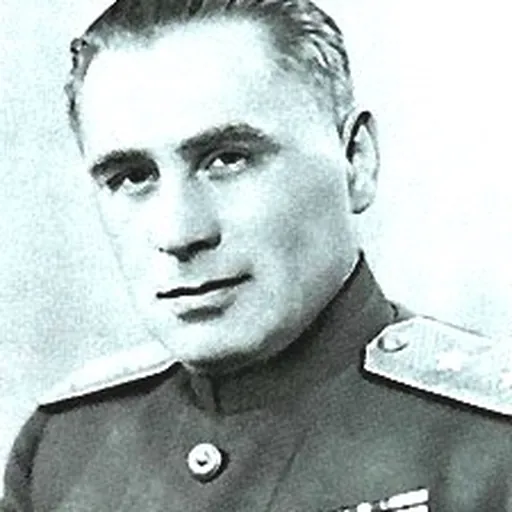
About Pavel Sudoplatov
Lived 1907 – 1996 (aged 89). Pavel Sudoplatov was a Russian military officer, spy, translator and author.
Functions in political police and intelligence apparatus Sudoplatov was recruited into the Cheka in 1921, at the age of 14, and was promoted to the Secret Political Department (SPO) of the Ukrainian State Political Directorate (OGPU) in 1927.
According to Sudoplatov, the order to assassinate Konovalets came directly from Joseph Stalin, who had personally told him: "This is not just an act of revenge, although Konovalets is an agent of German fascism. Our goal is to behead the movement of Ukrainian fascism on the eve of the war and force these "gangsters" to annihilate each other in a struggle for power."
Assassination of Leon Trotsky
In March 1939, Stalin rehabilitated Sudoplatov, promoting him to deputy director of the Foreign Department, and placed him in charge of the assassination of Trotsky, which was carried out in August 1940. Sudoplatov later said that he understood the offer to be a ruse, although other evidence suggests that Stalin was open to a peace settlement.
"Department S" and atomic bomb In February 1944, Beria allegedly named Sudoplatov to head the newly formed Department S, which, according to Sudoplatov, united both the army intelligence (GRU) and NKVD intelligence in an effort to aid and secure the Soviet atomic bomb project. Sudoplatov's exact role and contribution, as well as his claim that he "engineered the theft of atomic secrets from the United States with the aid of four eminent scientists" is under discussion, since, according to the Foreign Intelligence Service of Russia, Department S was established in September 1945, and Sudoplatov had limited access to the Soviet atomic effort from that time until October 1946 and did not have any access to foreign agents tasked with collecting the atomic intelligence. In 1995, the Federal Bureau of Investigation (F.B.I.) conducted an investigation and declared that it "is not in possession of any credible evidence that would suggest that Neils [sic] Bohr, Enrico Fermi, Robert Oppenheimer, or Leo Szilard engaged in any espionage activity on behalf of any foreign power [...], the F.B.I. has classified information available that argues against the conclusions reached by the author of 'Special Tasks.' The F.B.I., therefore, considers such allegations to be unfounded".
MGB In the summer of 1946, Sudoplatov was removed from both posts, and in September he was placed in charge of another group at the newly renamed MGB, one which was supposed to plan sabotage actions in Western countries. In November 1949, he was given a temporary job helping suppress a guerrilla Ukrainian nationalist movement in Ukraine that was a relic of World War II.
MVD In the spring of 1953, around the time of Stalin's death, Sudoplatov was appointed to head the yet-again renamed MVD's Bureau of Special Tasks, which was responsible for sabotage operations abroad, and ran networks of "illegals" who were given the task of preparing attacks on military establishments in NATO countries, in the event that NATO attacked the Soviet Union. He was accused, among other things, of involvement with Grigory Mairanovsky's laboratory of death: As established [during the court trial], Beria and his accomplices committed terrible crimes against humanity: they tested deadly poisons, which caused agonizing death, on live humans. A special laboratory, which was established for experiments on the action of poisons on living humans, worked under the supervision of Sudoplatov and his deputy Eitingon from 1942 to 1946. They demanded he provide them only with poisons that had been tested on humans [...]. but the Russian Foreign Intelligence Service and the American Federal Bureau of Investigation would later dispute such claims, while American and Russian scientists and historians have dismissed them.
Honorary State Security Officer (4 February 1942) Honored Worker of the Ministry of Internal Affairs
Legacy There are streets named after Sudoplatov in the city of Smolensk and the town of Gagarin. There is also a plaque honoring him in Smolensk. In 2022, during the Russian occupation of Zaporizhzhia Oblast as part of the 2022 Russian invasion of Ukraine, a monument to Sudoplatov was erected in the city of Melitopol. The occupation authorities also renamed the city's Dmytro Dontsov Street to Sudoplatov Street. Later in 2022, pro-Russian collaborators in Russian-occupied Zaporizhzhia Oblast raised the Pavel Sudoplatov Battalion led by Yevgeny Balitsky, the Russian-installed governor whose son also plays a prominent role in the militia.
Don’t just read it —
keep it.
Full-length biographies made to live with: read them, listen on the way to work, watch them tonight.
- E-book
- Audio
- Video
Instant download · yours to keep · every purchase keeps this site free
Important facts
People in Pavel Sudoplatov's life
Named in this biography and alive at the same time




Related people
Same field, nearest in time



Contemporaries
People whose lives overlapped Pavel Sudoplatov's

Frequently asked questions
Who was Pavel Sudoplatov?
Soviet spy (1907–1996)
When was Pavel Sudoplatov born?
Pavel Sudoplatov was born on 7 July 1907 in Melitopol.
When did Pavel Sudoplatov die?
Pavel Sudoplatov died on 24 September 1996 in Moscow.
What was Pavel Sudoplatov's occupation?
Pavel Sudoplatov was a military officer, spy, translator and author.
What nationality was Pavel Sudoplatov?
Pavel Sudoplatov was Russian.
Sources & further reading
Cite this page
APA: Biography.guide. (2026). Pavel Sudoplatov. https://biography.guide/pavel-sudoplatov/
MLA: "Pavel Sudoplatov." Biography.guide, https://biography.guide/pavel-sudoplatov/.
Chicago: "Pavel Sudoplatov." Biography.guide. https://biography.guide/pavel-sudoplatov/.
Data last updated: 2026-09-20 · Spot an error? Report a correction.
Portrait: Wikimedia Commons · author & licence
Page generated 2026-09-27 04:57 UTC