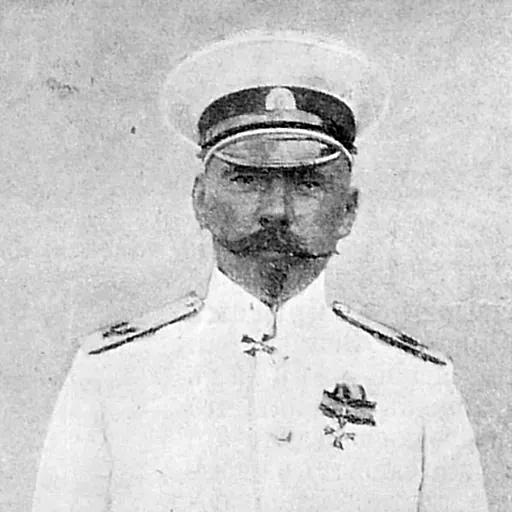
About Pavel Levitsky
Lived 1859 – 1938 (aged 78). Pavel Levitsky was a Russian military officer.
Pavel Pavlovich Levitsky (; October 3, 1859 – July 31, 1938) was a Russian Vice Admiral of the Russo-Japanese War and the Russian Civil War. He was known for commanding the Zhemchug during the Battle of Tsushima.
Biography Levitsky was born on 30 October 1859 in Reval, the son of the commander of the steam frigate Smelyy Pavel Pavlovich Levitsky and Nadezhda Efimovna (née Kholostova), daughter of a merchant of the first guild from Reval. In 1880, he graduated from the Naval Cadet Corps, was appointed michman in 1881, and graduated from his naval mine classes in 1884. under the guidance of Alexander Stepanovich Popov. Levitsky received his first command on 23 April 1885, as he headed the Plotva and from 1896 to 1898 was the senior mine officer of the Vladimir Monomakh. He then became the senior officer of the Sissoi Veliky on 15 June 1898, before being promoted to Captain 2nd rank on 6 December 1899. On 4 February 1904 he received command of the Zhemchug as part of the Second Pacific Squadron. On 27 May he participated in the Battle of Tsushima and after the battle, as part of the detachment of Rear-Admiral Oskar Enkvist, took the cruiser to Manila.
On 6 December 1906 Levitsky was promoted to Captain 1st rank before becoming the Head of the Diving Training Unit on the Baltic Sea on 17 June 1907. and was promoted to Counter Admiral on 25 March 1912 for "distinction in service". During World War I, Levitsky commanded a submarine brigade on the Baltic Sea. Around this time period, Levitsky's command and order was described as:
Modest, simple, friendly to everyone and everyone, Pavel Pavlovich always carefully listened to the opinions and wishes of submarine commanders, allowed him to argue with himself and never abused the power granted to him. For these qualities, he enjoyed universal respect and earned the nickname "Papa" in the brigade, which he was always proud of.
To this it should be added that he never tried to avoid danger and, although this was not at all required by his position, he always personally went on dives to great depths or on trials from which the boat risked not returning. Once the White Army began losing on all fronts however, Levitsky would flee with Pyotr Wrangel to Athens from Constantinople and lived in exile in Greece in November 1920. He later joined the Corps of Officers of the Imperial Army and Navy and was sent to Greece as a representative of Grand Duke Kirill Vladimirovich. He was the organizer and head of the Association of Former Russian Sailors in Estonia and was an honorary Member of the Seafarers Mutual Aid Fund. On 24 April 1930 he was promoted by Grand Duke Kirill Vladimirovich to Vice Admiral but Levitsky would die on 31 July 1938 in Tallinn and was buried at the Alexander Nevsky Cemetery.
Don’t just read it —
keep it.
Full-length biographies made to live with: read them, listen on the way to work, watch them tonight.
- E-book
- Audio
- Video
Instant download · yours to keep · every purchase keeps this site free
Important facts
People in Pavel Levitsky's life
Named in this biography and alive at the same time
Related people
Same field, nearest in time





Contemporaries
People whose lives overlapped Pavel Levitsky's

Frequently asked questions
Who was Pavel Levitsky?
Russian admiral (1859–1938)
When was Pavel Levitsky born?
Pavel Levitsky was born on 3 October 1859 in Tallinn.
When did Pavel Levitsky die?
Pavel Levitsky died on 31 July 1938 in Tallinn.
What was Pavel Levitsky's occupation?
Pavel Levitsky was a military officer.
What nationality was Pavel Levitsky?
Pavel Levitsky was Russian.
Sources & further reading
Cite this page
APA: Biography.guide. (2026). Pavel Levitsky. https://biography.guide/pavel-levitsky/
MLA: "Pavel Levitsky." Biography.guide, https://biography.guide/pavel-levitsky/.
Chicago: "Pavel Levitsky." Biography.guide. https://biography.guide/pavel-levitsky/.
Data last updated: 2026-09-23 · Spot an error? Report a correction.
Portrait: Wikimedia Commons · author & licence
Page generated 2026-09-27 05:08 UTC