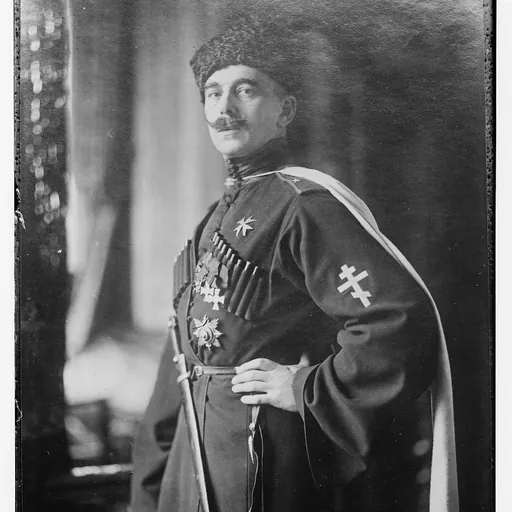
About Pavel Bermondt-Avalov
Lived 1877 – 1974 (aged 96). Pavel Bermondt-Avalov was a Russian warlord and writer.
Prince Pavel Rafailovich Bermondt-Avalov or Prince Avalov ( – 27 December 1973) was a Russian officer and Cossack adventurer-warlord. He is best known as the commander of the West Russian Volunteer Army which was active in present-day Latvia and Lithuania in the aftermath of World War I.
Born into a Georgian-Russian family, Avalov received a musical education in Warsaw and joined the Russian Imperial Army's Baikal Cossacks Host as a musical conductor. He participated in the Russo-Japanese War, during which he was awarded the Cross of St. George. After converting to Orthodoxy, he was transferred to the Ussuri Cossacks and was promoted to cornet. During the First World War, Avalov worked as a personal adjutant for Pavel Mishchenko, serving in Eastern Prussia and Galicia. Throughout his military career, Avalov was injured seven times.
After being demobilized in 1917, Avalov became involved in the Russian Civil War as an ardent supporter of the White Army. After defending Kiev from Symon Petliura, Avalov was captured and later exiled into Germany, where he formed a unit to fight the Bolsheviks in the Baltic States, along with general Rüdiger von der Goltz's Baltische Landeswehr. While fighting in Latvia and Lithuania to establish a pro-German and anti-Bolshevik territorial union, Avalov's West Russian Volunteer Army, also called the Bermontians, raided and pillaged the countryside and its occupied areas. After suffering defeats in Riga and Radviliškis, Avalov's army was severely damaged and subsequently retreated into Germany. In Germany, Avalov participated in right-wing White émigré movements, strongly supporting Adolf Hitler's Nazi Party. Despite this, he was imprisoned and sent to a concentration camp for embezzling funds meant for his Russian National Socialist Movement. Avalov escaped to Italy through Switzerland, later relocating to Belgrade before finally emigrating to the United States and living there until his death.
Early life Origins Pavel Bermondt-Avalov was born in Tbilisi in modern Georgia. There are varying accounts of his familial origins and date of birth. Some sources, like the United States Social Security Death Index, give his birthday at 16 (O.S. 4) March 1877, while others, such as Avalov's own memoirs, place the year at 1884. A version of his origin claims that his father was Georgian prince Mikhail Antonovich Avalishvili, while his mother was Princess Sofia Kugusheva of Tatar origin, whose second husband would be staff sergeant Rafail Bermondt. Another version claims that Avalov was born in 1877 in Vladivostok to jeweler Rafail Bermant, by origin a Jew who converted to Orthodoxy. Other versions claim that Avalov's father was a Karaite captain in the Russo-Turkish War of 1877–1878. Nevertheless, Avalov adopted both his father's and stepfather's surnames and since 1919 called himself Prince Pavel Mikhailovich Bermondt-Avalov.
Military service
After receiving a musical education with Professor Ziminski of the Warsaw Institute of Music, Avalov enlisted as a bandmaster in the 1st Argun Regiment of the Transbaikal Cossacks. In 1904 he joined the regiment as a volunteer soldier, and in 1905 was promoted to ensign. Avalov participated in the Russo-Japanese War, during which he was awarded the Order of St. George, 3rd and 4th degrees. He was wounded three times during his service in the war.
In 1905, Avalov converted to Orthodoxy. In 1906, Avalov was transferred to a Ussuri Cossack division and since then identified himself as an Ussuri Cossack. In 1908, Avalov was promoted to cornet The same year Avalov became head of the recruitment and counter-intelligence center of the White Army's southern army in Kiev. In winter of 1918, Avalov defended the city from Symon Petliura's nationalist forces, who, after seizing power in the region, imprisoned Avalov and other Russian officers. The officers as well as Avalov himself were evacuated to Germany when the German army abandoned Ukraine. In Germany he was active in Russian monarchist groups. While Prince Lieven's detachment sailed to Narva, Avalov and Vyrgolich refused to carry out Yudenich's order under the formal pretext that their detachments were not completed, while in reality Avalov, who viewed his army as equal to the Northwestern one, wished to remain in Latvia and further the creation of a pro-German, anti-Bolshevik territorial union.
After the disbandment of general Rüdiger von der Goltz's German Baltic volunteer corps, the German troops were ordered to retreat from the Baltics and return home, however Goltz and the soldiers refused in hopes of gaining land and citizenship in Latvia as was promised to them by the Latvian government. Avalov was later appointed the "commander of all Russian units formed in Courland and Lithuania" by Yudenich. Avalov's army numbered some 50,000 men at this point - 40,000 of them being German or Balto-German and 10,000 being Russian. Since the German government stopped paying for the troops, finances were mostly coming from German economic leaders that had interests in the Baltics, as well as J. P. Morgan Jr. and the Order of St John. Avalov's army also printed its own money. The army was marked by internal disagreements between Avalov and Vyrgolich.
War in Latvia
The Bermontians occupied a large part of Courland Governorate and Riga in Latvia after hostilities began in August. In Riga, Avalov supposedly was carried in a cart and exclaimed to the locals that he had come to heroically save St. Petersburg, meanwhile his troops pillaged the occupied areas. Several bombs, as well as leaflets in Russian, were dropped on the city from airplanes, in which Latvians were asked to “submit to the authority of Colonel Bermondt in order to be annexed to the great and mighty Russia.” As Bermondt wished to conclude a truce with the Latvians, military help from Estonia and Britain in the form of armored trains and battleships arrived, which helped the Latvians to repel the Bermontian army led by von der Goltz after the decisive Battle of Riga. One source reports that Avalov's army, while occupying Šiauliai, beat up the headmaster and a majority of the students of the Šiauliai gymnasium. In Šiauliai itself, Avalov printed newspapers in which promises were given to soldiers that they would receive Russian citizenship and land. His army continued raiding Lithuania by occupying the important railway city of Radviliškis and demanding free usage of Lithuanian and Latvian railways. The Bermontian rule over Radviliškis came to an end after the Lithuanian victory against the Bolshevik invasion, after which more troops could be relocated to fight the Bermontians. Avalov's army suffered severe equipment and manpower losses in the Battle of Radviliškis in November. French delegate Henri Niessel ordered the army to retreat into Germany, and by mid-December, the Bermontians began their retreat, and Avalov in the meanwhile declared himself Major General, escaping through Klaipėda into Germany, while his army retreated directly into Tilsit. He also worked in a trading company in Hamburg, unsuccessfully trying to build a political career in the early years of Russian emigres. Avalov supported the Kapp Putsch by offering to create military units from his former Bermontian army. Avalov collaborated with the Aufbau-Vereinigung, a right-wing German and Russian emigre organization, whose main goal was to overthrow the Weimar Republic's government, and later - the government of the USSR. Avalov regularly came under the attention of German police for publicly expressing plans such as the formation of an army under the leadership of Grand Duke Kiril, a campaign to Moscow, etc. Most contemporaries' accounts of Avalov are negative; “an arrogant, empty, crafty and weak person... an arrogant, petty man; to a certain extent, smart and cunning, like a snake, with a certain insolence and bravura behavior, but cowardly at heart." Stephen Tallents, a British delegate, also characterizes Avalov as "...Caucasian by birth, but of mixed blood, perhaps half Jewish. He is adventurous, obviously suffers from megalomania, is very theatrical, and seems to see himself in the future as a possible Tsar of Russia. [...] Lately he has been very openly befriending Germans in Jelgava, organizing extravagant parties and often drinking heavily. It is said that he knows very little German, but he does have a few phrases, the main of which is Deutschland über alles, which he uses in front of Germans, especially when drinking."
Latvian writer Andrievs Niedra describes Avalov as of "average height, thin, but proportionately built, with dark hair and eyes, a pale face of a southerner, a small mustache sticking up. He held himself straight, solidly, sometimes his body seemed to freeze in iconic immobility, especially when he felt that many eyes were turned on him. Outside the house, he wore a long Caucasian suit with gazyrs on his chest and a hat on his head. Bermondt spoke in a baritone voice... in a cheerful mood, he also willingly danced Caucasian mountain dances.” Avalov has also been reported to have shot one of his officers in the leg after drinking too much alcohol. Lucjan Żeligowski and his actions during the Żeligowski Mutiny were often compared to Avalov's warlord behavior. Avalov is featured in the Latvian film Defenders of Riga, played by Girts Krumins.
Honours and awards Order of St. George, 3rd and 4th degrees Order of St. Anna, 4th degree.
Bibliographical sources
Don’t just read it —
keep it.
Full-length biographies made to live with: read them, listen on the way to work, watch them tonight.
- E-book
- Audio
- Video
Instant download · yours to keep · every purchase keeps this site free
Important facts
People in Pavel Bermondt-Avalov's life
Named in this biography and alive at the same time





Related people
Same field, nearest in time


Contemporaries
People whose lives overlapped Pavel Bermondt-Avalov's




Frequently asked questions
Who was Pavel Bermondt-Avalov?
Russian Cossack warlord (1877–1974)
When was Pavel Bermondt-Avalov born?
Pavel Bermondt-Avalov was born on 4 March 1877 in Tbilisi.
When did Pavel Bermondt-Avalov die?
Pavel Bermondt-Avalov died on 27 January 1974 in New York City.
What was Pavel Bermondt-Avalov's occupation?
Pavel Bermondt-Avalov was a warlord and writer.
What nationality was Pavel Bermondt-Avalov?
Pavel Bermondt-Avalov was Russian.
Sources & further reading
· Wikipedia: Pavel Bermondt-Avalov
· DBpedia: Pavel Bermondt-Avalov
Cite this page
APA: Biography.guide. (2026). Pavel Bermondt-Avalov. https://biography.guide/pavel-bermondt-avalov/
MLA: "Pavel Bermondt-Avalov." Biography.guide, https://biography.guide/pavel-bermondt-avalov/.
Chicago: "Pavel Bermondt-Avalov." Biography.guide. https://biography.guide/pavel-bermondt-avalov/.
Data last updated: 2026-09-20 · Spot an error? Report a correction.
Portrait: Wikimedia Commons · author & licence
Page generated 2026-09-27 04:58 UTC