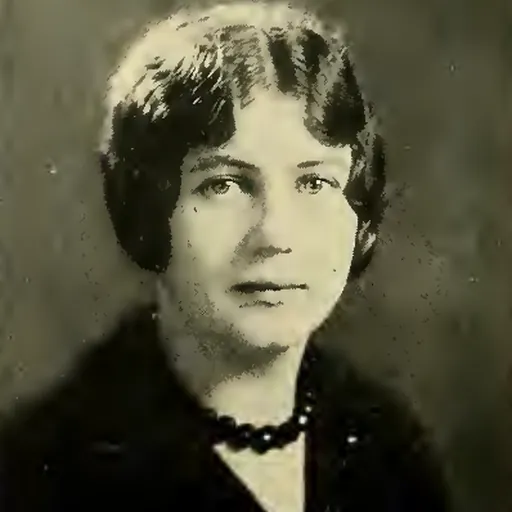
About Pauline Hald
Lived 1904 – 1998 (aged 94). Pauline Hald was a biochemist.
Pauline Merritt Hald (February 2, 1904 – December 5, 1998 ) was an American clinical chemist and medical researcher, based in New Haven, Connecticut. She worked in the laboratory of chemist John P. Peters for many years, and published the first description of his flame photometry technique for measuring serum sodium and potassium levels.
Early life and education Hald was born in New Haven, Connecticut, the daughter of Frank Xavier Hald and Josephine Merritt Hald. Her parents were immigrants; her father was born in Germany, and her mother was born in Nova Scotia. She graduated from Wellesley College in 1926.
Career Hald worked as a biochemist based in New Haven. starting in the laboratory of John P. Peters at Yale School of Medicine. She was the first person to describe Peters' flame photometry technique for measuring sodium and potassium concentrations in blood samples. She was later director of the clinical chemistry laboratory at Grace-New Haven Hospital. In 1957 she was one of the founding officers of the Connecticut section of the American Association for Clinical Chemistry.
Hald also worked at her family's moving and storage business, and volunteered for Catholic women's charities in New Haven. She was president of the New Haven Wellesley Club, and a member of the city's Soroptimist Club.
Publications From the 1930s to the 1960s, Hald's research was published in academic journals including Journal of Clinical Investigation, Journal of Biological Chemistry, American Journal of Physiology, and Methods in Medical Research. She also contributed to the textbook Standard Methods of Clinical Chemistry (1963).
"The plasma proteins in relation to blood hydration. VI. Serum proteins in nephritic edema" (1931, with John P. Peters, Frederick S. Bruckman, Anna J. Eisenman, and A. Maurice Wakeman) "The state of the inorganic components of human red blood cells" (1940, with Rebecca Z. Solomon and John P. Peters) "Factors that influence the passage of ascorbic acid from serum to cells in human blood" (1940, with Martin Heinemann) "Notes on the determination and distribution of sodium and potassium in cells and serum of normal human blood" (1946) "The flame photometer for the measurement of sodium and potassium in biological materials" (1946) "Sodium, potassium and phosphates in the cells and serum of blood in diabetic acidosis" (1947, with Thaddeus S. Danowski and John P. Peters) "Determinations with flame photometry" (1951) "Sodium and potassium by flame photometry" (1958, with W. Burkett Mason) "Free Amino Acids in Plasma and Urine by the Gasometric Ninhydrin-Carbon Dioxide Method" (1963, with Elizabeth G. Frame, Neil Y. Chiamori, and Ethel Conger)
Personal life Hald lived with her younger brother Walter for most of her life. She died in 1998, aged 94 years, in New Haven.
Don’t just read it —
keep it.
Full-length biographies made to live with: read them, listen on the way to work, watch them tonight.
- E-book
- Audio
- Video
Instant download · yours to keep · every purchase keeps this site free
Important facts
People in Pauline Hald's life
Named in this biography and alive at the same time


Related people
Same field, nearest in time




Contemporaries
People whose lives overlapped Pauline Hald's


Frequently asked questions
Who was Pauline Hald?
American biochemist
When was Pauline Hald born?
Pauline Hald was born on 2 February 1904 in New Haven, Connecticut.
When did Pauline Hald die?
Pauline Hald died on 5 December 1998.
What was Pauline Hald's occupation?
Pauline Hald was a biochemist.
Sources & further reading
Cite this page
APA: Biography.guide. (2026). Pauline Hald. https://biography.guide/pauline-hald/
MLA: "Pauline Hald." Biography.guide, https://biography.guide/pauline-hald/.
Chicago: "Pauline Hald." Biography.guide. https://biography.guide/pauline-hald/.
Data last updated: 2026-09-22 · Spot an error? Report a correction.
Portrait: Wikimedia Commons · author & licence
Page generated 2026-09-27 04:57 UTC