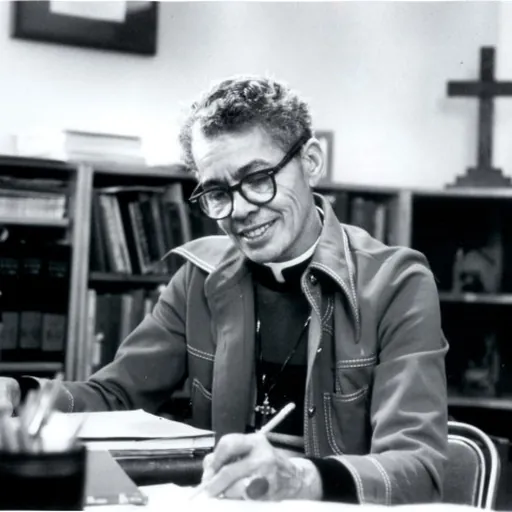
About Pauli Murray
Lived 1910 – 1985 (aged 74). Pauli Murray was an American lawyer, writer, poet, university teacher, human rights defender and priest.
1938–1945: Early activism and law school Back, l to r, Albert M. Sacks, Pauli Murray, Mary Bunting; seated, l to r, Alma Lutz and Betty Friedan
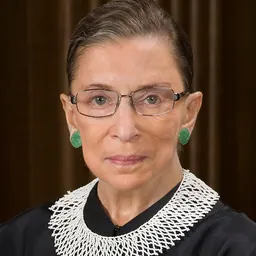
Murray applied to a PhD program in sociology at the University of North Carolina, Chapel Hill, in 1938, but was rejected because of her race. All schools and other public facilities in the state were segregated by state law, as was the case across the South. Murray was the first Black woman hired as an associate attorney at the Paul, Weiss law firm in New York City, working there from 1956 to 1960. Murray was the firm's second Black associate after Bill Coleman. She first met Ruth Bader Ginsburg at Paul, Weiss, when Ginsburg was briefly a summer associate there.
In 1961, US President John F. Kennedy appointed Murray to the Presidential Commission on the Status of Women. She prepared a memo entitled "A Proposal to Reexamine the Applicability of the Fourteenth Amendment to State Laws and Practices Which Discriminate on the Basis of Sex Per Se", which argued that the Fourteenth Amendment forbade sex discrimination as well as racial discrimination.
In 1963, she became one of the first to criticize the sexism of the civil rights movement, in her speech "The Negro Woman in the Quest for Equality". In a letter to civil rights leader A. Philip Randolph, she criticized the fact that in the 1963 March on Washington no women were invited to make one of the major speeches or to be part of its delegation of leaders who went to the White House, among other grievances. She wrote:
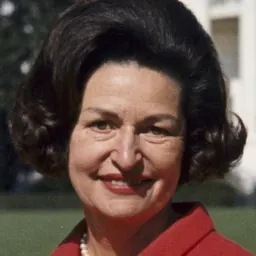
In 1964, Murray wrote an influential legal memorandum in support of the National Woman's Party's successful effort (led by Alice Paul) to add "sex" as a protected category in the Civil Rights Act of 1964. In 1965, Murray published her landmark article (coauthored by Mary Eastwood), "Jane Crow and the Law: Sex Discrimination and Title VII", in the George Washington Law Review. The article discussed Title VII of the Civil Rights Act of 1964 as it applied to women, and drew comparisons between discriminatory laws against women and Jim Crow laws. The memo was shared with every member of Congress and Lady Bird Johnson, then First Lady, who brought it to President Lyndon B. Johnson's attention.
In 1966, she was a cofounder of the National Organization for Women (NOW), which she hoped could act as an NAACP for women's rights. In March of that year, Murray wrote to Commissioner Richard Alton Graham that the Equal Employment Opportunity Commission was not fulfilling its duty in upholding the gendered portion of its mission, leaving only half the black population protected. Later in 1966, she and Dorothy Kenyon of the ACLU successfully argued White v. Crook, a case in which a three-judge court of the United States District Court for the Middle District of Alabama ruled that women have an equal right to serve on juries. When future Associate Justice Ruth Bader Ginsburg, then with the ACLU, wrote her brief for Reed v. Reed, the 1971 Supreme Court case that extended the Fourteenth Amendment's Equal Protection Clause to women for the first time, she added Murray and Kenyon as coauthors in recognition of her debt to their work.
Murray served as vice president of Benedict College from 1967 to 1968. She left Benedict to become a professor at Brandeis University. She taught at Brandeis from 1968 to 1973, receiving tenure in 1971 as a full professor in American studies and appointed as Louis Stulberg Chair in Law and Politics. In addition to teaching law, Murray introduced classes on African-American studies and women's studies, both firsts for Brandeis University. Murray later wrote that her time at Brandeis was "the most exciting, tormenting, satisfying, embattled, frustrated, and at times triumphant period of my secular career".
Priesthood Increasingly inspired by her connections with other women in the Episcopal Church, Murray, then more than sixty years old, left Brandeis to attend General Theological Seminary, where she received a Master of Divinity in 1976 with her thesis, "Black Theology and Feminist Theology: A Comparative Review", spending the final year and a half of her course at Virginia Theological Seminary. She was ordained to the diaconate in 1976 and, after three years of study, in 1977 she became the first African-American woman ordained as an Episcopal priest and was among the first generation of Episcopal women priests. That year she celebrated her first Eucharist by invitation and preached her first sermon at Chapel of the Cross. That was the first time a woman celebrated the Eucharist at an Episcopal church in North Carolina. In 1978, she preached in her home town of Durham, North Carolina, on Mother's Day at St. Philip's Episcopal Church, where her mother and grandparents had attended in the 19th century. She announced her mission of reconciliation.
In 2012, the General Convention of the Episcopal Church voted to honor Murray as one of its Holy Women, Holy Men, to be commemorated on July 1, the anniversary of her death, along with fellow writer Harriet Beecher Stowe. Bishop Michael Curry of the Diocese of North Carolina said this recognition honors "people whose lives have exemplified what it means to follow in the footsteps of Jesus and make a difference in the world."
In 2015, the National Trust for Historic Preservation designated the childhood home of Murray (on Carroll Street in Durham, North Carolina's West End neighborhood) as a National Treasure.
In April 2016, Yale University announced that it had selected Murray as the namesake of one of two new residential colleges (Pauli Murray College) to be completed in 2017; the other was to be named after Benjamin Franklin. In December 2016, the Pauli Murray Family Home was designated as a National Historic Landmark by the US Department of Interior.
In 2018, Murray was chosen by the National Women's History Project as one of its honorees for Women's History Month in the United States.
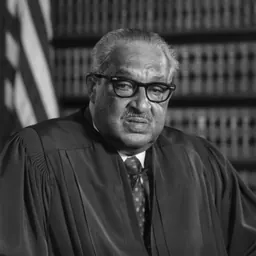
Also in 2018, Murray was made a permanent part of the Episcopal Church's calendar of saints (she is commemorated on July 1). Thurgood Marshall and Florence Li Tim-Oi were also added permanently to the calendar.
In January 2021, a biographical documentary entitled My Name Is Pauli Murray premiered at the 2021 Sundance Film Festival.
Murray was an honoree on an American Women quarter in 2024.
In 2025, many scholars and organizations have rallied to support Murray's legitimate legacy as an important, gender non-conforming historical figure, with The Episcopal Diocese of North Carolina, The Pauli Murray Center for History and Social Justice, and others publicly proclaiming the significance of Murray's voice and achievements, particularly in light of the US National Park Service (NPS) disabling (likely in February 2025) a biographical webpage on Murray, and the agency's removal of LGBTQ+ references from a site describing the Pauli Murray Family Home. Widespread censorship of LGBTQIA+ issues on US government websites—as exemplified by the NPS editing its information on Murray—apparently stems from the administration's executive order 14168.
Sexuality and gender identity Murray struggled with her sexual and gender identity through much of her life. Her marriage as a teenager ended almost immediately with the realization that "when men try to make love to me, something in me fights". Although acknowledging the term "homosexual" in describing others, Murray preferred to describe herself as having an "inverted sex instinct" that caused her to behave as a man would when attracted to women. She wanted a "monogamous married life", but one in which she was the man. The majority of her relationships were with women whom she described as "extremely feminine and heterosexual". In her younger years, Murray often was devastated by the end of these relationships, to the extent that she was hospitalized for psychiatric treatment twice, in 1937 and in 1940.
Murray wore her hair short and preferred pants to skirts; due to her slight build, there was a time in her life when she was often able to pass as a teenage boy. In her twenties, she shortened her name from Pauline to the more androgynous Pauli. At the time of her arrest for the bus segregation protest in 1940, she gave her name as "Oliver" to the arresting officers. Murray pursued hormone treatments in the 1940s to correct what she saw as a personal imbalance and even requested abdominal surgery to determine if she had "submerged" male sex organs.
Writing about Murray's understanding of her sex, Rosalind Rosenberg, author of Jane Crow: The Life of Pauli Murray, categorized Murray as a transgender man. When asked about her understanding of Murray's gender in a 2017 interview with the African American Intellectual History Society, Rosenberg states: "[During Pauli's life,] the term transgender did not exist and there was no social movement to support or help make sense of the trans experience. Murray's papers helped me to understand how her struggle with gender identity shaped her life as a civil rights pioneer, legal scholar, and feminist." In an interview with HuffPost Queer Voices, Brittney Cooper agreed on the matter: "Murray preferred androgynous dress, had a short hairstyle and may have identified as a transgender male today, but she lacked the language to do so at the time."
Relationships It has been said that Murray had just two significant romantic relationships in her life, both with white women. The first, in 1934, was brief. The second was with Irene "Renee" Barlow, an office manager at Paul, Weiss, where Murray worked as an associate attorney from 1956 to 1960. Murray's relationship with Barlow lasted nearly two decades. Barlow has been described by Murray's biographer as Pauli's "life partner", although the pair never lived in the same house and only occasionally lived in the same city. Due to Murray destroying Barlow's letters, a lot of the story is unknowable. However, while Barlow does not make an appearance in Murray's memoir, when Barlow was dying of a brain tumor, in 1973, she described Pauli as her "closest friend". In her essay, she calls upon historians and scholars to complement this growing interpretation through the use of masculine pronouns to reflect Murray's masculine perception of self. Simmons-Thorne is not the first academic to draw attention to the issue of Murray's pronouns, however. Historian Simon D. Elin Fisher has also challenged the historical and textual practices of assigning Murray female pronouns through his pronominal use of "s/he" in some of his writings. Simmons-Thorne, however, makes exclusive use of "he-him-his" pronouns in reference to Murray. She conceives of the practice as one of many "de-essentialist" trans historiographical methods capable of "interrupt[ing] the logic of biological determinism" and "the constraints of cissexism operating historically." Dark Testament has received little critical attention, and as of 2007, was out of print. It was republished in 2018, following publication of a new biography about Murray in 2017.
A follow-up volume to Proud Shoes, her memoir Song in a Weary Throat: An American Pilgrimage, was published posthumously in 1987. Song focused on Murray's own life, particularly her struggles with both gender and racial discrimination. It received the Robert F. Kennedy Book Award, the Christopher Award, and the Lillian Smith Book Award.
Works by Murray
Law
Murray, Pauli (Editor) (1952) States' Laws on Race and Color (Studies in the Legal History of the South), Athens: University of Georgia Press, Reprint edition, 2016. Murray, Pauli, and Rubin, Leslie. The Constitution and Government of Ghana, London: Sweet & Maxwell, 1964. ,
Poetry Dark Testament and Other Poems, Connecticut: Silvermine Publishers, 1970.
Sermons and speeches To Speak a Defiant Word: Sermons and Speeches on Justice and Transformation (Anthony B. Pinn, ed.; foreword by Michael Eric Dyson), New Haven: Yale University Press, 2023.
Autobiographies Proud Shoes: The Story Of An American Family, New York: Harper & Brothers, 1956. . Song in a Weary Throat: An American Pilgrimage, New York: Harper & Row, 1987. . Reissued as Pauli Murray: The Autobiography of a Black Activist, Feminist, Lawyer, Priest and Poet, University of Tennessee Press, 1989.
Don’t just read it —
keep it.
Full-length biographies made to live with: read them, listen on the way to work, watch them tonight.
- E-book
- Audio
- Video
Instant download · yours to keep · every purchase keeps this site free
Important facts
People in Pauli Murray's life
Named in this biography and alive at the same time



Related people
Same field, nearest in time



Contemporaries
People whose lives overlapped Pauli Murray's






Frequently asked questions
Who was Pauli Murray?
American writer, activist, lawyer and Episcopal priest (1910-1985)
When was Pauli Murray born?
Pauli Murray was born on 20 November 1910 in Baltimore.
When did Pauli Murray die?
Pauli Murray died on 1 July 1985 in Pittsburgh.
What was Pauli Murray's occupation?
Pauli Murray was a lawyer, writer, poet, university teacher, human rights defender and priest.
What nationality was Pauli Murray?
Pauli Murray was American.
Sources & further reading
Cite this page
APA: Biography.guide. (2026). Pauli Murray. https://biography.guide/pauli-murray/
MLA: "Pauli Murray." Biography.guide, https://biography.guide/pauli-murray/.
Chicago: "Pauli Murray." Biography.guide. https://biography.guide/pauli-murray/.
Data last updated: 2026-09-22 · Spot an error? Report a correction.
Portrait: Wikimedia Commons · author & licence
Page generated 2026-09-27 05:02 UTC