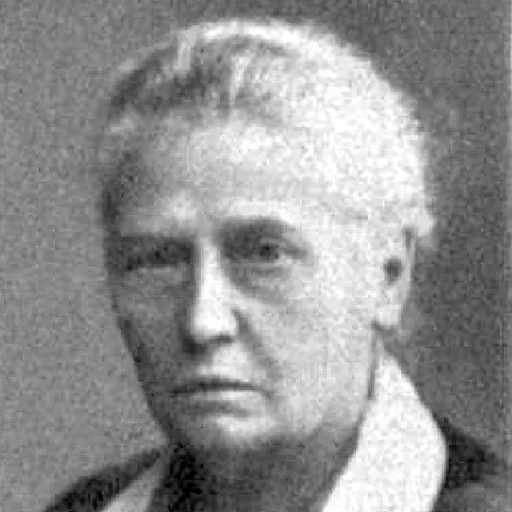
About Paula Mueller-Otfried
Lived 1865 – 1946 (aged 80). Paula Mueller-Otfried was a German politician and non-fiction writer.
Paula Müller-Otfried (born Pauline Sophie Christiane Müller; June 7, 1865 – January 8, 1946) was a German social reformer, politician, and leading figure in the Protestant women's movement. As long-time chairwoman of the German Evangelical Women's Association (DEF), she promoted Christian-based social work, women's vocational training, and moral reform. Initially an opponent of women's suffrage, she later served as a Reichstag member for the German National People's Party (DNVP) from 1920 to 1932, advocating for youth welfare and support for small pensioners. She was known for bridging conservative religious values with emerging roles for women in public life and was awarded an honorary doctorate in theology in 1930.
Early life Pauline Sophie Christiane Müller was born on June 7, 1865, in Hoya. Her father, Carl Hugo Müller (1830–1908), was a jurist who moved to Lüneburg as a senior court assessor. His wife, Emma Henriette Sophie née Bauer (1828–1891), followed with their two children. In 1869, the family moved to Hanover, where the father worked for 30 years as Second Finance Councillor in the administration, and from 1895 also as provincial director of Hanover. Pauline's grandfather was Karl Otfried Müller, founder of classical antiquities studies. The liberal professor from Göttingen maintained an open household promoting art and literature. Pauline's father continued this tradition in their Hanover home. Paula thus experienced a happy childhood in an intellectually stimulating environment. She attended the Evangelical-Lutheran Higher Girls’ School in Hanover, traveled to Greece and Italy, the world of her grandfather, and spent a year at a girls’ boarding school in Lausanne to improve her French. As a child, she came into contact with the hardships of the working class by often accompanying her mother on visits to the homes of the poor. Her father also conveyed to her the connections between economic development and the social problems of industrial society.
Social work As a child, Paula helped her mother in charitable work. From 1893, she became active in church-based poor relief and came into contact with the plight of prostitutes, which became a personal concern. Though initially hesitant about the women's movement and skeptical of its necessity, her growing engagement with the "women’s question" gradually shifted her perspective. She came to advocate for independent employment opportunities for women across social classes, seeking to improve their status within Wilhelmine society. The realization has grown that, in our time, alongside the duties of Christian charity, there remains a vast and largely untouched field of work for women in social welfare. That serious hardship exists among entire social classes and among working women. That women’s employment can no longer be prevented, but must be guided into appropriate paths. And that not only working-class women need help and support, but that the situation of educated women who must earn their own living is often one of deep desperation. In 1899, she took over the chairmanship of the Hanover local group of the German Evangelical Women's Association (DEF), which had been founded shortly before at the Evangelical Church Congress in Kassel. Beginning in 1901, Paula Müller became the first chairwoman of the German Evangelical Women's Association (DEF), prompting the organization's headquarters to move from Kassel to Hanover, where it remains currently.
In 1902, she joined a commission for recruiting and training professional female workers in the Inner Mission. The goal was to provide young women with financial security through such training and to recruit them as suitable personnel for church-based social work. Fields of activity included youth welfare, orphanages, management of girls' homes, city missions, and rescue work. From 1904 to 1932, she was editor of the Evangelical Women’s Newspaper (Evangelische Frauenzeitung). Together with Adelheid von Bennigsen, she founded the Christian-Social Women's Seminary for women and girls of educated classes in Hanover in 1905, which was later renamed Protestant University of Applied Sciences Hanover (Evangelische Fachhochschule Hannover) as part of higher education reform. Since 2007, the school has been integrated into the University of Applied Sciences Hannover.
In 1908, she published a handbook on the women's question and the pamphlet The "New Ethics" and Its Danger. In 1911, Paula Mueller co-founded the Association of Conservative Women (VKF). In 1921, she supported Protestant welfare workers in founding their own independent professional association, the Association of Protestant Welfare Workers of Germany (VEW), and participated in the first German Evangelical Church Congress in Dresden in 1919. That same year, she ran for the Weimar National Assembly. To distinguish herself from others with the same surname, she adopted the name Müller-Otfried, honoring her grandfather, the classical scholar Karl Otfried Müller, and was elected to the Reichstag in 1920 as a candidate for the conservative German National People's Party (DNVP). She was re-elected twice and served until 1932. In 1930, she was awarded an honorary doctorate in theology from the University of Göttingen in recognition of her contributions and life's work, a very rare honor for a woman at the time. She withdrew from public life and died in Einbeck on 8 January 1946.
Don’t just read it —
keep it.
Full-length biographies made to live with: read them, listen on the way to work, watch them tonight.
- E-book
- Audio
- Video
Instant download · yours to keep · every purchase keeps this site free
Important facts
People in Paula Mueller-Otfried's life
Named in this biography and alive at the same time

Related people
Same field, nearest in time




Contemporaries
People whose lives overlapped Paula Mueller-Otfried's




Frequently asked questions
Who was Paula Mueller-Otfried?
German politician (1865-1946)
When was Paula Mueller-Otfried born?
Paula Mueller-Otfried was born on 7 June 1865 in Hoya.
When did Paula Mueller-Otfried die?
Paula Mueller-Otfried died on 8 January 1946 in Einbeck.
What was Paula Mueller-Otfried's occupation?
Paula Mueller-Otfried was a politician and non-fiction writer.
What nationality was Paula Mueller-Otfried?
Paula Mueller-Otfried was German.
Sources & further reading
· Wikipedia: Paula Mueller-Otfried
· DBpedia: Paula Müller-Otfried
Cite this page
APA: Biography.guide. (2026). Paula Mueller-Otfried. https://biography.guide/paula-mueller-otfried/
MLA: "Paula Mueller-Otfried." Biography.guide, https://biography.guide/paula-mueller-otfried/.
Chicago: "Paula Mueller-Otfried." Biography.guide. https://biography.guide/paula-mueller-otfried/.
Data last updated: 2026-09-23 · Spot an error? Report a correction.
Portrait: Wikimedia Commons · author & licence
Page generated 2026-09-27 05:06 UTC