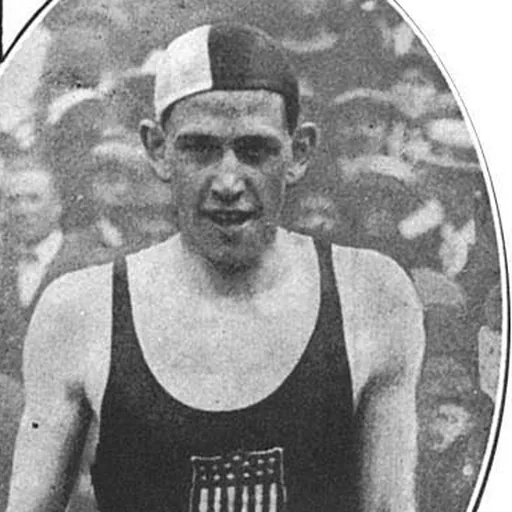
About Paul Wyatt
Lived 1907 – 1970 (aged 63). Paul Wyatt was an American swimmer.
Paul Henry Wyatt (February 27, 1907 – December 15, 1970) was an American competition swimmer for Pennsylvania's Uniontown YMCA and a two-time Olympic medalist, representing the United States in the 100-meter backstroke at both the 1924 Paris and 1928 Amsterdam Olympics. After ending his swimming career around 1928, he worked twenty-three years as an X-Ray and lab technician primarily at Brownsville Hospital in Southwestern Pennsylvania quite near where he grew up. After 1954, he worked as a biochemist and lab technician at a hospital in Ely, Nevada and beginning around 1956 set up his own lab in Carson City and Zephry Cove, Nevada, before returning to the Brownsville area around 1963. According to local legend, Paul Wyatt introduced himself to his sport at the age of eight when he first swam in a creek in nearby Perryopolis, Pennsylvania, and like many young men of his era later swam in the Monongahela River, adjacent to Brownsville.
By 15, as a Uniontown resident, he began training and competing in earnest for the Uniontown YMCA. In an interview in 1960, Wyatt claimed Fred L. Brothers, former local D.A. of Fayette County, where he grew up, taught him the backstroke. He was also assisted in his stroke development by Dr. Herman Heise, of Uniontown Hospital, a former college swimmer and YMCA coach who recognized Wyatt's potential. In important early competition in 1923, he had his first major victory in Pennsylvania's Johnstown at the Junior Nationals, capturing a third place in the backstroke. In 1924 he won the Junior National championship for the backstroke in Atlantic City, New Jersey.
Wyatt qualified in backstroke again at the 1928 U.S. swimming trials in Detroit. At the 1928 Amsterdam Olympics, with the U.S. Men's team again managed by Hall of Fame Coach Bill Bachrach, Wyatt won a bronze medal in the 100-meter backstroke with a time of 1:12.0 for his third-place finish. The Americans swept the event finals with George Kojac winning the gold with a time of 1:08.2, and Walter Laufer capturing the silver with a time of 1:10.0.
Wyatt spoke at the Sports Banquet of his accomplished club, the Uniontown YMCA on April 8, 1954.
Paul and Juanita lived much of their married life in Coal Center, Pennsylvania, just five miles North of Brownsville, Pennsylvania, where they both worked.
Work as medical tech in Nevada In 1954, Wyatt relocated to Nevada and took up lab work at the hospital at Ely in East Central Nevada, working there a little over a year. He then set up his own lab at Nevada's capital, Carson City around 1956, later moving the lab to Zephry Cove. As a biochemist working with his own lab in Nevada, in addition to his knowledge of X-ray technology, he did a broader range of biomedical lab work for the State of Nevada, and served on the Board of the National Safety Council's Drugs and Alcohol Committee. His work with the Drugs and Alcohol Committee included analyzing intoxication testing to help enact legislation to reduce highway accidents caused by intoxicated drivers. Working with the National Safety Council, he also compiled Nevada accident records to determine the relationship of drinking to the cause of the accidents, and sought mandatory testing for drivers suspected of driving while drinking. While in Carson City in 1957, Wyatt helped arrange a course and program in parasitology as part of his role as Committee Chairman for the Nevada Association of Medical Technicians.
Wyatt's wife Juanita followed him to Nevada, working first as a supervisor at Steptoe Valley Hospital in Ely from 1955-56, then serving as a supervisor two years at Tahoe Hospital, in Carson City, Nevada, before leaving in 1958. From 1958-1961, she worked in Doctor T.V. Ross office in Gardenerville, Nevada. Returning to the Brownsville area around 1963, she served from 1966-76 as a coordinator for the Vocational Technical Practical Nursing Program for Fayette County before retiring. Paul and his wife Juanita returned to the Brownsville area in 1963. He was survived by his wife, Edith Knuth Wyatt, a son Thomas of Nevada's Carson City, a brother Frank, and grandchildren. Memorial services were held at St. Thomas Aquinus Church on 409 Union Street in nearby California, Pennsylvania very close to where the Wyatts had resided. Paul Wyatt was buried at the Lafayette Memorial Park near Brownsville, as would be his wife Juanita in 2001.
Honors Riverfront Park, adjacent to the Monongahela River, in Pennsylvania's California Borough, very near where Paul and Juanita Wyatt lived for many years, was renamed the Paul H. Wyatt Riverfront Park in Paul Wyatt's honor in 1984. As noted earlier, Paul Wyatt spent much of his life in Brownsville, and swam as a youngster in the adjacent Monongahela River.
Don’t just read it —
keep it.
Full-length biographies made to live with: read them, listen on the way to work, watch them tonight.
- E-book
- Audio
- Video
Instant download · yours to keep · every purchase keeps this site free
Important facts
People in Paul Wyatt's life
Named in this biography and alive at the same time


Related people
Same field, nearest in time



Contemporaries
People whose lives overlapped Paul Wyatt's



Frequently asked questions
Who was Paul Wyatt?
American swimmer, Olympic silver medalist (1907-1970)
When was Paul Wyatt born?
Paul Wyatt was born on 27 February 1907 in Brier Hill.
When did Paul Wyatt die?
Paul Wyatt died on 15 December 1970 in Brownsville.
What was Paul Wyatt's occupation?
Paul Wyatt was a swimmer.
What nationality was Paul Wyatt?
Paul Wyatt was American.
Sources & further reading
Cite this page
APA: Biography.guide. (2026). Paul Wyatt. https://biography.guide/paul-wyatt/
MLA: "Paul Wyatt." Biography.guide, https://biography.guide/paul-wyatt/.
Chicago: "Paul Wyatt." Biography.guide. https://biography.guide/paul-wyatt/.
Data last updated: 2026-09-22 · Spot an error? Report a correction.
Portrait: Wikimedia Commons · author & licence
Page generated 2026-09-27 05:01 UTC