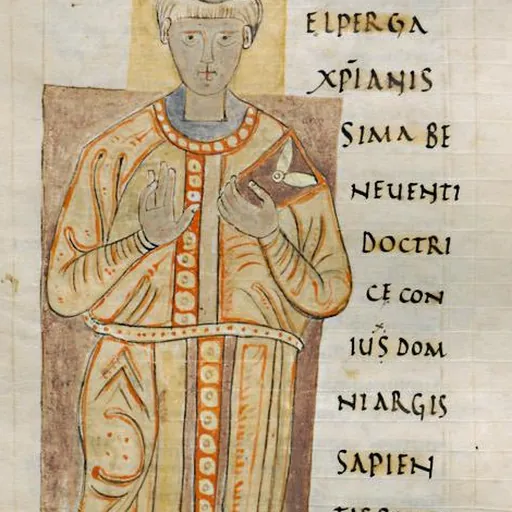
About Paul the Deacon
Lived 720 – 799 (aged 78–79). Paul the Deacon was a historian, poet, christian monk, writer, monk and cleric.
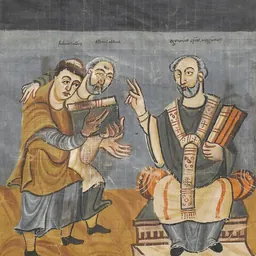
Paul the Deacon ( 720s 13 April in 796, 797, 798, or 799 AD), also known as Paulus Diaconus, Warnefridus, Barnefridus, or Winfridus, and sometimes suffixed Cassinensis ("of Casīnum", the citadel of which was present day Monte Cassino), was a Benedictine monk, scribe, and historian of the Lombards.
Life An ancestor of Paulus's named Leupichis emigrated to Italy in 568 in the train of Alboin, King of the Lombards. There, he was granted lands at or near Forum Julii (Cividale del Friuli). During an invasion by the Avars, Leupichis's five sons were carried away to Pannonia, but one of them, his namesake, returned to Italy and restored the ruined fortunes of his house. The grandson of the younger Leupichis was Warnefrid, who by his wife Theodelinda became the father of Paul. Paulus was his monastic name; he was born Winfrid, son of Warnefrid, about 720 in the Duchy of Friuli.
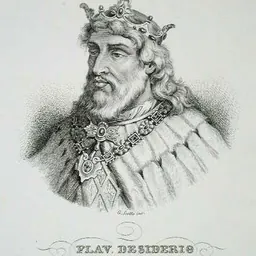
Thanks to the possible noble status of his family, Paul received an exceptionally good education, probably at the court of the Lombard king Ratchis in Pavia, learning the rudiments of Greek from a teacher named Flavian. Paul was probably the secretary of the Lombard king Desiderius, a successor of Ratchis. After Desiderius's daughter Adelperga had married Arichis II, duke of Benevento, Paul, at her request, wrote his continuation of Eutropius's Summary of Roman History (Latin: ).
He lived at the court of Benevento for at least several years before 774, when Charlemagne captured Pavia, and he may have fled the city during that conquest. Eventually he entered a monastery on Lake Como, and before 782 he entered the great Benedictine house of Monte Cassino, where he made the acquaintance of Charlemagne. Around 776, Paul's brother Arichis was carried off to Francia as a prisoner after a revolt in Friuli. When Charlemagne visited Rome five years later, Paul wrote to him on behalf of Arichis, who was then freed.
After Paul's literary achievements had drawn the attention of Charlemagne, he became an important contributor to the Carolingian Renaissance. In 787 he returned to Monte Cassino, where he died on 13 April probably in the year 799.
At the request of Angilram, Bishop of Metz (d. 791), Paul wrote a history of the bishops of Metz to 766, the first work of its kind north of the Alps. This was translated into English in 2013 as Liber de episcopis Mettensibus. He also wrote many letters, verses, and epitaphs, including those of Duke/Prince Arichis II of Benevento and of many members of the Carolingian family. Some of these letters were published with the Historia Langobardorum in the Monumenta; poems and epitaphs edited by Ernst Dümmler were published in the Poetae latini aevi carolini, Band i. (Berlin, 1881). Fresher material having come to light, a newer edition of the poems (Die Gedichte des Paulus Diaconus) was edited by Karl Neff (Munich, 1908). Neff denied, however, that Paul had written the most famous poem in the collection, the hymn to St. John the Baptist , which Guido of Arezzo set to a melody that had previously been used for Horace's Ode 4.11. From the initial syllables of the first verses of the resultant setting, Guido then took the names of the first notes of the musical scale. Paul also wrote an epitome, which has survived, of Sextus Pompeius Festus's De verborum significatu, which he dedicated to Charlemagne.
While Paul was in Francia, Charlemagne asked him to compile a collection of homilies. Paul granted this request after returning to Monte Cassino; the compilation was largely used in the Frankish churches. Paul also composed two important homilies In Assumptione, in the second of which, unlike Ambrose Autpert, he admits the possibility of Mary's bodily assumption into heaven.
A life of Pope Gregory the Great has also been attributed to Paul, and he is credited with a Latin translation of the Greek Life of Saint Mary the Egyptian.
Don’t just read it —
keep it.
Full-length biographies made to live with: read them, listen on the way to work, watch them tonight.
- E-book
- Audio
- Video
Instant download · yours to keep · every purchase keeps this site free
Important facts
People in Paul the Deacon's life
Named in this biography and alive at the same time

Related people
Same field, nearest in time




Contemporaries
People whose lives overlapped Paul the Deacon's

Frequently asked questions
Who was Paul the Deacon?
8th century Benedictine monk, scribe and historian
When was Paul the Deacon born?
Paul the Deacon was born in 720 in Cividale del Friuli.
When did Paul the Deacon die?
Paul the Deacon died in 799 in Abbey of Monte Cassino.
What was Paul the Deacon's occupation?
Paul the Deacon was a historian, poet, christian monk, writer, monk and cleric.
What nationality was Paul the Deacon?
Paul the Deacon's recorded nationality: Kingdom of the Lombards.
Sources & further reading
Cite this page
APA: Biography.guide. (2026). Paul the Deacon. https://biography.guide/paul-the-deacon/
MLA: "Paul the Deacon." Biography.guide, https://biography.guide/paul-the-deacon/.
Chicago: "Paul the Deacon." Biography.guide. https://biography.guide/paul-the-deacon/.
Data last updated: 2026-09-21 · Spot an error? Report a correction.
Portrait: Wikimedia Commons · author & licence
Page generated 2026-09-27 05:01 UTC