
About Paul Nietsche
Lived 1885 – 1950 (aged 65). Paul Nietsche was a German painter.
Paul Nietsche (17 June 1885 – 4 October 1950) was a Ukrainian artist and teacher who emigrated to Ulster in 1936 where he became a central figure on the Belfast artistic and literary scenes between the 1930s and his death in 1950.
Early life Paul Felix Franz Nietsche was born to German parents in Kiev in Ukraine on 17 June 1885. At the age of six his family moved to Odessa where his father established a lithographic printing firm.
Nietsche studied art at the Imperial Academy of Fine Arts in Odessa In 1908 he enrolled at the Academy of Fine Arts in Berlin. Nietsche then moved to Paris where he befriended the sculptor Auguste Rodin and showed at the Salon of 1912. Nietsche returned to Odessa in 1914 where he remained until the end of World War I, when he relocated to Berlin to be with his family. In August 1919 Nietsche showed at the Der Sturm Gallery alongside Maria Uhden and Paul Busch.
Life and works Whilst living in Berlin Nietsche befriended a post-graduate student and later a lecturer in English at the University of Leipzig, the Dubliner Michael O'Brien. When O'Brien moved to Queens University Belfast as a lecturer in Celtic Studies in 1926, Nietsche was invited to visit Belfast where he was to show five paintings with the Ulster Arts Club in the same year. In the year that he settled in Northern Ireland Nietsche exhibited at the Brook Street Art Galleries in London in 1934, with a further one man show at Dublin's United Arts Club in June of that year. Two years later he held a show at the Magee Gallery in Belfast. and afterwards returned to work in Devon and Cornwall before his onward journey to Belfast. At the invitation of Major R G Heyn, Nietsche's work debuted in Canada in 1936, with an exhibition at the Continental Galleries of Fine Art in Montreal. The show comprised 28 works including landscapes, still-life, flowers and a few self-portraits. Several of the landscapes were local scenes of Georgeville and Lake Memphremagog. Nietsche showed with John Hunter and George MacCann at Belfast's Magee Gallery in 1938, with a further solo display at the same venue in 1939.
During World War II Nietsche was interned on the Isle of Man "with chess-playing intellectuals",
Art collector and patron Zoltan Lewinter-Frankl opened an exhibition of Nietsche's flower paintings at Tyrone House on Belfast's Ormeau Avenue in 1945. The exhibition was arranged under the auspices of the Council For the Encouragement of Music and Art with thirty works loaned from local patrons. In 1946 the Council for the Encouragement of Music and Art purchased a painting by Nietsche, in addition to works by other contemporary Ulster artists. Twenty-four of the works from the CEMA collection, including Nietsche's painting, were later presented at their Donegall Place gallery in 1954.
Nietsche showed at the CEMA Gallery in Belfast in 1947, 1948, and in 1949. The latter comprised 21 paintings and was opened by his good friend, the Lisburn writer Barbara Hunter, whom along with H E Broderick, had contributed a foreword to the 1947 exhibition. The 1949 exhibition included portraits of the stage actors Robert H McCandless, and James G Devlin and the catalogue contained a foreword by the Odd Man Out writer, FL Green. The artist also wrote poetry and short stories. He was fluent in Russian, French, German and English. play and in 1949 he contributed one poem, A Vision, to the shortlived Ulster poetry journal Rann established by his old friend Barbara Hunter and Roy McFadden in the previous year. His students included Jean Osborne, and Markey Robinson whom he took under his wing, teaching him technique and introducing Robinson to the influential art collector Zoltan Lewinter-Frankl.
The actor Jack Loudan described Nietsche's charitable nature in 1972, in repairing broken dolls, cars and trucks, which he would later distribute to underprivileged children around Castlewellan, County Down. Nietsche's eccentric nature was often cited, and indeed Loudan refers to the alarm experienced by visitors to Nietsche's Dublin Road studio where he fed and entertained with a mouse that had taken up residence there. Nietsche's portrait of Loudan can be viewed in the collection of the National Museums of Northern Ireland. Nietsche's eccentricities extended to his studio where the poet Roy McFadden says he "flaunted a huge ceramic penis on the wall". His home and studio were open house to visitors from members of Belfasts artistic and theatrical world, whom Nietsche would entertain with coffee and conversation whilst he continued working. He rose late in the day and worked long into the night, often retiring just before sunrise. He spent some time in Belfast City Hospital in June 1948 and later convalesced at the Crawfordsburn Inn as a guest of a friend. He never fully recovered from this illness and suffered from ill-health until his death. Dr Sarah Finlay, writing of his work in the National Self-Portrait Collection of Ireland, described his working methods,"He worked slowly, taking up to fifteen or more sittings of one or two hours to complete each portrait. Landscapes, still lifes and flower studies make up the rest of his subject-matter. His landscapes tend to be dark, his still lifes and flower paintings more colourful. His style is loose and his line assured. The emphasis on form, in the still lifes in particular indicates the influence of Cézanne, whose work he saw and admired when living in Paris between 1912 and 1914."
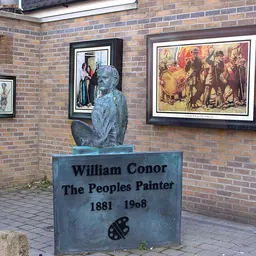
A short funeral service was held at All Souls Church on Elmwood Avenue, before his remains were interred at Belfast City Cemetery. Amongst the mourners were Zoltan and Anny Frankl, Jack Loudan of CEMA, Professor J L Montrose of Queen's University, and Joseph Tomelty and R H McCandless of the Group Theatre. Amongst the artists present were William Conor, William R Gordon, Fred Hull, Herbert E Broderick, John Lyness and William Minshull.
His friends organised a memorial exhibition of his works in the Ulster Farmers' Union Hall in Belfast in 1952 for which Nietsche's brother Eugene made his first visit to Belfast. Jack Loudan opened the exhibition and expressed his desire to see Nietsche commanding his own section in the Belfast Museum and Art Gallery. the Arts Council of Northern Ireland and the National Self-Portrait Collection of Ireland.
Don’t just read it —
keep it.
Full-length biographies made to live with: read them, listen on the way to work, watch them tonight.
- E-book
- Audio
- Video
Instant download · yours to keep · every purchase keeps this site free
Important facts
People in Paul Nietsche's life
Named in this biography and alive at the same time






Related people
Same field, nearest in time

Contemporaries
People whose lives overlapped Paul Nietsche's



Frequently asked questions
Who was Paul Nietsche?
German painter (1885-1950)
When was Paul Nietsche born?
Paul Nietsche was born on 17 June 1885 in Kyiv.
When did Paul Nietsche die?
Paul Nietsche died on 4 October 1950.
What was Paul Nietsche's occupation?
Paul Nietsche was a painter.
What nationality was Paul Nietsche?
Paul Nietsche was German.
Sources & further reading
Cite this page
APA: Biography.guide. (2026). Paul Nietsche. https://biography.guide/paul-nietsche/
MLA: "Paul Nietsche." Biography.guide, https://biography.guide/paul-nietsche/.
Chicago: "Paul Nietsche." Biography.guide. https://biography.guide/paul-nietsche/.
Data last updated: 2026-09-20 · Spot an error? Report a correction.
Page generated 2026-09-27 05:24 UTC