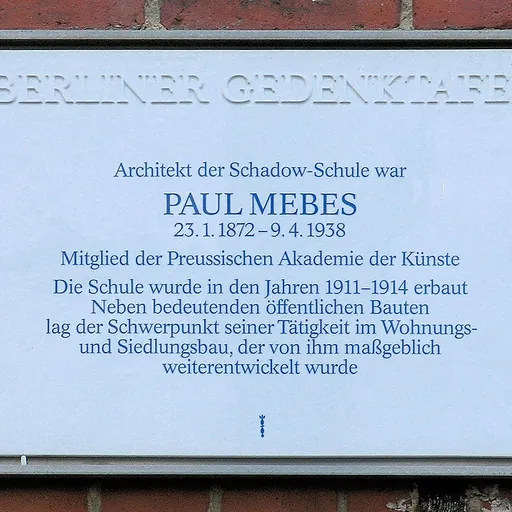
About Paul Mebes
Lived 1872 – 1938 (aged 66). Paul Mebes was an architect and government architect.
Paul Louis Adolf Mebes (23 January 1872 – 9 April 1938) was a German architect, architectural theorist and university professor.
Life
Paul Mebes was born on 23 January 1872 in Magdeburg. He completed practical training as a carpenter and then studied at the Technische Hochschulen in Braunschweig and Charlottenburg. After graduating he worked as a government architect (assessor) in the public works department.
By 1906 (according to some sources as early as 1902) Mebes was working for the Berlin Civil Servants Dwelling Association. From 1909 to 1919, he served as a part-time member of its technical board. From 1911, he and Paul Emmerich ran the architectural firm of "Mebes and Emmerich", which was devoted mainly to the Dwelling Association's buildings. The firm also created designs for other buildings, including schools and administrative buildings. On 19 November 1920 he was awarded an honorary doctorate by the Technische Hochschulen Braunschweig. In 1931 Mebes became a member of the Prussian Academy of Arts. He resigned this membership on 15 May 1933.
Mebes died on 9 April 1938 in Berlin. His memorial grave is located in the Städtischer Friedhof Berlin-Zehlendorf. The "Paul Mebes Park" on Potsdamer Strasse at the corner of Fischer-Dieskau-way in Zehlendorf, Berlin was named in his honor.
Style Former commerce building of the Iduna insurance company at Charlottenstraße No. 82 in Berlin-Kreuzberg. It was built in 1913 to a design by Paul Mebes. The building has been designated as a cultural heritage monument. Mebes' designs were innovative and won him recognition in Europe. He was one of the pioneers of housing estates before the First World War. His apartment building designs for the Berlin Civil Servants Dwelling Association and the Kroch village in Leipzig were particularly notable.
The activity of Mebes can be divided into three periods: the early phase (1909–1918), an expressive phase (1918–1924) and the substantive phase that continued until his death (1925–1938). The early phase was characterized by work within the traditional architecture of Berlin's early days, with elaborate stucco facades and indiscriminate eclecticism. Here, Mebes worked entirely within existing styles: particularly often using classical details, but various forms of North German or Baroque Dutch details, and even early Gothic forms, occur.
In the expressive phase, residential buildings were created with expressive, but sparingly used elements, such as contrasting colors of alternating brick and plaster, jagged protruding stairways and pointed windows. From the second half of the 1920s he created buildings in a classical modernism style. Mebes was less concerned about the details than before, but still designed aesthetically coherent works. He continued to emphasize color effects. He made carefully considered floor plans, with bright and well ventilated apartments.
Buildings
1906–1907: housing development at Planufer in Berlin-Kreuzberg 1906–1907: Residential Development in Berlin-Schöneberg, just north of the Rudolph Wilde Square (now John F. Kennedy Platz ) 1907–1908: Condominium Steglitz II Fritschweg / Grillparzerstraße / Rückertstraße, officials Dwellings Association, Berlin 1907–1910: Condominium Charlottenburg IIa and b, Horstweg / Danckelmannstraße / Wundtstraße / Vereinsweg, officials Dwellings Association, Berlin 1908–1909: Residential Development in Berlin Niederschönhausen, Grabbeallee / Paul Franke Road, officials Dwellings Association, Berlin 1909–1910: houses for the housing association officials in Berlin-Zehlendorf, Clayallee 289–303 1909-1914/1921-1923: development "Reichshof" (now the "family farm") for the apartment association officials to Bochum in Bochum Grumme: 210 residential units in four stages along the streets Herder avenue Wielandstraße, family farm and at the family farm 1910–1912: Garden City Zehlendorf in Berlin-Zehlendorf, 1st Phase: elf house groups along the Camphausen, Dallwitz, Berlepsch and Thürstraße, and in Stieg Rother 1912: Villa Fahrenholtz, Jean-Burger-Straße 2 in Magdeburg district Leipziger Straße 1913–1929: so-called " brass housing settlement "with water tower in Finow 1914: Schadow Gymnasium in Berlin-Zehlendorf 1918–1922: Condominium "Rechener Busch" in Bochum Wiemelhausen, Else-deer-road 13–21, 18–20, 32–40, Ottilie Schoenewald-road 16–24, 21–27, Dr. David Moritz -Straße 1–3 1919–1921: Garden City Zehlendorf 2nd, Phase: eleven groups along the house-door, and Dallwitz Radtkestraße 1921–1923: Garden City Zehlendorf 3rd, Phase: 108 apartments between Schrock, Berlepsch and Camp Street house 1921–1927: Housing in Bochum Wiemelhausen, Grolmannstraße 4–14, 11–17, Kampmann street 4–22, 17–23, 1–13 Mulderpaßstraße, Brinkmann Straße 5–9, Friedrich-Strasse 21 Harkort 1923: Semi-detached house in Bochum Wiemelhausen, Ostermann Straße 5–7 1923–1925: development "On Heidehof" in Berlin-Schlachtensee 1924–1926: Residential Building "Werra block" in Berlin-Neukölln 1925–1930: Residential Development in Berlin-Pankow 1926: houses in Bochum-Hamme, Overdycker 8–10 1926–1927: Housing Development Lincoln, Zachert, Bietzke, Eggersdorfer and Einbecker street in Berlin-Friedrichsfelde 1926–1927: houses in Bochum Wiemelhausen, Königsallee 160–164, 36 units 1926–1929: Housing in Bochum Grumme, Heckertstraße 108–110, Starenweg 7–9 1926–1929: Housing in Bochum Wiemelhausen, Danziger Strasse 1–11, 2–14, Thorner Road 20–28, Druze mountain road 138, 130 apartments 1927: Group of houses in the village bear, Bochum-Weitmar, Graff ring 39–49 1927–1928: residential development in central Berlin, Oslo Road 94–98 1926–1928: residential development of the SPD in Berlin-Schöneberg, Rubens / Otzen / Traeger / Eisackstraße 1928–1930: Mountain School in Apolda 1929–1930: Housing in Bochum Grumme, Alexandrinenstraße 6–24, 18–25 Teylestraße 1930–1932: residential development, called " Kroch settlement ", in Gohlis (Leipzig) 1930–1934: "fire-and smoke-free settlement" in Berlin-Steglitz, Steglitz dam 1932–1934: residential development, so-called "Flußpferdhof" in Berlin-Alt-Hohenschoenhausen, Große-Leege Road 60–82 1934–1935: Administration Building Feuersozietät the Province of Brandenburg in Berlin-Tiergarten, at Carlsbad
Gallery
Don’t just read it —
keep it.
Full-length biographies made to live with: read them, listen on the way to work, watch them tonight.
- E-book
- Audio
- Video
Instant download · yours to keep · every purchase keeps this site free
Important facts
People in Paul Mebes's life
Named in this biography and alive at the same time


Related people
Same field, nearest in time



Contemporaries
People whose lives overlapped Paul Mebes's





Frequently asked questions
Who was Paul Mebes?
German architect (1872-1938)
When was Paul Mebes born?
Paul Mebes was born on 23 January 1872 in Magdeburg.
When did Paul Mebes die?
Paul Mebes died on 9 April 1938 in Berlin.
What was Paul Mebes's occupation?
Paul Mebes was an architect and government architect.
What nationality was Paul Mebes?
Paul Mebes's recorded nationality: German Reich.
Sources & further reading
Cite this page
APA: Biography.guide. (2026). Paul Mebes. https://biography.guide/paul-mebes/
MLA: "Paul Mebes." Biography.guide, https://biography.guide/paul-mebes/.
Chicago: "Paul Mebes." Biography.guide. https://biography.guide/paul-mebes/.
Data last updated: 2026-09-22 · Spot an error? Report a correction.
Portrait: Wikimedia Commons · author & licence
Page generated 2026-09-27 05:03 UTC