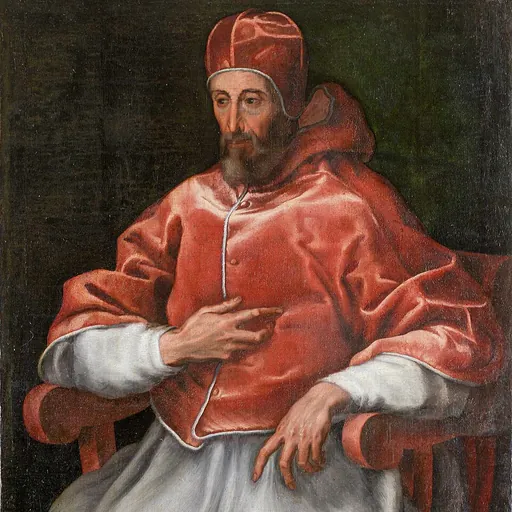
About Paul IV
Lived 1476 – 1559 (aged 83). Paul IV was a catholic priest, diplomat and catholic bishop.
Pope Paul IV (; ; 28 June 1476 – 18 August 1559), born Gian Pietro Carafa, was head of the Catholic Church and leader of the Papal States from 23 May 1555 to his death, in August 1559. While serving as papal nuncio in Spain, he developed an anti-Spanish outlook that later coloured his papacy. In response to an invasion of part of the Papal States by Spain during his papacy, he called for a French military intervention. After a defeat of the French and with Spanish troops at the edge of Rome, the Papacy and Spain reached a compromise: French and Spanish forces left the Papal States and the Pope thereafter adopted a neutral stance between France and Spain.
Carafa was appointed bishop of Chieti, but resigned in 1524 in order to found with Saint Cajetan the Congregation of Clerics Regular (Theatines). Recalled to Rome, and made Archbishop of Naples, he worked to re-organise the Inquisitorial system in response to the emerging Protestant movement in Europe, any dialogue with which he opposed (the inquisition itself had been first instituted by Pope Innocent III who first regulated inquisitional procedure in the 13th century). Carafa was elected pope in 1555 through the influence of Cardinal Alessandro Farnese in the face of opposition from Charles V, Holy Roman Emperor.
His papacy was characterised by strong nationalism in reaction to the influence of Philip II of Spain and the Habsburgs. The appointment of Carlo Carafa as Cardinal Nephew damaged the papacy further, and scandals forced Paul to remove him from office. He curbed some clerical abuses in Rome, but his methods were seen as harsh. He would introduce the first modern Index Librorum Prohibitorum or "Index of Prohibited Books" banning works he saw as in error. In spite of his advanced age, he was a tireless worker and issued new decrees and regulations daily, unrelenting in his determination to keep Protestants and recently immigrated Marranos from gaining influence in the Papal States. Paul IV issued the Papal bull Cum nimis absurdum, which confined Jews in Rome to the neighbourhood claustro degli Ebrei ("enclosure of the Hebrews"), later known as the Roman Ghetto. He died highly unpopular, to the point that his family rushed his burial to make sure his body would not be desecrated by a popular uprising.
Early life Gian Pietro Carafa was born in Capriglia Irpina, near Avellino, into the prominent Carafa family of Naples.
Church career
Bishop He was mentored by Cardinal Oliviero Carafa, his relative, who resigned the see of Chieti (Latin Theate) in his favour. Under the direction of Pope Leo X, he was ambassador to England and then papal nuncio in Spain, where he conceived a violent detestation of Spanish rule that affected the policies of his later papacy.
The Regensburg Colloquy in 1541 failed to achieve any measure of reconciliation between Catholics and Protestants in Europe, but instead saw a number of prominent Italians defect to the Protestant camp. In response, Carafa was able to persuade Pope Paul III to set up a Roman Inquisition, modelled on the Spanish Inquisition with himself as one of the Inquisitors-General. The Papal Bull was promulgated in 1542. Carafa demanded the surveillance of education, ordered the confiscation of many authors, such as Erasmus, and inspired the warning of the Inquisition against printed books containing perceived threats against the Christianity. In this regard, he headed the commission that investigated the Bragadin-Giustiniani dispute and that recommended the burning of the Talmud in 1553.
Election as pope
He was a surprise choice as pope to succeed Pope Marcellus II (1555); his severe and unbending character combined with his advanced age and Italian patriotism meant under normal circumstances he would have declined the honor. He accepted apparently because Emperor Charles V was opposed to his accession.
Paul IV was violently opposed to the liberal Cardinal Giovanni Morone, whom he strongly suspected of being a hidden Protestant, so much that he had him imprisoned. In order to prevent Morone from succeeding him and imposing what he believed to be his Protestant beliefs on the Church, Pope Paul IV codified the Catholic Law excluding heretics and non-Catholics from receiving or legitimately becoming pope, in the bull Cum ex apostolatus officio.
Paul IV was rigidly orthodox, austere in life, and authoritarian in manner. He affirmed the Catholic doctrine of extra ecclesiam nulla salus ('outside the Church there is no salvation'), and used the Holy Office to suppress the Spirituali, a Catholic group deemed heretical. The strengthening of the Inquisition continued under Paul IV, and few could consider themselves safe by virtue of position in his drive to reform the Church; even cardinals he disliked could be imprisoned. He appointed inquisitor Michele Ghislieri, the future Pope Pius V, to the position of Supreme Inquisitor despite the fact as Inquisitor of Como, Ghislieri's persecutions had inspired a citywide rebellion, forcing him to flee in fear for his life. As such, in the Papal States, especially in the seaport of Ancona, Marranos had thrived under benevolent popes Clement VII (1523–34), Paul III (1534–49), and Julius III (1550–55). These had even received a guarantee that if accused of apostasy they would be subject only to papal authority. Convinced that the papal policy of kindness had been abused by the Jews and not resulted in enough conversions, he enacted harsh restrictions and ended all dispensations to the Jews in the papal state, with the aim of encouraging the Jews to convert. All secular offices, from the highest to the lowest, were assigned to others based on merit. Important economies were made, and taxes were proportionately remitted. Paul IV established a chest, of which only he held the key, for the purpose of receiving all complaints that anyone desired to make.
During his papacy, censorship reached new heights. Among his first acts as pope was to cut off Michelangelo's pension, and he ordered the nudes of The Last Judgment in the Sistine Chapel be painted more modestly (a request that Michelangelo ignored) (the beginning of the Vatican's Fig leaf campaign). Paul IV also introduced the Index Librorum Prohibitorum or "Index of Prohibited Books" to Venice, then an independent and prosperous trading state, in order to crack down on the growing threat of Protestantism. Under his authority, all books written by Protestants were banned, together with Italian and German translations of the Latin Bible.
Exterior policy Paul IV was displeased at the French signing a five-year truce with Spain in February 1556 (in the midst of the Italian War of 1551–1559) and urged King Henry II of France to join the Papal States in an invasion of Spanish Naples. On 1 September 1556, King Philip II responded by preemptively invading the Papal States with 12,000 men under the Duke of Alba. French forces approaching from the north were defeated and forced to withdraw at Civitella del Tronto in August 1557. The Papal armies were left exposed and were defeated, with Spanish troops arriving at the edge of Rome. Out of fear of another sack of Rome, Paul IV agreed to the Duke of Alba's demand for the Papal States to declare neutrality by signing the Peace of Cave-Palestrina on 12 September 1557. Emperor Charles V criticised the peace agreement as being overly generous to the Pope.
As cardinal-nephew, Carlo Carafa became his uncle's chief political adviser. Having accepted a pension from the French, Cardinal Carafa worked to secure a French alliance. Despite the bull, his relations with England were not positive. Paul IV had known Cardinal Reginald Pole while Pole was living in Italy and the two had been members of the spirituali together. Pole was the leader of Mary's efforts, but Paul IV seems to have hated Pole and become convinced he was a crypto-Protestant. Combined with hostility towards Spain and thus Mary's husband, Paul IV refused to allow any English bishops to be appointed, and began inquisitorial discipline proceedings against Pole, leading to the "farcical" situation that by 1558, the most serious opponent of English Catholicism was the Pope himself. He also angered people in England by insisting on the restitution of property confiscated during the dissolution of the monasteries. After Mary's death, he rejected the succession of Elizabeth I of England to the throne.
Death Paul IV's health began to break down in May 1559. He rallied in July, holding public audiences and attending meetings of the Inquisition. But he engaged in fasting, and the heat of the summer wore him down again. He was bedridden, and on 17 August it became clear he would not live. Cardinals and other officials gathered at his bedside on 18 August, where Paul IV asked them to elect a "righteous and holy" successor and to retain the Inquisition as "the very basis" of the Catholic Church's power. By 2 or 3 pm, he was close to death, and died at 5 pm.
The people of Rome did not forget what they had suffered because of the war he had brought on the State. Crowds of people gathered at the Piazza del Campidoglio and began rioting even before Paul IV died. His statue, erected before the Campidoglio just months before, had a yellow hat placed on it (similar to the yellow hat Paul IV had forced Jews to wear in public). After a mock trial, the statue was decapitated.
The crowd broke into the three city jails and freed more than 400 prisoners, then broke into the offices of the Inquisition at the Palazzo dell' Inquisizone near to the Church of San Rocco. They murdered the Inquisitor, Tommaso Scotti, and freed 72 prisoners. One of those released was Dominican John Craig, who later was a colleague of John Knox. The people ransacked the palace, and then set it afire (destroying the Inquisition's records). On the third day of rioting, the crowd removed the Carafa family coat of arms from all churches, monuments, and other buildings in the city.
Carafa hated by the devil and the sky is buried here with his rotting corpse, Erebus has taken the spirit; he hated peace on earth, our faith he contested. he ruined the church and the people, men and sky offended; treacherous friend, suppliant with the army which was fatal to him. You want to know more? Pope was him and that is enough.
Such hostile views have not mellowed much with time; modern historians tend to view his papacy as an especially poor one. His policies stemmed from personal prejudices—against Spain, for example, or the Jews—rather than any overarching political or religious goals. In a time of precarious balance between Catholic and Protestant, his adversarial nature did little to slow the latter's spread across northern Europe. His anti-Spanish feelings alienated the Habsburgs, arguably the most powerful Catholic rulers in Europe, and his ascetic personal beliefs left him out of touch with the artistic and intellectual movements of his era (he often spoke of whitewashing the Sistine Chapel ceiling). Such a reactionary attitude alienated clergy and laity alike: historian John Julius Norwich calls him "the worst pope of the 16th century."
As Paul IV, appears as a character in John Webster's Jacobean revenge drama The White Devil (1612).
In the novel Q by Luther Blissett, while not appearing himself, Gian Pietro Carafa is mentioned repeatedly as the cardinal whose spy and agent provocateur, Qoelet, causes many of the disasters to befall Protestants during the Reformation and the Roman Church's response in the 16th century.
Don’t just read it —
keep it.
Full-length biographies made to live with: read them, listen on the way to work, watch them tonight.
- E-book
- Audio
- Video
Instant download · yours to keep · every purchase keeps this site free
Important facts
People in Paul IV's life
Named in this biography and alive at the same time




Related people
Same field, nearest in time


Contemporaries
People whose lives overlapped Paul IV's


Frequently asked questions
Who was Paul IV?
pope of catholic church 1555-1559
When was Paul IV born?
Paul IV was born on 28 June 1476 in Capriglia Irpina, Capriglio.
When did Paul IV die?
Paul IV died on 18 August 1559 in Rome.
What was Paul IV's occupation?
Paul IV was a catholic priest, diplomat and catholic bishop.
What nationality was Paul IV?
Paul IV's recorded nationality: Vatican City.
Sources & further reading
Cite this page
APA: Biography.guide. (2026). Paul IV. https://biography.guide/paul-iv/
MLA: "Paul IV." Biography.guide, https://biography.guide/paul-iv/.
Chicago: "Paul IV." Biography.guide. https://biography.guide/paul-iv/.
Data last updated: 2026-09-23 · Spot an error? Report a correction.
Portrait: Wikimedia Commons · author & licence
Page generated 2026-09-27 05:06 UTC