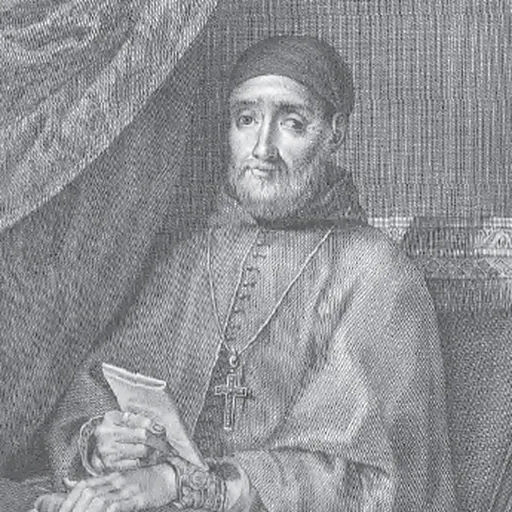
About Bartolomé Carranza
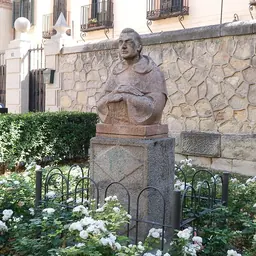
Lived 1503 – 1576 (aged 72–73). Bartolomé Carranza was a Spanish catholic priest, university teacher, friar, archbishop and catholic theologian.
Bartolomé Carranza (15032 May 1576, sometimes called de Miranda or de Carranza y Miranda) was a Navarrese priest of the Dominican Order, theologian and Archbishop of Toledo. He is notable for having been persecuted by the Spanish Inquisition. He spent much of his later life imprisoned on charges of heresy. He was first denounced in 1530, and imprisoned during 1558–1576. The final judgement found no proof of heresy but secluded him to the Dominican cloister of Santa Maria sopra Minerva where he died seven days later.
Early life and education Carranza belonged to a noble family which had its estates at Miranda de Arga, Kingdom of Navarre, in present-day Spain. He was born there in 1503, as the youngest son of Pedro Carranza.
As a young man, he bore witness to the Spanish conquest of his home country, Navarre. The ensuing institutional takeover brought about deep changes to church structures of Navarre, such as a redesign of ecclesiastic boundaries and an attempt to prevent European influences from entering Navarre and Spain altogether.
He studied at Alcalá from 1515 to 1520, where , his uncle, was professor, entering in 1520 the Dominican order, and then, from 1521 to 1525, at Salamanca and at Valladolid.
He received his early education at Alcalá and in 1520 entered the Dominican convent of Benalaque near Guadalajara.
Career Teacher (1527–1540) At Valladolid he was teacher of theology beginning in 1527. No Spaniard save Melchior Cano rivalled him in learning; students from all parts of Spain flocked to hear him. In 1530 he was denounced to the Inquisition as limiting the papal power and leaning to the opinions of Erasmus, but the process failed; he was made professor of philosophy and regent in theology (1533 to 1539). at the studium generale of the Dominican Order at the Convent of Santa Maria sopra Minerva, the progenitor of the Pontifical University of Saint Thomas Aquinas, Angelicum. While he mixed with the liberal circle associated with Juan de Valdés, he had also the confidence of Pope Paul III.
Thus in 1539 he represented his province at the general chapter of the Dominicans at Rome. After his return, in 1540, the Emperor Charles V offered him the See of Cuzco in Peru, but Carranza declined the appointment and continued performing his duties as lector of theology at Valladolid. He acted as censor (cualificador) of books (including versions of the Bible) for the Inquisition. In 1540 he was nominated to the sees of the Canary Islands and of Cuzco, Peru, but declined both. He also showed great zeal in the conferences concerning the reform of church discipline.
In the warm discussions as to the duty of episcopal residence, he insisted on the imperative duty of bishops and clergy to reside in their benefices, publishing at Venice (1547) his discourse to the council, De necessaria residentia personali, which he treated as iuris divini. His Lenten sermon to the Council, on justification, caused much remark. He was made provincial general of his order for Castile.
He was universally venerated at Rome. The Spanish people honoured him as a saint; Pope Gregory XIII placed a laudatory inscription on his tomb in the church of Santa Maria and gave permission for the placing over his grave of a monument bearing an inscription in his honour.
Besides the Commentary, Carranza published a (Venice, 1546), which has often been re-published and enlarged by later editors. The was prefaced by four dissertations:
Further, there is his controversial treatise concerning episcopal residence mentioned above, and an Introduction to the Hearing of the Mass. An edition of the latter was issued in Antwerp in 1555.
Don’t just read it —
keep it.
Full-length biographies made to live with: read them, listen on the way to work, watch them tonight.
- E-book
- Audio
- Video
Instant download · yours to keep · every purchase keeps this site free
Important facts
People in Bartolomé Carranza's life
Named in this biography and alive at the same time


Related people
Same field, nearest in time


Contemporaries
People whose lives overlapped Bartolomé Carranza's






Frequently asked questions
Who was Bartolomé Carranza?
Roman Catholic archbishop
When was Bartolomé Carranza born?
Bartolomé Carranza was born in 1503 in Miranda de Arga.
When did Bartolomé Carranza die?
Bartolomé Carranza died on 2 May 1576 in Rome.
What was Bartolomé Carranza's occupation?
Bartolomé Carranza was a catholic priest, university teacher, friar, archbishop and catholic theologian.
What nationality was Bartolomé Carranza?
Bartolomé Carranza was Spanish.
Sources & further reading
· Wikipedia: Bartolomé Carranza
Cite this page
APA: Biography.guide. (2026). Bartolomé Carranza. https://biography.guide/bartolome-carranza/
MLA: "Bartolomé Carranza." Biography.guide, https://biography.guide/bartolome-carranza/.
Chicago: "Bartolomé Carranza." Biography.guide. https://biography.guide/bartolome-carranza/.
Data last updated: 2026-09-22 · Spot an error? Report a correction.
Portrait: Wikimedia Commons · author & licence
Page generated 2026-09-27 04:58 UTC