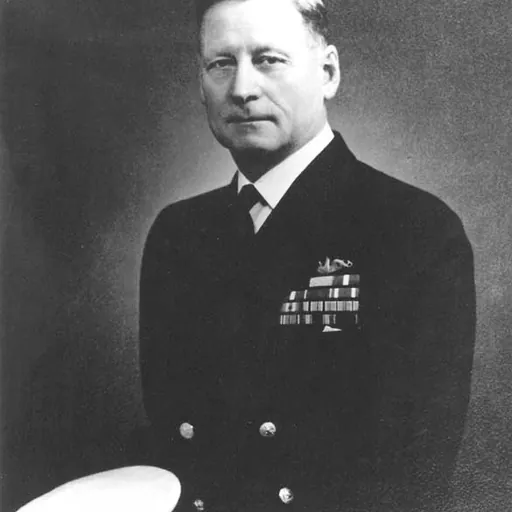
Paul Frederick Foster
United States Navy Medal of Honor recipient
About Paul Frederick Foster
Lived 1889 – 1972 (aged 82). Paul Frederick Foster was an American military officer and international Atomic Energy Agency.
Paul Frederick Foster (March 25, 1889 – January 30, 1972) was a highly decorated officer in the United States Navy with the rank of vice admiral. A graduate of the Naval Academy at Annapolis, he distinguished himself during the Battle of Veracruz in April 1914 and received Medal of Honor, the United States of America's highest and most-prestigious personal military decoration.
Early career
Paul F. Foster was born on March 25, 1889, in Wichita, Kansas, the son of Congregational minister Festus Foster and Lillian C. Howe. Due to his father's work with the Congregationalists, he spent his childhood successively in Kansas, Utah, Oklahoma, and Idaho. Foster graduated from high school and entered the University of Idaho in Moscow, Idaho, where he spent one year before received an appointment to the United States Naval Academy at Annapolis, Maryland, nominated by Senator Fred Dubois of Idaho in summer 1907.
Among his classmates were several future distinguished flag officers, including four-star admirals Oscar C. Badger, John W. Reeves Jr.; vice admirals Bernhard H. Bieri, Calvin H. Cobb, Morton Deyo, Robert M. Griffin, Edward Hanson, Howard F. Kingman, Frank J. Lowry, Oliver M. Read; rear admirals Daniel J. Callaghan, Theodore E. Chandler, Robert H. English, George M. Lowry, and Harry L. Merring.
Foster relieved McWhorter as commanding officer of the submarine in February 1916 and led her during the maneuvers with Atlantic Fleet off Nantucket and Martha's Vineyard. He also transported Elmer A. Sperry to try out his gyroscopic ship stabilizer, but when the United States entered World War I in April 1917, Foster travelled to Washington, D.C., where he approached his former commanding officer from Utah, now Chief of Naval Operations, Admiral William S. Benson, and requested to be assigned to the war zone in Europe. But Benson declined to interfere in personnel matters and turned down Foster's request.
In April 1924, Foster was ordered to the Philadelphia Navy Yard for duty in connection with the fitting out of the light cruiser Trenton and, upon her commissioning, he was appointed the ship's engineering officer under Captain Edward C. Kalbfus. Foster took part in the shakedown cruise to the Mediterranean Sea and Port Said, Egypt; Aden, Arabia; and Bushehr, Persia, where the remains of the assassinated Vice Consul Robert Imbrie were taken aboard.
By the end of October 1924, Trenton was conducting gunnery drills off the Virginia Capes near Norfolk, but powder bags in her forward turret exploded, killing or injuring every member of the gun crew. Noting the difficulties of rescuing the men in the turret through the access door and extinguishing the fire from the forecastle, and with total disregard for his own safety, Foster entered the turret from the upper handling rooms, took the fire hose which was passed to him from without and extinguished the fire in the turret and on the clothing of the members of the crew. For this act of valor, he was decorated with the Navy Cross.
At the beginning of Great Depression, Foster resigned from active duty at his own request in March 1929 and was active in various civilian organizations, some directly involved with U.S. military functions. In 1941, Foster surveyed resources of the Galapagos Islands for the Pacific Development Company. He remained a member of the United States Naval Reserve and received the Naval Reserve Medal for 10 years of service with the reserves.
World War II
Following the Japanese attack on Pearl Harbor and the United States entry into World War II, Foster was recalled to active duty with the rank of commander in the Naval Reserve and was tasked directly by President Franklin D. Roosevelt to conduct special naval inspections. One of his first mission was to conduct an investigation in the Panama Canal Zone following the series of complaints from the Army's Lieutenant General Daniel Van Voorhis, commander of Caribbean Defense Command on Army-Navy cooperation.
Foster is promoted to acting general manager of the commission in July 1957 and held that assignment until June of the following year. He then resumed his job as special assistant to the general manager and remained in that capacity until February 1959. For his service with the Atomic Energy Commission, he was decorated with the AEC Distinguished Service Award. They had one son, Paul.
The Spruance-class destroyer was named in his honor in 1976.
Decorations
Here is the ribbon bar of Vice Admiral Paul F. Foster:
Medal of Honor citation Rank and organization: Ensign Organization: U.S. Navy Born: Wichita, Kans. Entered service at: Kansas Place/Date: Vera Cruz, Mexico, 21 and 22 April 1914 Date of issue: 12/04/1915
Citation:
For distinguished conduct in battle, engagements of Vera Cruz, 21 and 22 April 1914. In both days' fighting at the head of his company, Ens. Foster was eminent and conspicuous in his conduct, leading his men with skill and courage.
Don’t just read it —
keep it.
Full-length biographies made to live with: read them, listen on the way to work, watch them tonight.
- E-book
- Audio
- Video
Instant download · yours to keep · every purchase keeps this site free
Important facts
People in Paul Frederick Foster's life
Named in this biography and alive at the same time



Related people
Same field, nearest in time


Contemporaries
People whose lives overlapped Paul Frederick Foster's





Frequently asked questions
Who was Paul Frederick Foster?
United States Navy Medal of Honor recipient (1889-1972)
When was Paul Frederick Foster born?
Paul Frederick Foster was born on 25 March 1889 in Wichita.
When did Paul Frederick Foster die?
Paul Frederick Foster died on 30 January 1972 in Virginia Beach.
What was Paul Frederick Foster's occupation?
Paul Frederick Foster was a military officer and international Atomic Energy Agency.
What nationality was Paul Frederick Foster?
Paul Frederick Foster was American.
Sources & further reading
· Wikipedia: Paul Frederick Foster
· DBpedia: Paul Frederick Foster
Cite this page
APA: Biography.guide. (2026). Paul Frederick Foster. https://biography.guide/paul-frederick-foster/
MLA: "Paul Frederick Foster." Biography.guide, https://biography.guide/paul-frederick-foster/.
Chicago: "Paul Frederick Foster." Biography.guide. https://biography.guide/paul-frederick-foster/.
Data last updated: 2026-09-22 · Spot an error? Report a correction.
Portrait: Wikimedia Commons · author & licence
Page generated 2026-09-27 05:02 UTC