
About Paul Flory
Lived 1910 – 1985 (aged 75). Paul Flory was an American chemist, engineer, physicist, autobiographer and university teacher, known for Flory convention, Flory-Stockmayer Theory and Flory–Fox equation.
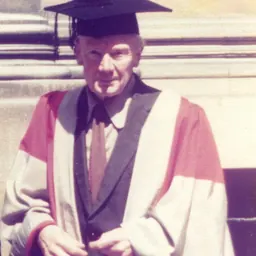
Paul John Flory (June 19, 1910 – September 9, 1985) was an American chemist and Nobel laureate who was known for his work in the field of polymers, or macromolecules. He was a pioneer in understanding the behavior of polymers in solution, and won the Nobel Prize in Chemistry in 1974 "for his fundamental achievements, both theoretical and experimental, in the physical chemistry of macromolecules".
Biography
Personal life Flory was born in Sterling, Illinois, on June 19, 1910 to Ezra Flory and Martha Brumbaugh. His father worked as a clergyman-educator, and his mother was a school teacher. His ancestors were German Huguenots, who traced their roots back to Alsace. He first gained an interest in science from Carl W Holl, who was a chemistry professor at Manchester College. In 1936, he married Emily Catherine Tabor. They had three children together: Susan Springer, Melinda Groom and Paul John Flory, Jr. His first position was at DuPont with Wallace Carothers. He was posthumously inducted into the Alpha Chi Sigma Hall of Fame in 2002. His wife Emily died in 2006 aged 94.
Schooling After graduating from Elgin High School in 1927, Flory received a bachelor's degree from Manchester College (now Manchester University (Indiana) in 1931 and a Ph.D. from the Ohio State University in 1934. He completed a years of master's study in organic chemistry under the supervision of Prof. Cecil E Boord, before moving into physical chemistry. Flory's doctoral thesis was on the photochemistry of nitric oxide, supervised by Prof. Herrick L. Johnston.
Work In 1934 Flory joined the Central Department of Dupont and Company working with Wallace H. Carothers. At Cornell he elaborated and refined his Baker Lectures into his magnum opus, Principles of Polymer Chemistry which was published in 1953 by Cornell University Press. This quickly became a standard text for all workers in the field of polymers, and is still widely used to this day.
Flory introduced the concept of excluded volume, coined by Werner Kuhn in 1934, to polymers. Excluded volume refers to the idea that one part of a long chain molecule can not occupy space that is already occupied by another part of the same molecule. Excluded volume causes the ends of a polymer chain in a solution to be further apart (on average) than they would be were there no excluded volume. The recognition that excluded volume was an important factor in analyzing long-chain molecules in solutions provided an important conceptual breakthrough, and led to the explanation of several puzzling experimental results of the day. It also led to the concept of the theta point, the set of conditions at which an experiment can be conducted that causes the excluded volume effect to be neutralized. At the theta point, the chain reverts to ideal chain characteristics – the long-range interactions arising from excluded volume are eliminated, allowing the experimenter to more easily measure short-range features such as structural geometry, bond rotation potentials, and steric interactions between near-neighboring groups. Flory correctly identified that the chain dimension in polymer melts would have the size computed for a chain in ideal solution if excluded volume interactions were neutralized by experimenting at the theta point.
Among his accomplishments are an original method for computing the probable size of a polymer in good solution, the Flory-Huggins Solution Theory, the extension of polymer physics concepts to the field of liquid crystals, and the derivation of the Flory exponent, which helps characterize the movement of polymers in solution. In 1968, he received the Charles Goodyear Medal. He also received the Priestley Medal and the Golden Plate Award of the American Academy of Achievement in 1974. He received the Carl-Dietrich-Harries-Medal for commendable scientific achievements in 1977. Flory received the Nobel Prize in Chemistry in 1974 "for his fundamental achievements both theoretical and experimental, in the physical chemistry of the macromolecules." Additionally in 1974 Flory was awarded the National Medal of Science in Physical Sciences. The medal was presented to him by President Gerald Ford. This award was given to him because of his research on the "formation and structure of polymeric substances".
Don’t just read it —
keep it.
Full-length biographies made to live with: read them, listen on the way to work, watch them tonight.
- E-book
- Audio
- Video
Instant download · yours to keep · every purchase keeps this site free
Important facts
more
Polymer chemistry, Polymer physics, Random sequential adsorption, Self-avoiding walk, Star-shaped polymerPeople in Paul Flory's life
Named in this biography and alive at the same time




Related people
Same field, nearest in time



Contemporaries
People whose lives overlapped Paul Flory's






Frequently asked questions
Who was Paul Flory?
American chemist (1910-1985)
When was Paul Flory born?
Paul Flory was born on 19 June 1910 in Sterling.
When did Paul Flory die?
Paul Flory died on 9 September 1985 in Big Sur.
What was Paul Flory's occupation?
Paul Flory was a chemist, engineer, physicist, autobiographer and university teacher.
What was Paul Flory known for?
Paul Flory was known for Flory convention, Flory-Stockmayer Theory, Flory–Fox equation, Flory–Huggins solution theory, Flory–Rehner equation and Flory–Schulz distribution.
What nationality was Paul Flory?
Paul Flory was American.
Sources & further reading
Cite this page
APA: Biography.guide. (2026). Paul Flory. https://biography.guide/paul-flory/
MLA: "Paul Flory." Biography.guide, https://biography.guide/paul-flory/.
Chicago: "Paul Flory." Biography.guide. https://biography.guide/paul-flory/.
Data last updated: 2026-09-26 · Spot an error? Report a correction.
Page generated 2026-09-27 05:13 UTC