
About Pasquale Verrusio
Lived 1935 – 2012 (aged 76). Pasquale Verrusio was an Italian painter.
Pasquale Verrusio (24 November 1935 – died Torino di Sangro, Italian Republic, 12 February 2012) was an Italian painter, sculptor and engraver.
Biography
Pasquale Verrusio was born in the Garbatella district in Rome to a small bourgeois family of employees. After abandoning his studies at the Technical Institute for Surveyors, he devoted himself to painting as a self-taught artist.
In 1957, he studied figure and nude drawing at the French Academy at Villa Medici. In the same year, he met and became a student of Renato Guttuso. In 1959, his work is noted at the VIII Quadrennial Exhibition in Rome, where his works were selected by the jury and praised by the national press. In 1960 he founded the group "Libertà-Realtà" (Freedom-Reality) with the painters Confetti, Ganna, , Gino Guida, , Reggiani and . They proposed a new figuration which opposed the notion of abstract art as 'the only valid expression of modern artistic creation. On his return from Paris, he helped to introduce artists such as Eduardo Arroyo, Gilles Aillaud, Tisserand and Biras in Italy.
In 1967, with Ugo Attardi, Bruno Caruso, , Piero Guccione, Alessandro Manzo, Laura Mazza and Alberto Mondadori, he founded the Galleria Il Gabbiano in Rome. In 1971, he joined the group of the Galleria Il Fante di Spade, directed by Netta Vespignani, who was a representative of the Nuova Scuola Romana. He exhibited at the Galleria La Vetrata in Rome in 1989 and 1990. In 1991 he won the 'Premio Sulmona' and in 1992 he moved to Abruzzo, where, in 1994 he founded the 'European Art Centre 'Le Morge with the painter Éteras, whom he married in 2009.
In 1996, he displayed his works at the exhibition "La Pittura Colta in Italia" in Rodengo Saiano, curated by Floriano De Santi. In 2000, he was invited with Èteras to exhibit at the University of Grand Junction in Colorado, where for three months they both taught Italian fresco. He died in Torino di Sangro in February 2012 after a long illness.
Style and technique Verrusio's stylistic research follows a well-defined path: from a production focused on the lesson from Renato Guttuso since 1957, to his own 'poetic light' where the details of reality are sublimated into a clearly articulated conceptual framework since the mid-60s.
The Parisian experience led him to analyze the 'human condition' under a psychological profile. He had already started on this theme some years before, and it would accompany him throughout his artistic production. From the mid-1960s, his attention focused on the representation of mechanical objects and the waste of the consumer society; such as tubular and fences, immersed in a monotone light where the line between dignity and degradation is blurred and a sense of loneliness and anxiety pervades all. References to Vermeer's paintings have been made in relation to Verrusio's interpretation of rural life and still lifes. Here the light undergoes a tonal change to warmer colours, and normality becomes a solemn moment. Representative of these themes are the 'Still Lives with Figs and Lemons' and the portrait of Natuccio and Giovannina of 1975. The most abstract form of this poetic and pictorial approach is found in the series of the Sassi, which began almost a decade earlier during a visit to the Island of Elba. In this regard, Renzo Vespignani wrote:
The lens is even smaller, and the search for an 'everything in focus' both cruel and unmoved together, burns every remaining twilight; the lens is focused and restricted as much as the conscience of the painter expands, and the object fills the canvas with no evidence of any effort. The world could be said to be reduced to a still life, but a still life – this still life – is elevated to the rank of absolute and pivotal phenomenon. It is a fatal mechanism that Verrusio realizes aggregating, overlapping, locking, around the same subject, the results of a more widespread observation: the pebble, smoothed by the wind from the sea, is found in every position possible, under every possible light, and is reborn countless times, totally possessed, in a succession of surfaces, curves, volumes, always the same and always different.
In the 1980s, the focus shifted on the relation between the pebbles and the movement and the transparency of the water, as well as with the introduction of figures in the marine landscape. In the 1990s, a new interpretation of the coloristic and use of light by Caravaggio leads to a thematic renewal: in the Foro Romano cycle, the light becomes twilight and cites the tradition of the Scuola Romana. The representation of Vestal and monuments has metaphysical and allegorical connotations. In the early 2000s, the predominant theme is the marine and American landscape. Verrusio's latest production maintains the use of twilight, and thematically focuses on self, where he continues his careful conceptual analysis of the 'symbiosis of objective and subjective' through the exploration of the self and his illness.
Exhibitions Solo Exhibitions Florence, Galleria Corrente 2, 1961 Rome, Don Chisciotte, 1963 Rome, Terzo Mondo, 1964 Rome, La Nuova Pesa, 1965, 1966 Milan, L'Agrifoglio, 1966 Rome, Il Gabbiano, 1968 Modena, La Mutina, 1969, 1972 Rome, Il Fante di Spade, 1972, 1974 Viareggio, Premio Fondazione Viani – Premio Saporetti (prize winner), 1980 Cairo, Istituto Italiano di Cultura, 1983 Stockholm, Galleria Hedström-Ogebjer, 1986 New York, Schmidt-Bingham Gallery, 1986 Rome, La Vetrata, 1989, 1990 Collective Exhibitions Rome, Quadriennale di Roma, 1959–60 Rome, Prima Mostra del Gruppo "Libertà – Realtà", Galleria Stagni, 1961 Republic of San Marino, Premio Italia-Austria-Repubblica di San Marino (prize winner), 1961 Spoleto, Tendenze della Pittura Contemporanea' al Festival dei Due Mondi di Spoleto, 1962 Milan, I Premio Nazionale di Pittura Paderno Dugnano (prize winner), 1964 Paris, 16ème Salon de la Jeune Peinture, 1965 Sydney, Modern and Contemporary Painters, The Macquarie Galleries, 1966 Chicago, Modern Italian Painters, Roman Gallery, 1966 Paris, 18ème Salon de la Jeune Peinture, 1967 Arezzo, Per Copia Conforme, 1971 Milan, XXVII Biennale Nazionale d'Arte Città di Milano, Palazzo della Permanente, 1971–1972 Florence, Biennale Internazionale D’Arte – XXI Premio del Fiorino, 1973 Milan, XXVIII Biennale Nazionale d'Arte Città di Milano, Palazzo della Permanente, 1973–1974 Moscow and Leningrad, Giornate della Cultura Italiana nell’ U.R.S.S., 1974 Rome, Una Storia Verosimile – 25 Anni di Collaborazione tra Artisti Italiani e Sandro Gindro, Teatro il Vascello, 2003 Reggio Emilia, La Collezione Zavattini – Unicità e Fantasia del Piccolo Formato, 2008
Don’t just read it —
keep it.
Full-length biographies made to live with: read them, listen on the way to work, watch them tonight.
- E-book
- Audio
- Video
Instant download · yours to keep · every purchase keeps this site free
Important facts
People in Pasquale Verrusio's life
Named in this biography and alive at the same time
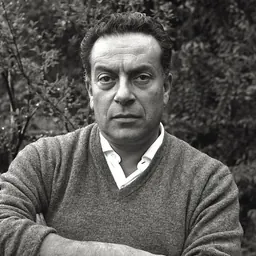


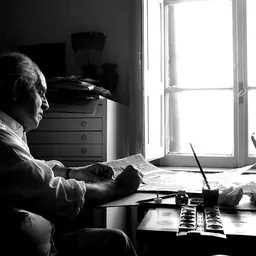




Related people
Same field, nearest in time

Contemporaries
People whose lives overlapped Pasquale Verrusio's

Frequently asked questions
Who was Pasquale Verrusio?
Italian painter (1935-2012)
When was Pasquale Verrusio born?
Pasquale Verrusio was born on 24 November 1935 in Rome.
When did Pasquale Verrusio die?
Pasquale Verrusio died on 12 February 2012 in Torino di Sangro.
What was Pasquale Verrusio's occupation?
Pasquale Verrusio was a painter.
What nationality was Pasquale Verrusio?
Pasquale Verrusio was Italian.
Sources & further reading
· Wikipedia: Pasquale Verrusio
Cite this page
APA: Biography.guide. (2026). Pasquale Verrusio. https://biography.guide/pasquale-verrusio/
MLA: "Pasquale Verrusio." Biography.guide, https://biography.guide/pasquale-verrusio/.
Chicago: "Pasquale Verrusio." Biography.guide. https://biography.guide/pasquale-verrusio/.
Data last updated: 2026-09-20 · Spot an error? Report a correction.
Page generated 2026-09-27 05:31 UTC