
About Park Seung-hwan
Lived 1869 – 1907 (aged 37–38). Park Seung-hwan was a military personnel.
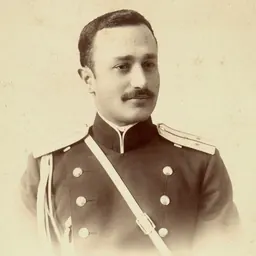
Pak Sŭnghwan was a Korean military officer and independence activist of the Korean Empire. After his suicide, he was known for instigating the Battle of Namdaemun as a response to the disbanding of the Korean military following the Japan–Korea Treaty of 1907 and the abdication of Emperor Gojong.
Biography He was born on September 7, 1869, in Hanseong, Gyeonggi as the eldest of three children of Park Joo-pyo and Namyang Hong.
In 1887, he took the exam in Mugwa and on September 28, 1896, he entered the Military Academy of Korean Empire. Yi Hak-gyun, the academy principal, was a nationalist who opposed Japanese influence, which influenced Pak's beliefs. He graduated on March 21, 1897, and was commissioned as a Second-Lieutenant in the Imperial Korean Guards. Afterwards, on November 11, 1899, he was promoted to the rank of lieutenant in the army and was appointed as the platoon commander of the 2nd Battalion of the 1st Siwi Regiment and on July 23, 1900, he was promoted to the rank of captain and took the command of the 1st company of the 1st Qinwi Regiment. Then on 14 August 1900 he took the command of company leader of the 1st Siwi Regiment. On 15 February 1904, Park was promoted to Major and became the 1st Battalion leader of 1st Siwi Regiment.
While serving as the 1st Battalion Commander of the 1st Siwi Regiment, he entered the palace when Emperor Gojong was forcibly taken away by the Japanese in 1907 and attempted to restore the throne, but he stopped because he was afraid of harming King Gojong. On August 1, 1907, he gathered officers above a battalion commander or higher at the Japanese military headquarters to disband the army. Pak then committed suicide with a pistol and wrote a suicide letter which read:
I couldn't defend my country as a soldier and I couldn't show my loyalty as a servant. Jongmyo Shrine and Sajik had already been destroyed, and the country's defense disappeared accordingly. Since I am a soldier, I cannot afford to live in peace. In August 2003, he was selected as a national figure of South Korea.
In popular culture His suicide and subsequent Battle of Namdaemun that it triggered are depicted in both the 1979 North Korean film An Jung Gun Shoots Ito Hirobumi and the 2018 Korean drama Mr Sunshine.
Don’t just read it —
keep it.
Full-length biographies made to live with: read them, listen on the way to work, watch them tonight.
- E-book
- Audio
- Video
Instant download · yours to keep · every purchase keeps this site free
Important facts
Related people
Same field, nearest in time





Contemporaries
People whose lives overlapped Park Seung-hwan's





Frequently asked questions
Who was Park Seung-hwan?
imperial Korean Army officer (1869–1907)
When was Park Seung-hwan born?
Park Seung-hwan was born in 1869.
When did Park Seung-hwan die?
Park Seung-hwan died in 1907.
What was Park Seung-hwan's occupation?
Park Seung-hwan was a military personnel.
Sources & further reading
Cite this page
APA: Biography.guide. (2026). Park Seung-hwan. https://biography.guide/park-seung-hwan/
MLA: "Park Seung-hwan." Biography.guide, https://biography.guide/park-seung-hwan/.
Chicago: "Park Seung-hwan." Biography.guide. https://biography.guide/park-seung-hwan/.
Data last updated: 2026-09-20 · Spot an error? Report a correction.
Page generated 2026-09-27 05:23 UTC