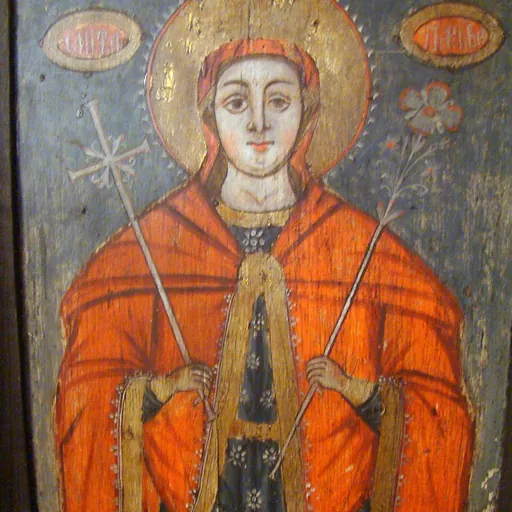
Paraskeva of the Balkans
Ascetic saint
About Paraskeva of the Balkans
Lived 1000 – 1100. Paraskeva of the Balkans was a Byzantine christian nun.
Paraskeva of the Balkans, alternatively known as Petka, was an ascetic female saint of the 11th century. She was born in Epivates, near Constantinople, and, according to legends, had visions of the Virgin Mary. After living in Chalcedon and Heraclea Pontica, she settled in a convent in the desert near the Jordan River. An angel told her to return to her homeland, and two years later she died at the age of 27. Veneration of Saint Paraskeva began to spread in the 14th century from Bulgaria into the Danubian Principalities of Wallachia and Moldavia. There was confusion over her identity and attributes because her Greek name Παρασκευή "Paraskeuḗ, Paraskevi" means "Friday," and translations in other languages, such as Romanian and Serbian, were "Saint Friday". Her life continues to be celebrated in many Orthodox countries, and her feast day is commemorated on October 14 in the Eastern Orthodox Church.
Life Visual hagiography of St Paraskeva (Patriarchate of Peć, 1719–20).
Paraskeva was born in the town of Epivates (today's Selimpaşa, close to Istanbul) on the shore of the Sea of Marmara. Her parents were wealthy landowners. In Bulgaria she is venerated as Sveta Petka Tarnovska, "of Tarnovo".
Serbia In 1393, they were transferred to Belgrade,
The confusion occurred in part because the original Greek name of Paraskeva was Παρασκευή, meaning "preparation [of the Sabbath]," understood as "Friday," and was literally translated to various languages as "Saint Friday" (such as "Sveta Petka" in Serbian, "Sfânta Vineri" in Romanian). Scholars sometimes misunderstood the translated name and connected it with a certain character from folk tales having a similar name.
As one scholar asked:
Was Parasceve, or Paraskeva, an early Christian maiden named in honor of the day of the Crucifixion? Or was she a personification of that day, pictured cross in hand to assist the fervor of the faithful? And was the Paraskeva of the South Slavs the same who made her appearance in northern Russia?
The veneration of Saint Paraskeva, also known as Saint Petka, began to spread in the 14th century from Bulgaria into the Romanian principalities of Wallachia and Moldavia.
Modern-day veneration in Romania 1947 procession A severe drought in 1946-47 affected Moldavia, adding to the misery left by the war. Metropolitan Justinian Marina permitted the first procession featuring the coffin containing the relics of Paraskeva, kept at Iaşi until then. The relics winded their way through the drought-deserted villages of Iaşi, Vaslui, Roman, Bacău, Putna, Neamţ, Baia and Botoşani Counties. The offerings collected on this occasion were distributed, based on Metropolitan Justinian's decisions, to orphans, widows, invalids, school cafeterias, churches under construction, and to monasteries in order to feed the sick, and old or feeble monks.
Annual Iași pilgrimage Pilgrimage at the shrines located in the Metropolitan Cathedral of Iași has become one of the major religious events in Romania. Hundreds of thousands of pilgrims gather each year in Iași in the second weekend of October to commemorate Saint Parascheva, while the city itself established its Celebration Days at the same time.
Hagiographies In the 14th century, Bishop Euthymius of Tarnovo (1332–1402) wrote a notable biography of Paraskeva - "Hagiography of Saint Petka of Tarnovo". The bishop's work was inspired from the Greek vita of Saint Paraskeva of the Balkans, written by deacon Basilikos in 1150 on the request of the Patriarch of Constantinople, Nicholas IV Mouzelon. Hagiographies were also written by Metropolitan Mattheos of Mira in 1605, Metropolitan Varlaam of Moldavia in 1643, Nikodimos the Athonite (19th century), and Romanian bishop Melchisedec of Roman in 1889. Some modern Romanian theologians published studies about Paraskeva: Gheorghe Păvăloiu (1935), Arhimandrite Varahil Jitaru (1942), D. Stănescu (1938), M. Țesan (1955), Scarlat Porcescu, and Mircea Păcurariu.
Dedicated churches Birthplace church in Epivates A church dedicated to her was built in Epivates (present-day Selimpaşa) on the spot where her house of birth once stood. The oldest testimony regarding the church - written by the Russian traveller Anthony of Novgorod (who later became Archbishop of Novgorod) - dates back to the early-13th century. In August 1817 a great fire completely destroyed the church; it was rebuilt in 1820 with the financial support of the citizens of Constantinople and of the former Prince of Moldo-Wallahia, Alexander Kallimachi. In 1885 the Community demolished the old church in order to construct a much bigger one on the same site. The building, completed after 6 years, re-used parts of the 1327–1341 Byzantine tower of Duke Alexis Apokaukos as building material. It was the biggest church in the whole of Eastern Thrace (16 m in height, 26 m in width and 30 m in length), a real jewel that could be seen from kilometres away. It was completely demolished in the spring of 1979; a park occupies the site.
Extant notable churches
Worldwide, there are many churches named in honour of or dedicated to St Paraskeva. Some of the more notable include: Metropolitan Cathedral, Iași, Romania Church of St Paraskeva, Nesebar, Bulgaria Church of St Petka of the Saddlers, Sofia, Bulgaria Church of St Petka, Vukovo, Bulgaria Church of Sv. Petka, Crniche, Skopje, North Macedonia Church of Saint Parascheva, Slabinja, Croatia St. Petka's Church, Banovci, Croatia St Petka Chapel at Kalemegdan, Belgrade, Serbia St Petka's Church in Urovci, Obrenovac, Belgrade, Serbia Church of St Parascheva, Cotnari, Iași County, Romania
Don’t just read it —
keep it.
Full-length biographies made to live with: read them, listen on the way to work, watch them tonight.
- E-book
- Audio
- Video
Instant download · yours to keep · every purchase keeps this site free
Important facts
Related people
Same field, nearest in time


Contemporaries
People whose lives overlapped Paraskeva of the Balkans's

Frequently asked questions
Who was Paraskeva of the Balkans?
ascetic saint
When was Paraskeva of the Balkans born?
Paraskeva of the Balkans was born in 1000 in Selimpaşa.
When did Paraskeva of the Balkans die?
Paraskeva of the Balkans died in 1100 in Selimpaşa.
What was Paraskeva of the Balkans's occupation?
Paraskeva of the Balkans was a christian nun.
What nationality was Paraskeva of the Balkans?
Paraskeva of the Balkans was Byzantine.
Sources & further reading
· Wikipedia: Paraskeva of the Balkans
· DBpedia: Paraskeva of the Balkans
Cite this page
APA: Biography.guide. (2026). Paraskeva of the Balkans. https://biography.guide/paraskeva-of-the-balkans/
MLA: "Paraskeva of the Balkans." Biography.guide, https://biography.guide/paraskeva-of-the-balkans/.
Chicago: "Paraskeva of the Balkans." Biography.guide. https://biography.guide/paraskeva-of-the-balkans/.
Data last updated: 2026-09-29 · Spot an error? Report a correction.
Portrait: Wikimedia Commons · author & licence
Page generated 2026-10-04 13:47 UTC