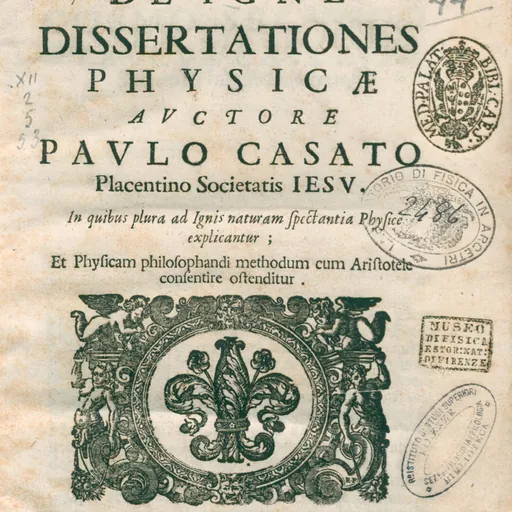
About Paolo Casati
Lived 1617 – 1707 (aged 89–90). Paolo Casati was a physicist, mathematician, astronomer and monk.
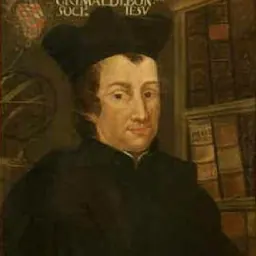
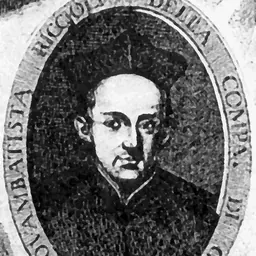
Biography Born in Piacenza to a Milanese family, Casati joined the Jesuits in 1634. From 1636 to 1637 he studied physics and metaphysics at the College of Ferrara. One of the most famous Jesuits scientists of the time, Niccolò Cabeo (1586–1650), was teaching at Ferrara when Casati arrived there. In 1640 he moved to the Roman College, where he studied theology for four years. He was then sent to teach logic at the Jesuit college of Bologna. Bologna Jesuits had developed a strong program of experimentation, such as with falling bodies. During his time in Bologna, Casati frequented the scientific circle gathered around Giovanni Battista Riccioli and Francesco Maria Grimaldi. In Bologna Casati befriended the mathematician Giannantonio Rocca (1607-1656), a disciple of Cavalieri and one of the first Italian supporters of Cartesian philosophy. In 1650, Casati moved to Rome, where he assumed the position of professor at the Roman College. He was given the chair in mathematics after teaching philosophy and theology.
Sweden
In 1651, Casati was sent on a mission to Stockholm in order to gauge the sincerity of Christina of Sweden's intention to become Catholic. He subsequently returned to his post at Rome. In 1677, he moved to the Jesuit College in Parma, where he remained until his death. Casati was a friend and correspondent of the famous florentine librarian Antonio Magliabechi, and other scientists like Carlo Rinaldini, Giovanni Antonio Rocca and Daniello Bartoli.
Terra machinis mota
The astronomical work Terra machinis mota (1658) imagines a dialogue between Galileo, Paul Guldin, and Marin Mersenne on various intellectual problems of cosmology, geography, astronomy and geodesy. For example, they discuss how to determine the Earth's dimensions, floating bodies, the phenomena of capillarity, and also describe the experiment on the vacuum made by Otto von Guericke in 1654. The work is remarkable for the fact that it represents Galileo in a positive light, in a Jesuit work, only 25 years after Galileo's condemnation by the Church.
Theories on the vacuum
Casati discussed the hypothesis of horror vacui, that nature abhors a vacuum, in his thesis Vacuum proscriptum, published in Genoa in 1649. Casati confuted the existence of both vacuum and atmospheric pressure, but he did not rely entirely on scientific observation, and refers to Catholic thought in order to back his claims. The absence of anything implied the absence of God, and hearkened back to the void prior to the story of creation in the book of Genesis (see Vacuum: historical interpretation).
Recognition The crater Casatus on the Moon is named after him.
Other works
Le ceneri dell'Olimpo ventilate (1673), a dialogue about meteorology. De gli horologi solari (unpublished manuscript): about sundial construction.
Exercitationes matheseos candidatis exhibitaæ (1698) (unpublished manuscript): a collection of algebraic and geometrical subjects.
Don’t just read it —
keep it.
Full-length biographies made to live with: read them, listen on the way to work, watch them tonight.
- E-book
- Audio
- Video
Instant download · yours to keep · every purchase keeps this site free
Important facts
People in Paolo Casati's life
Named in this biography and alive at the same time



Related people
Same field, nearest in time


Contemporaries
People whose lives overlapped Paolo Casati's





Frequently asked questions
Who was Paolo Casati?
Italian mathematician
When was Paolo Casati born?
Paolo Casati was born in 1617 in Piacenza.
When did Paolo Casati die?
Paolo Casati died on 22 December 1707 in Parma.
What was Paolo Casati's occupation?
Paolo Casati was a physicist, mathematician, astronomer and monk.
Sources & further reading
Cite this page
APA: Biography.guide. (2026). Paolo Casati. https://biography.guide/paolo-casati/
MLA: "Paolo Casati." Biography.guide, https://biography.guide/paolo-casati/.
Chicago: "Paolo Casati." Biography.guide. https://biography.guide/paolo-casati/.
Data last updated: 2026-09-23 · Spot an error? Report a correction.
Portrait: Wikimedia Commons · author & licence
Page generated 2026-09-27 05:05 UTC