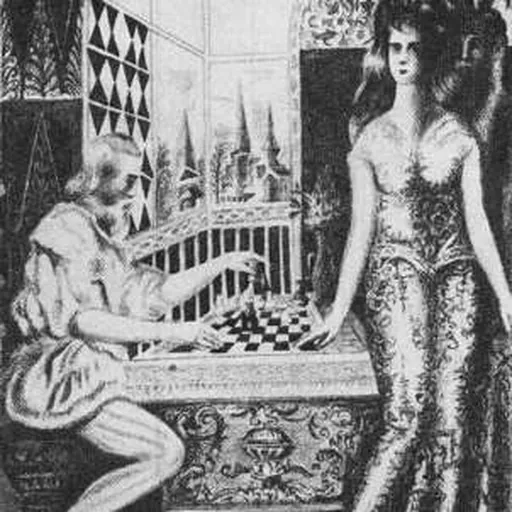
About Paolo Boi
Lived 1528 – 1598 (aged 69–70). Paolo Boi was an Italian chess player.
Paolo Boi (1528–1598) was an Italian chess player. He is considered to have been one of the greatest chess players of the 16th century. In 1549, he beat Pope Paul III in a chess match.
Early life He was born in Syracuse, Sicily (now Italy), and he was brought up for the church under the belief that Paolo would become a pope and a saint, because of a prediction. However, Paolo formed different plans: he started to learn chess, and a few years later he escaped to Greece, then to Saragossa, and finally returned to Sicily as a well-known chess player.
Career
He had played several times against Giovanni Leonardo Di Bona in Italy, and the two chess players were considered equal. Then Paolo Boi and Giovanni Leonardo Di Bona defeated the strongest chess player of their time, the famous Spanish player Ruy López de Segura, at the first known international chess tournament in the court of Philip II of Spain at Madrid, in 1575. As a result, they became the strongest chess players of the era, and henceforth the two were called the "Light" and "Lustre" of the noble game.
He was the first who, without seeing the board, played three games at once, and at the same time conversed with other parties upon different topics. In France, Catherine de Medici, who was also adept at chess, showered favours upon him; and, in Portugal, he had the honour of having the King Don Sebastian for his adversary. Paolo Boi -described as a deeply religious man - regularly attended services at the Church of Santa Maria, in a small town in Calabria. It was there, on a morning in 1570, that he is said to have met a young woman of extraordinary beauty.
After a brief conversation, Paolo Boi was surprised to learn that the woman played chess. He agreed to a game, during which he quickly realised the exceptional strength of his opponent. The game continued until a critical position was reached, at which point Paolo Boi confidently announced:
- “Mate in two.”
The position is traditionally presented as a mate in two moves for White.
https://www.chess.com/emboard?id=14349797
At the moment when Paolo Boi was about to move his knight, the narrative states that the White Queen suddenly transformed into a Black Queen, suggesting a supernatural intervention.
https://www.chess.com/emboard?id=14349805
The woman is said to have declared:
- “Ah, Paolo, you will not win. It is I who have a Queen, and you have none.”
The peasant According to the same legendary account, some time later Paolo Boi was challenged to another game by a peasant. Suspecting that this was the same adversary in disguise - implicitly identified as the Devil—he nevertheless accepted the challenge.
The game progressed in silence until a decisive position was reached. At that moment, the peasant allegedly declared with confidence:
- “Mate in seven.”
Upon analysing the position, Paolo Boi realised that the proposed combination did indeed lead inevitably to mate, but that on the final move the arrangement of the pieces on the board would form a cross - a Christian symbol incompatible with the nature of his opponent.
https://www.chess.com/emboard?id=14349867
Faced with this realisation, the peasant hesitated and did not execute the final blow, abruptly abandoning the game and disappearing. The narrative interprets this outcome as the Devil's inability to complete a victory that would require the formation of a Christian symbol.
Interpretation This story is now understood as a symbolic and literary legend, without historical foundation, representing the idea that Paolo Boi was always under divine protection and that reason, combined with faith, ultimately prevails over supernatural forces.
Death
Boi died in Naples. Historian H. J. R. Murray says he was poisoned by jealous rivals. Other sources say he caught a cold when hunting and died as a result of it. His body was buried in the church of Saint Francesco di Paola; Prince Stigliano and many of the Neapolitan nobility followed him to the grave.
Don’t just read it —
keep it.
Full-length biographies made to live with: read them, listen on the way to work, watch them tonight.
- E-book
- Audio
- Video
Instant download · yours to keep · every purchase keeps this site free
Important facts
People in Paolo Boi's life
Named in this biography and alive at the same time
Related people
Same field, nearest in time


Contemporaries
People whose lives overlapped Paolo Boi's


Frequently asked questions
Who was Paolo Boi?
Italian chess player
When was Paolo Boi born?
Paolo Boi was born in 1528 in Syracuse.
When did Paolo Boi die?
Paolo Boi died in 1598 in Naples.
What was Paolo Boi's occupation?
Paolo Boi was a chess player.
What nationality was Paolo Boi?
Paolo Boi was Italian.
Sources & further reading
Cite this page
APA: Biography.guide. (2026). Paolo Boi. https://biography.guide/paolo-boi/
MLA: "Paolo Boi." Biography.guide, https://biography.guide/paolo-boi/.
Chicago: "Paolo Boi." Biography.guide. https://biography.guide/paolo-boi/.
Data last updated: 2026-09-23 · Spot an error? Report a correction.
Portrait: Wikimedia Commons · author & licence
Page generated 2026-09-27 05:06 UTC