
About Giulio Cesare Polerio
Lived 1548 – 1612 (aged 63–64). Giulio Cesare Polerio was an Italian chess player.
Giulio Cesare Polerio ( – ; reconstruction of places and dates by Adriano Chicco ) was an Italian chess theoretician and player.
Name affixes used for him are l'Apruzzese, Giulio Cesare da Lanciano (Salvio/Walker ), and Lancianese, because he was born in Lanciano, a town in the province of Chieti of the region Abruzzo of Italy. He died in Rome.
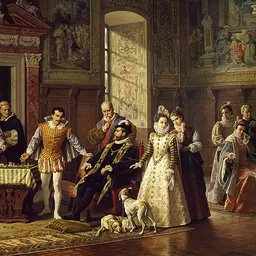
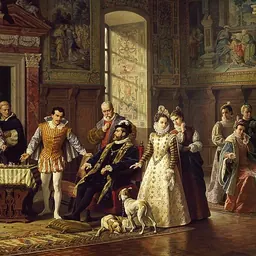
Chess playing "Sfida scacchistica alla corte del Re di Spagna" showing Giovanni Leonardo ("Il Puttino") at the court of Philip II of Spain, around 1575, painting by Luigi Mussini (1883). Games of Giò Leonardo, including those against Ruy López de Segura, are recorded in the Codexes of Polerio.
The first published mention of Polerio is from 1634 in Il Puttino by Alessandro Salvio. It recounts an event that must have occurred around 1575. "Il Puttino, altramente detto il Cavaliere errante" is a nickname used by Alessandro Salvio for Giovanni Leonardo. According to Salvio, Polerio accompanied Giovanni Leonardo on his way to Madrid until Genoa.
After returning to Rome around 1584, Polerio became a chess player and writer in ordinary of Giacomo Boncompagni, Duke of Sora and son of Pope Gregory XIII (born Ugo Boncompagni).
Polerio wrote a number of codexes in which a lively international chess dialogue is described involving the exchange of ideas among players in Italy, Portugal, and Spain. In these codexes, besides new ideas regarding chess openings, Polerio describes some of his own matches.
In Il Puttino, Salvio mentions that, starting in 1606 from "Città di Piazza", "Geronimo Cascio, on his way to Rome, beat Giulio Cesare (Polerio), companion of Il Puttino, the best in Rome, in the house/court of his Excellence Giacomo Boncompagni, Duke of Sora."
The Codexes of Giulio Cesare Polerio The first systematic investigation of the Codexes of Polerio was published by in 1874. The subject of the investigations by Van der Linde can be found at the , part of the Koninklijke Bibliotheek, National Library of the Netherlands.
The current systematics of the Codexes of Polerio has been performed and published by Alessandro Sanvito in 2005.
Impact of Polerio on chess history and theory (before 1874)
The systematic organisation of overall seven Codexes, described and called A-G by Van der Linde, and attributed to Polerio in 1874, had major impact on the further description of chess history, and history of chess theory. A relevant part of the work of Van der Linde was to compare Codexes of Polerio and Gioacchino Greco even superfine. According to this investigation, most of the analytic work of Polerio was mediated outside of Italy, up to 1874, via Gioacchino Greco. More recent work by Peter J. Monté compiling game scores from all sixteenth and seventeenth century manuscripts reveals where Greco copied Polerio and where he carried the games further.
Impact of Polerio on chess terminology (after 1874)
Polerio Defense/Polerio's Attack
Polerio Gambit
On p. 186 of "Das Schachspiel des XVI. Jahrhunderts" van der Linde wrote in 1874:
"D. Polerio-Gambit
224
Exactly this move order was also found later even in a second Polerio Codex discovered and described by J.A. Leon in 1894.
"SALVIO states that the following Gambit was sent to him by Signor Muzio..."
Actually, Alessandro Salvio never stated this. Rather, in the third book of the Il Puttino he wrote that Signor Mutio d'Alessandro did see that Geronimo Cascio did play the move order (with free castling, also called "Italian method" of castling ).
With p. 165, vol. 2, of the 1821 edition of A New Treatise of the Game of Chess the term Muzio Gambit was coined by Jacob Henry Sarratt. And with the latter work of Sarrat, in 1821 the modern theory of the "Muzio Gambit" with castling according modern rules started – an idea and a position already Polerio analysed in 1579/80.
"Polerio Gambits and Variations"
Don’t just read it —
keep it.
Full-length biographies made to live with: read them, listen on the way to work, watch them tonight.
- E-book
- Audio
- Video
Instant download · yours to keep · every purchase keeps this site free
Important facts
People in Giulio Cesare Polerio's life
Named in this biography and alive at the same time

Related people
Same field, nearest in time

Contemporaries
People whose lives overlapped Giulio Cesare Polerio's


Frequently asked questions
Who was Giulio Cesare Polerio?
Italian chess player
When was Giulio Cesare Polerio born?
Giulio Cesare Polerio was born in 1548 in Lanciano.
When did Giulio Cesare Polerio die?
Giulio Cesare Polerio died in 1612 in Rome.
What was Giulio Cesare Polerio's occupation?
Giulio Cesare Polerio was a chess player.
What nationality was Giulio Cesare Polerio?
Giulio Cesare Polerio was Italian.
Sources & further reading
· Wikipedia: Giulio Cesare Polerio
· DBpedia: Giulio Cesare Polerio
Cite this page
APA: Biography.guide. (2026). Giulio Cesare Polerio. https://biography.guide/giulio-cesare-polerio/
MLA: "Giulio Cesare Polerio." Biography.guide, https://biography.guide/giulio-cesare-polerio/.
Chicago: "Giulio Cesare Polerio." Biography.guide. https://biography.guide/giulio-cesare-polerio/.
Data last updated: 2026-09-20 · Spot an error? Report a correction.
Page generated 2026-09-27 05:01 UTC