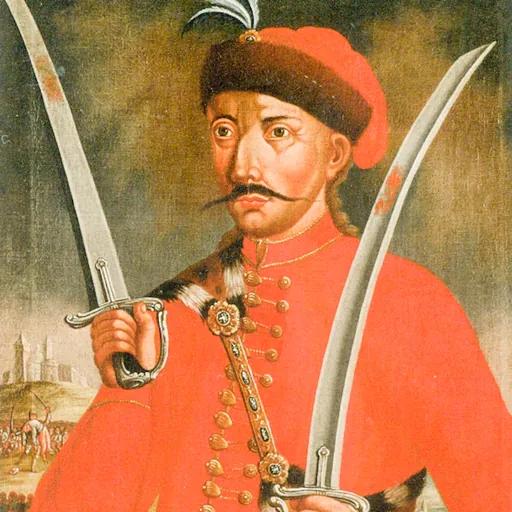
About Pál Kinizsi
Lived 1432 – 1494 (aged 61–62). Pál Kinizsi was a Hungarian military personnel, military leader and politician.
Pál Kinizsi (; ; 1432–1494) was a Hungarian general in the service of Hungarian army under king Matthias Corvinus. He was the Count of Temes County, located in the Banat region in the Kingdom of Hungary (now part of Romania and Serbia following the Treaty of Trianon in 1920) from 1484 and Captain-General of the Lower Parts of the Kingdom. He was a general of the famed Black Army of Hungary during the reign of King Mathias Corvinus. He is famous for his victory over the Ottomans in the Battle of Breadfield in October 1479. Kinizsi is widely praised for his role in defending Hungary from the Ottomans. He reputedly never lost a battle.
Life
Origin and early life
Kinizsi's ancestry is obscure. According to some he was a son of a miller, and prior to his military career, he was a journeyman miller. The available old documents from the Hungarian National Archives suggest that Paul Kinizsi was born into a Hungarian noble family from Abaúj County in northern part of the Kingdom of Hungary. According to the research of contemporary Hungarian historians, Pál Kinizsi was of Hungarian nationality and was most likely born in Abaúj County, in the village of either Kiskinizs or Nagykinizs. Scholars have been able to trace the genealogy of the Kinizsi family back to the thirteenth century, where the possible presence of Germanic elements—and to a lesser degree perhaps Slavic ones—cannot be entirely excluded. In Kinizsi’s time, the ethnic composition of Abaúj County was predominantly Hungarian, with some German communities, particularly in the vicinity of Hernádnémeti. His Hungarian mother tongue and Catholic faith are further supported by the fact that in the 1480s Kinizsi founded a monastery for the Pauline Order at Nagyvázsony, an order of distinctly Hungarian origin, where he also chose his final resting place.
The first mention of his name is in 1464, in a Latin written document mentioning that (His Excellency) receives a possession in the Abaúj County. Later in 1510, appears also in form of .
In Romanian historiography, Paul Kinizsi was traditionally considered to have been born into a humble knezial family from Banat. However, according to Romanian historian Adrian Magina, this claim was inaccurate, and Kinizsi's only connection with the territory of Banat was his role as Count of Temes and general captain of the southern regions of the Kingdom of Hungary. and was possibly a descendant of Vuk Branković, though this could not be determined.
Kinizsi is widely praised for his role in defending the Kingdom of Hungary from the Ottomans. "Captain General of the Lower Parts of the Kingdom of Hungary"
Folklore
In legends, he is known as a commoner. Kinizsi is a hero of some Hungarian and Romanian folk tales along with king Matthias Corvinus as an extremely strong former miller's apprentice. According to these tales, the king was hunting in the Bakony forest near the mill where he worked and asked for a drink; Kinizsi, to show his strength, served the cup on a millstone. The king, impressed, took him into his service, where Kinizsi's strength, prowess and loyalty earned him rapid promotion. He is said to have wielded two greatswords in battle and to have danced a victory dance after the Battle of Kenyérmező with a captured or dead Turk under each arm and a third held with his hair or belt in his teeth.
Tomb of Pál Kinizsi The Nagyvázsony region was occupied by the Ottomans in the mid-16th century, and the surrounding Hungarian landowners chose to destroy the monastery founded by Pál Kinizsi to prevent it from being used as a fortress by the invaders. The marble tombs containing the ashes of Kinizsi and his successor remained undisturbed at the time, as local legends hold that the Ottomans feared their greatest adversary even in death. According to tradition, a janissary once fired at Kinizsi's marble tomb, but the bullet rebounded and killed him, suggesting that Kinizsi continued his bloodshed even after his death. and in 1945. This same stamp was surcharged 28 fillér on 5 fillér and issued in 1945.
The Hungarian Defence Forces Kinizsi Pál 30th Armoured Infantry Brigade was originally established in 1951, operated until 2003, and was re-established in 2023. It is one of the largest ground military units of the Hungarian Defence Forces, operating under the direct command of the Land Forces Command. The brigade is named after Pál Kinizsi and is stationed in the garrison of Hódmezővásárhely. The Lynx infantry fighting vehicle is part of the brigade.
Gallery
Don’t just read it —
keep it.
Full-length biographies made to live with: read them, listen on the way to work, watch them tonight.
- E-book
- Audio
- Video
Instant download · yours to keep · every purchase keeps this site free
Important facts
People in Pál Kinizsi's life
Named in this biography and alive at the same time

Related people
Same field, nearest in time

Contemporaries
People whose lives overlapped Pál Kinizsi's

Frequently asked questions
Who was Pál Kinizsi?
Hungarian general, politician (1432-1494)
When was Pál Kinizsi born?
Pál Kinizsi was born in 1432 in Satchinez.
When did Pál Kinizsi die?
Pál Kinizsi died on 24 November 1494 in Smederevo.
What was Pál Kinizsi's occupation?
Pál Kinizsi was a military personnel, military leader and politician.
What nationality was Pál Kinizsi?
Pál Kinizsi was Hungarian.
Sources & further reading
Cite this page
APA: Biography.guide. (2026). Pál Kinizsi. https://biography.guide/pal-kinizsi/
MLA: "Pál Kinizsi." Biography.guide, https://biography.guide/pal-kinizsi/.
Chicago: "Pál Kinizsi." Biography.guide. https://biography.guide/pal-kinizsi/.
Data last updated: 2026-09-22 · Spot an error? Report a correction.
Portrait: Wikimedia Commons · author & licence
Page generated 2026-09-27 05:03 UTC