About Edmund Beaufort, 2nd Duke of Somerset
Lived 1406 – 1455 (aged 48–49). Edmund Beaufort, 2nd Duke of Somerset was an English military personnel.
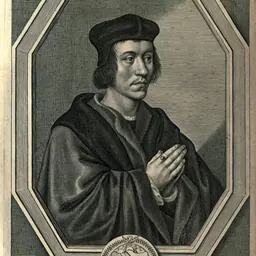
Edmund Beaufort, 2nd Duke of Somerset, 4th Earl of Somerset, 1st Earl of Dorset, 1st Marquess of Dorset styled 1st Count of Mortain, (140622 May 1455), was an English nobleman and an important figure during the Hundred Years' War. His rivalry with Richard, Duke of York, was a leading cause of the Wars of the Roses.
Origins Edmund Beaufort was the fourth surviving son of John Beaufort, 1st Earl of Somerset, and his wife, Margaret Holland. Edmund's father John Beaufort was the eldest son of John of Gaunt, the third surviving son of King Edward III, and his mistress, later wife, Katherine Swynford. Although John Beaufort had been born out of wedlock, he was legitimised in 1396. Edmund's mother, Margaret Holland, was a daughter of Thomas Holland, 2nd Earl of Kent, and his wife, Alice FitzAlan. Alice was the daughter of Richard FitzAlan, 10th Earl of Arundel, and his wife, Eleanor of Lancaster. Eleanor in turn was the daughter of Henry, 3rd Earl of Lancaster, a grandson of King Henry III. Edmund was thus a cousin of both Richard, Duke of York, and the Lancastrian King Henry VI.
Early Life Around the time of Edmund's birth in 1406, the House of Beaufort was among the most significant noble families in England. The Beauforts were half-brothers of King Henry IV, who was the son of John of Gaunt and his first wife, Blanche of Lancaster, and held significant royal favor. Edmund's father John was considered "one of Henry IV's most trusted councillors." Edmund's uncles Henry and Thomas Beaufort were also significant political figures: Henry was the Bishop of Lincoln and Winchester and would serve on three occasions as Lord Chancellor; Thomas held various military posts and would later become Chancellor.
Edmund's father John died in 1410, soon after his birth. Margaret Holland, Edmund's mother, remarried Thomas of Lancaster, Duke of Clarence, the younger brother of King Henry V, and Edmund may have been raised by the pair. Because of his youth, Edmund likely remained with his mother's household in Rouen instead of joining Clarence's campaign, which culminated with the death of the Duke of Clarence and the capture of both Edmund's brothers in 1421 at the Battle of Baugé. Edmund's attempts to secure lands and offices with an income that would support his claim to be a leading magnate of the realm would prove a driving force of his career. The liaison may have been the impetus for a parliamentary statute issued in 1427–28 seeking to regulate the remarriage of queens of England. Although Catherine of Valois later remarried Owen Tudor in secret, it is not clear when any relationship between the queen and Edmund ended (if it had existed at all), and Catherine's choice to name her first son through this new marriage Edmund Tudor has led to serious speculation as to whether Edmund Beaufort was the real father.
Early Military Career and Marriage Edmund returned to Normandy in February 1427 with a significant retinue (likely paid for by his wealthy uncle Henry Beaufort, now a cardinal and one of the leading churchmen in England) to fight in the Hundred Year's War. In addition to the modest lands she held as the widow of Baron Roos, Eleanor was expected to receive a significant inheritance from her wealthy parents Richard de Beauchamp, Earl of Warwick and Elizabeth Berkeley.
Calais and Harfleur In March 1436, Cardinal Beaufort lent the Crown the funds to equip a 2,000-man expedition to Normandy led by Edmund. Edmund came under the overall command of the Duke of Gloucester, who was planning a campaign to punish Duke Phillip of Burgundy for his decision to align with France in the Hundred Year's War. Under Gloucester's command, Edmund led a series of chévauchées into Burgundian Picardy.
1438 also saw the final conclusion of the 17-year negotiations for the ransom of Edmund's older brother John Beaufort, and, despite his more extensive military experience, seniority meant that Edmund was placed under his brother's command in 1439 and 1440. In October 1440, Edmund recaptured Harfleur, an important port and stronghold on the mouth of the Seine after defeating a French relief force.
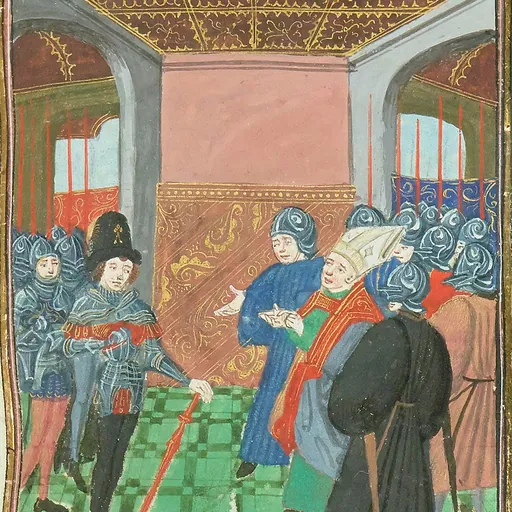
Political power and conflict Edmund surrenders to Charles VII at Rouen in 1449. Illuminated page from the Anciennes chroniques d'Angleterre, Jean de Wavrin. Edmund was created Earl of Dorset on 28 August 1442 (though he seems to have been styled as such since around 1438) and Marquess of Dorset on 24 June 1443. During the five-year truce from 1444 to 1449 he served as Lieutenant of France. On 31 March 1448 he was created Duke of Somerset. As the title had previously been held by his brother, he is sometimes mistakenly called the second duke, but the title was actually created for the second time, and so he was actually the first duke, the numbering starting over again.
Somerset was appointed to replace York as commander in France in 1448. Somerset was supposed to be paid £20,000; but little evidence exists that he was. Fighting began in Normandy in August 1449. Somerset's subsequent military failures left him vulnerable to criticism from York's allies. The most humiliating moment was when Somerset surrendered Rouen, the capital of Normandy, to the French without even a token siege. He failed to repulse French attacks, and by the summer of 1450 nearly all the English possessions in northern France were lost, with Normandy having fallen after the Battle of Formigny and Siege of Caen. By 1453 all the English possessions in the south of France were also lost and the Battle of Castillon ended the Hundred Years War.
The fall of the duke of Suffolk left Somerset the chief among King Henry VI's ministers, and the Commons in vain petitioned for his removal in January 1451. Power rested with Somerset and he virtually monopolised it, with Margaret of Anjou, wife of King Henry, as one of his principal allies. It was also widely suspected that Somerset had an extra-marital affair with Margaret. After giving birth to a son in October 1453, Margaret took great pains to quash rumours that Somerset might be his father. During her pregnancy Henry suffered a mental breakdown, prompted by the English defeat at Castillon, which left him in a withdrawn and unresponsive state that lasted for one-and-a-half years. This medical condition, untreatable either by court physicians or by exorcism, plagued him throughout his life. During Henry's illness, the child was baptised Edward, Prince of Wales, with Somerset as godfather; if the King could be persuaded, he would become legal heir to the throne.
Somerset's fortunes, however, soon changed when his rival York assumed power as Lord Protector in April 1454 and imprisoned him in the Tower of London. Somerset's life was probably saved only by the King's seeming recovery late in 1454, which forced York to surrender his office. Henry agreed to recognise Edward as his heir, putting to rest concerns about a successor prompted by his known aversion to physical contact; subsequently he came to view Edward's birth as a miracle. Somerset was honourably discharged, and restored to his office as Captain of Calais.
By now York was determined to depose Somerset by one means or another, and in May 1455 he raised an army. He confronted Somerset and the King in an engagement known as the First Battle of St Albans, which marked the beginning of the Wars of the Roses. Somerset was killed in a last wild charge from the house where he had been sheltering. His son, Henry, never forgave York and Warwick for his father's death, and spent the next nine years attempting to restore his family's honour.
Marriage and children At some time between 1431 and 1433, Somerset married Eleanor Beauchamp, daughter of Richard de Beauchamp, 13th Earl of Warwick, by his first wife Elizabeth de Berkeley, daughter and heiress of Thomas de Berkeley, 5th Baron Berkeley. Eleanor was an elder half-sister of Henry de Beauchamp, 1st Duke of Warwick, and Anne de Beauchamp, 16th Countess of Warwick, wife of Richard Neville, 16th Earl of Warwick, known as the "Kingmaker". The marriage was without royal licence, which offence was pardoned on 7 March 1438. By his wife he had issue including:
Sons Henry Beaufort, 3rd Duke of Somerset (26 January 143615 May 1464), eldest son and heir, who was beheaded after the Battle of Hexham, where he commanded the Lancastrian troops. He died unmarried, but left an illegitimate son by his mistress Joan Hill: Charles Somerset, 1st Earl of Worcester, 1st Baron Herbert (c.1460-1526), KG, who was given the surname "Somerset" and was created Baron Herbert in 1506 and Earl of Worcester in 1513. From him descend the Earls and Marquesses of Worcester and the present Dukes of Beaufort. Edmund Beaufort, 4th Duke of Somerset (14396 May 1471), John Beaufort, Earl of Dorset (1441 4 May 1471), Eleanor Beaufort (Countess of Ormond) (between 1431 and 143316 August 1501), who married firstly James Butler, 5th Earl of Ormond, and secondly Sir Robert Spencer (d. pre-1510), of London and Bridport, Dorset, also of Ashbury in Devon; frequently stated erroneously in credible sources to be of Spencer Combe, Crediton, Devon. One of the two daughters and co-heiresses of Sir Robert Spencer by his wife Eleanor Beaufort was Margaret Spencer (1472–1536) (or Eleanor), who married Thomas Cary of Chilton Foliat in Wiltshire, the younger son of William Cary (1437–1471) of Cockington and Clovelly in Devon, whose descendants included Cary, Viscount Falkland; Cary, Baron Hunsdon; Cary, Baron Cary of Leppington, Earl of Monmouth; and Cary, Viscount Rochfort, Earl of Dover, all of whom quartered the arms of Beaufort. Joan Beaufort (143311 August 1518), married firstly Robert St Lawrence, 3rd Baron Howth, and secondly Sir Richard Fry. Anne Beaufort (143517 September 1496), who married Sir William Paston (1436before 7 September 1496), a younger son of William Paston (1378–1444), Justice of the Common Pleas. Margaret Beaufort, Countess of Stafford (1437–1474), married firstly Humphrey, Earl of Stafford and secondly Sir Richard Darell, of Littlecote (in Ramsbury), Wiltshire. married Sir Henry Fitz Lewis. Mary Beaufort (born between 1431 and 1455)
Ancestry
Footnotes
Don’t just read it —
keep it.
Full-length biographies made to live with: read them, listen on the way to work, watch them tonight.
- E-book
- Audio
- Video
Instant download · yours to keep · every purchase keeps this site free
Important facts
Family & relationships
People in Edmund Beaufort, 2nd Duke of Somerset's life
Named in this biography and alive at the same time





Related people
Same field, nearest in time



Contemporaries
People whose lives overlapped Edmund Beaufort, 2nd Duke of Somerset's


Frequently asked questions
Who was Edmund Beaufort, 2nd Duke of Somerset?
English military personnel
When was Edmund Beaufort, 2nd Duke of Somerset born?
Edmund Beaufort, 2nd Duke of Somerset was born in 1406.
When did Edmund Beaufort, 2nd Duke of Somerset die?
Edmund Beaufort, 2nd Duke of Somerset died on 22 May 1455 in St Albans.
What was Edmund Beaufort, 2nd Duke of Somerset's occupation?
Edmund Beaufort, 2nd Duke of Somerset was a military personnel.
What nationality was Edmund Beaufort, 2nd Duke of Somerset?
Edmund Beaufort, 2nd Duke of Somerset was English.
Sources & further reading
· Wikipedia: Edmund Beaufort, 2nd Duke of Somerset
· DBpedia: Edmund Beaufort, 2nd Duke of Somerset
Cite this page
APA: Biography.guide. (2026). Edmund Beaufort, 2nd Duke of Somerset. https://biography.guide/edmund-beaufort-2nd-duke-of-somerset/
MLA: "Edmund Beaufort, 2nd Duke of Somerset." Biography.guide, https://biography.guide/edmund-beaufort-2nd-duke-of-somerset/.
Chicago: "Edmund Beaufort, 2nd Duke of Somerset." Biography.guide. https://biography.guide/edmund-beaufort-2nd-duke-of-somerset/.
Data last updated: 2026-09-21 · Spot an error? Report a correction.
Portrait: Wikimedia Commons · author & licence
Page generated 2026-09-27 04:59 UTC