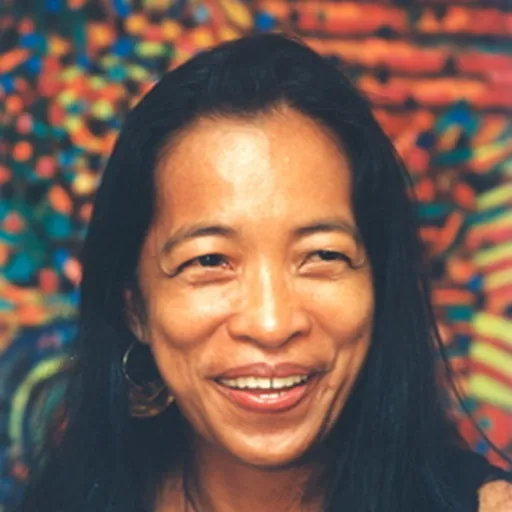
About Pacita Abad
Lived 1946 – 2004 (aged 58). Pacita Abad was a Filipino painter.
Pacita Barsana Abad (October 5, 1946 – December 7, 2004) was a Filipino-American Ivatan visual artist. She worked in mixed media, integrating fiber art with painting; in particular she created mixed-media canvases using trapunto quilting as well as painting. Her work is characterized by vibrant color. Over more than 30 years, she exhibited her work in over 200 museums, galleries and other venues around the world, including 75 solo shows. Abad's work is now in public, corporate and private art collections in over 70 countries.
Early life and education Abad was born in Basco, Batanes, on October 5, 1946, the fifth of thirteen children. From 1949 to 1972, her father, Jorge Abad, represented the lone district of Batanes in the Congress of the Philippines for a total of five nonconsecutive terms. Her mother, Aurora Abad, served for one term (1966 to 1969) in the same elected position after Jorge Abad was appointed secretary of public works and highways by President Diosdado Macapagal. The Abad family moved from Batanes to Manila at the end of Jorge Abad's first term, returning temporarily when he was campaigning for reelection. In Manila, Pacita Abad attended Legarda Elementary School and Ramon Magsaysay High School.
She graduated from the University of the Philippines Diliman with a Bachelor of Arts in political science in 1968. The following year, she began graduate studies in law at the same institution.
Abad's father successfully protested his 1969 election defeat to the Commission on Elections and the Supreme Court of the Philippines, and the family home in Manila became a target of violence, including once being shot at. Although no one was harmed, Abad's parents encouraged her to leave the country and continue her law studies in Spain.
While working as a secretary for a foreign aid foundation and as a home seamstress, Abad started a graduate program in Asian history at Lone Mountain College. In 1973 she earned a master's degree with a thesis titled "The Role of Emilio Aguinaldo in the Acquisition of the Philippines by the United States from Spain: 1898". She was offered a scholarship to attend the Boalt Law School at the University of California, Berkeley. However, she deferred her enrollment after meeting Stanford University graduate student Jack Garrity. The two traveled across Asia for a year, including a two-month stay in the Philippines. Upon returning to California, Abad relinquished her law school scholarship and took up painting. took painting classes at the Art Students League of New York At the Art Students League, Abad studied still life and figurative art under John Heliker and Robert Beverly Hale. The exhibit did not include one of her most notable works, Flight to Freedom (1980), which was not yet complete.
In 1986, Abad and Garrity moved back to Washington, D.C. for his work at the World Bank; Her work is characterized by vibrant color. In 1991, she painted a self-portrait in front of San Francisco landmarks, If My Friends Could See Me Now; she is wearing a red beret, the Transamerica Pyramid is royal blue, and other buildings are scarlet and violet, with Lombard Street embroidered in gold thread. In 1988 she taught classes on trapunto painting and on wearable art at the Smithsonian Institution. Immigrant Experience (begun in 1994), and a series of depictions of Indonesian wayang puppets that grew to encompass more than 100 paintings and led to a 2000 commission from Kedaung Ceramics for a hand-painted limited-edition dinnerware set. In addition to the Cambodian Refugee and Immigrant Experience series, Abad's political art included Death of Ninoy (1983, painted immediately after the assassination of Benigno Aquino Jr), the trapunto painting Marcos and His Cronies (1985–95), Caught at the Border (1991), Korean Shopkeepers (1992, in response to the 1992 Los Angeles riots), Haitians Waiting (1992), L.A. Liberty (1992), Contemplating Flor (1995, in response to the sentencing of Flor Contemplacion), Filipinas in Hong Kong (1995), The Sky Is Falling, the Sky Is Falling (1998), and in collaboration with New York women artists, three 2001 murals commemorating the September 11 attacks as part of the 9/11 Phoenix Project.
Exhibitions Solo Pacita Abad: A Philippine Painter Looks at the World, curated by Arturo Luz, Museum of Philippine Art, Manila, 1984 Circles in My Mind, Cultural Center of the Philippines, 2004
Joint and group 2nd Havana Biennial, 1986
Abad was naturalized as a citizen of the United States in 1994.
Legacy
Since her death, Abad's works have often been displayed in galleries and museums in the Philippines during the annual Philippine Arts Month and other art festivals.
In 2019, the Tate Modern in London exhibited Abad's quilted canvas works "Bacongo III-IV" (1986) and "European Mask" (1990). In the same year, trapunto paintings by Abad were shown at Frieze London.
In 2023, the first major retrospective of Abad's work was held. and traveled to the San Francisco Museum of Modern Art, An exhibition of her works titled Colors of My Dream was also presented by the Tina Kim Gallery in New York City in 2023. Works by Abad have since been exhibited in the Guggenheim Abu Dhabi and at the 60th Venice Biennale, among others.
On July 31, 2020, Abad was commemorated with a Google Doodle.
Her work was included in the exhibition Making Their Mark: Works from the Shah Garg Collection at the Berkeley Art Museum and Pacific Film Archive (BAMPFA).
Awards Abad was the first woman to receive the Outstanding Young Men of the Philippines Arts award, in 1984. In 1990 she won the Washington, DC, Metro Art Award. In 1995 she received the Excellence 2000 Award for the Arts of the US Pan Asian American Chamber of Commerce. In 2000, in Manila, she received the Pamana ng Pilipino Award for outstanding achievement in the arts.
Don’t just read it —
keep it.
Full-length biographies made to live with: read them, listen on the way to work, watch them tonight.
- E-book
- Audio
- Video
Instant download · yours to keep · every purchase keeps this site free
Important facts
People in Pacita Abad's life
Named in this biography and alive at the same time






Related people
Same field, nearest in time


Contemporaries
People whose lives overlapped Pacita Abad's

Frequently asked questions
Who was Pacita Abad?
painter (1946-2004)
When was Pacita Abad born?
Pacita Abad was born on 5 October 1946 in Basco, Batanes, Philippines.
When did Pacita Abad die?
Pacita Abad died on 7 December 2004 in Singapore.
What was Pacita Abad's occupation?
Pacita Abad was a painter.
What nationality was Pacita Abad?
Pacita Abad was Filipino.
Sources & further reading
Cite this page
APA: Biography.guide. (2026). Pacita Abad. https://biography.guide/pacita-abad/
MLA: "Pacita Abad." Biography.guide, https://biography.guide/pacita-abad/.
Chicago: "Pacita Abad." Biography.guide. https://biography.guide/pacita-abad/.
Data last updated: 2026-09-22 · Spot an error? Report a correction.
Portrait: Wikimedia Commons · author & licence
Page generated 2026-09-27 05:02 UTC