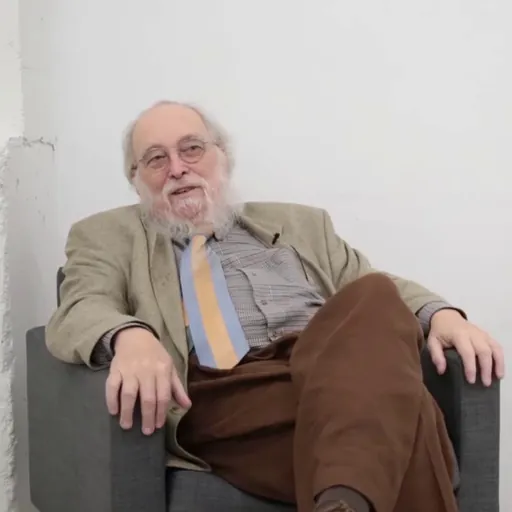
About P. Adams Sitney
Lived 1944 – 2025 (aged 80). P. Adams Sitney was an American film critic, journalist, editor, film historian and university teacher.
Paul Adams Sitney (August 9, 1944 – June 8, 2025) was a historian of American avant-garde cinema. His 1974 book Visionary Film was one of the first to chronicle the history of experimental film in the United States.
Early life and education Paul Adams Sitney was born on August 9, 1944, in New Haven, Connecticut. In a later interview, he described his family as poor; his father ran a small grocery store in downtown New Haven. Sitney said he attended a "ghetto grammar school" where he learned to become "street smart" and developed strong self-confidence. He was meanwhile working as a lab assistant at the Yale Medical Center, and also frequenting Yale University's Sterling Memorial Library to read about film. He originally attended Trinity College under a full scholarship, where he studied Greek with Professor James Notopoulos. After Sitney's parents divorced and Notopoulos fell ill, Sitney left Trinity and took a year off, during which he lectured in Europe on experimental cinema. He then transferred to Yale University, receiving an A.B. in Greek and Sanskrit in 1967. Sitney initially held the post of general director, although he soon found himself ill-suited for its administrative duties, and instead took the role of director of library and publications. He later edited a volume of essays on the selected films, The Essential Cinema (1975).
After editing a series of monographs on individual filmmakers, Sitney published his first major work of scholarship in 1974, Visionary Film: The American Avant Garde. It has been praised as "a brilliant analysis of the groundbreaking films at the heart of the experimental film movement". Sitney was an intellectual leader of the movement. One of his theoretical contributions was to identify four main techniques of structural film: fixed camera position; "flicker" effect; re-photography off the screen; and loop printing. These techniques were implemented by experimental filmmakers in the 1960s to create cinema "in which the shape of the whole film is pre-determined and simplified".
In his academic career, Sitney was Professor of Visual Arts at the Lewis Center for the Arts at Princeton University. Prior to joining Princeton, he taught at the Cooper Union for the Advancement of Science and Art, as well as at Yale, NYU, and Bard College.
Personal life and death Sitney was Roman Catholic and a conscientious objector to the Vietnam War. He was married twice; he had two children with his first wife, Julie Adams, and two with his second wife, Marjorie Keller.
Don’t just read it —
keep it.
Full-length biographies made to live with: read them, listen on the way to work, watch them tonight.
- E-book
- Audio
- Video
Instant download · yours to keep · every purchase keeps this site free
Important facts
People in P. Adams Sitney's life
Named in this biography and alive at the same time


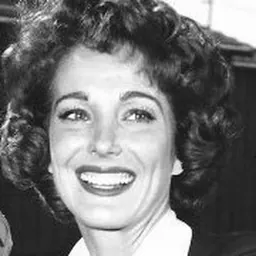

Related people
Same field, nearest in time


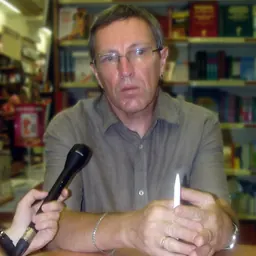
Contemporaries
People whose lives overlapped P. Adams Sitney's

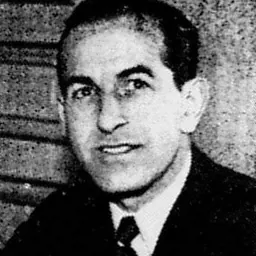

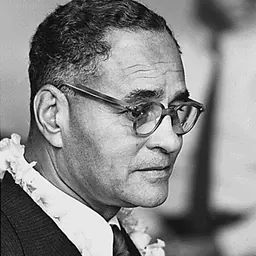

Frequently asked questions
Who was P. Adams Sitney?
American film historian (1944–2025)
When was P. Adams Sitney born?
P. Adams Sitney was born on 9 August 1944 in New Haven.
When did P. Adams Sitney die?
P. Adams Sitney died on 8 June 2025 in Rhode Island.
What was P. Adams Sitney's occupation?
P. Adams Sitney was a film critic, journalist, editor, film historian and university teacher.
What nationality was P. Adams Sitney?
P. Adams Sitney was American.
Sources & further reading
Cite this page
APA: Biography.guide. (2026). P. Adams Sitney. https://biography.guide/p-adams-sitney/
MLA: "P. Adams Sitney." Biography.guide, https://biography.guide/p-adams-sitney/.
Chicago: "P. Adams Sitney." Biography.guide. https://biography.guide/p-adams-sitney/.
Data last updated: 2026-09-22 · Spot an error? Report a correction.
Portrait: Wikimedia Commons · author & licence
Page generated 2026-09-27 05:04 UTC