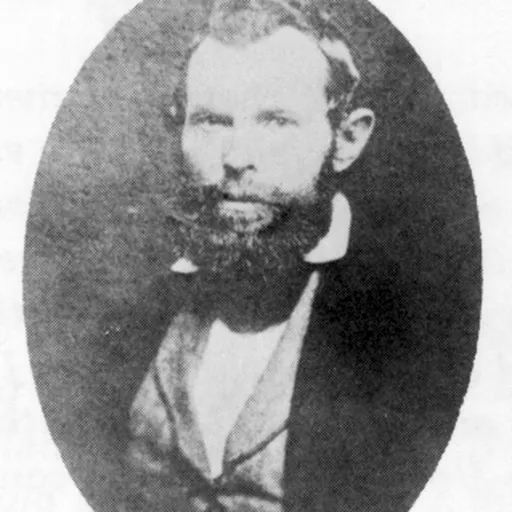
About Owen Brown
Lived 1824 – 1889 (aged 64). Owen Brown was an American abolitionist and farmer, known for John Brown's raid on Harpers Ferry.
Owen Brown (November 4, 1824 – January 8, 1889) was the third son of abolitionist John Brown. He participated more in his father's anti-slavery activities than did any of his siblings. He was the only son to participate both in the Bleeding Kansas activities—specifically the Pottawatomie massacre, during which he killed a man —and his father's raid on Harpers Ferry. He was the only son of Brown present in Tabor, Iowa, when Brown's recruits were trained and drilled. He was also the son who joined his father in Chatham, Ontario, Canada, when the raid was planned; he was chosen as treasurer of the organization of which his father was made president.
He was much affected by the death of his mother, along with his newborn brother Frederick, when he was eight.
His burial site, atop a hill near Altadena, California, has become a minor tourist destination, reached via a public hiking trail. In 2024 the site was designated a Los Angeles County historical landmark.
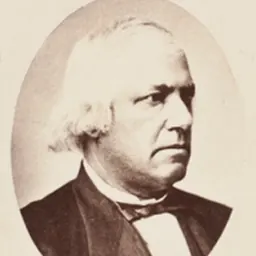
Resemblance to his father Physically Of John Brown's six adult sons, he was said to be the one that most resembled his father physically; he was "exactly like the portraits of his father", "he bore the likeness of his father more perfectly than either of his brothers [Jason and John Jr.], and in many characteristics was like him." He was described thus in the 1859 warrant for his arrest:
Owen's arm injury According to his father, "Owen [was] to some extent a cripple from childhood by an injury of the right arm".
Psychologically He was also said to most resemble his father psychologically:
Another reporter said that Owen, of John Brown's sons, "is perhaps the greatest character of them all. Noticeably eccentric, with a strange mingling of gentleness and roughness, sentiment and course practicability , which even his intimate friends cannot understand, with one of the warmest of hearts and the readiest hand, he leads a wandering kind of life, seeming to cut himself off from old friends and associations, and yet after a while returning to them, or letting them know by some kind message that they are not forgotten. He seems literally a man without a home, for realizing his restless disposition he has never married or formed any ties that could not easily be shaken off. He resembles his father in form and feature, and also—though in an exaggerated degree—his independence of the world's opinion."
Comments on his personality He was "a man of eccentrlc character, humorous and kindly, and endowed with one of those wonderful memories in which every past scene and event seems preserved exactly as it befell, no matter how long the intervening time. His narration of his adventures was minute to the least point. ...The friendliest of men." He was compared with Thoreau, though "without his learning and genius." Owen was "generous to a fault, giving poorer neighbors all that he earns except the merest pittance for his own simple wants."
Abolitionist activities Kansas Owen fought together with his father in Kansas and was present at the sack of Lawrence. Border ruffians from Missouri burned his house and stole his cattle. He participated, along with brother-in-law Henry Thompson, in the Pottawatomie massacre.
Harpers Ferry
Owen was the only child of Brown to participate in the Chatham, Ontario, meeting in which the raid was planned. He was chosen as treasurer of the organization, of which John Brown was president.
Owen, as he told it later, before the raid "spent many months in the mountains of the South, searching out suitable places for the rendezvous and concealment of liberty-seeking slaves". During the three months before the raid, his father, under cover of prospecting for minerals, examined and approved of a number of them. his shoes having given out, Now near the Ohio border, he reached the safety of the home of his brother John Jr., at that time in Dorset, Ashtabula County, Ohio, some from Harpers Ferry. Together with him in John Jr.'s home for three weeks were fellow escaped raiders Barclay Coppock and Francis Jackson Meriam, as well as Brown's first biographer, James Redpath.
In early February 1860 Owen was indicted by a Virginia grand jury for "conspiring with slaves to create an insurrection". On March 8, 1860, the new governor of Virginia, John Letcher, announced a $500 reward for his apprehension and delivery to Virginia. The Attorney General of Ohio, Republican Christopher Wolcott, refused to honor Virginia's request for Owen's arrest and extradition. A reporter had to make many visits to get him to tell the story of his difficult escape, which he said he had never told in 12 years.
At that time Owen and his older brother John Jr. were farming at Put-in-Bay, Ohio, Owen in a "one-roomed shanty", full of mementos, near his brother's house. "Everything in the room was neat and tidy, but very cheap and rude. He had a cot for a bed, and heat was supplied by a little stove fed with dry cuttings from the grapevines."
Locals described Owen as "extremely eccentric". He spent much of his time fishing. John Henry Kagi had taught him shorthand while they were training in Iowa in 1857–58.
Pasadena, California
The first cabin of Owen (left) and Jason Brown, near Altadena, California. The beams protect from the winds high on the hill. This cabin was destroyed by fire in 1888. Bird's-eye view, Brown boys' rancho (first cabin). Note the visitors. The supporting beams have not yet been installed.
The second cabin, at a higher elevation. Left to right, Jason, John Jr., and Owen Brown, with their livestock. 1888? John Jr. is visiting. Jason and Owen Brown's second cabin, Altadena, California. In the background is Little Round Top. In 1885, his health failing, Owen moved to Pasadena, California, joining his brother Jason, who emigrated in 1881 after his Akron, Ohio, home was destroyed by fire, Henry had bought of land. They were seeking to escape "the increasingly negative broad popular memory of Brown." the men "eccentric and charming". "They were much visited by tourists and citizens, some from mere curiosity and other from a warm sympathy with the heroic career of the family." They were "often" visited by the naturalist Charles Frederick Holder, who talked with them about their experiences and the Underground Railroad. According to one report, "it was difficult to get Owen to speak of the tragic events of his life",
Owen and Jason Brown won the respect of their neighbors, "but their ideas of law and justice were as peculiar as their father's. They kept to themselves their charities, and they were always quick to help anyone who was persecuted. When the boycott was placed upon the Chinese in Los Angeles county, three years ago [1886, see Chinese Exclusion Act] Owen and Jason went down into Pasadena and hired each a Chinaman to work on his place for the sake of the principle, although they had no need of the Celestials' labor, and would be troubled to find money to pay for it. They refused to take interest on money when they had any to loan. When some friends raised a contribution for them, they asked that the money be sent instead to the colored sufferers of the 1886 Charleston earthquake."
According to an obituary:
Jason wrote, in an 1886 letter, "The people of Pasadena are eastern, mostly, and are very kind to us; they raised over $100 (~$ in ), a short time ago without our knowing it, and gave it to us to buy a cow." When John Jr. visited them (see picture at right), and decided not to stay, they had to sell the cow to get money for John Jr.'s return east.
There, they were celebrated and supported, not for helping their father end slavery, but for a more contemporary movement, temperance. Owen became "one of the best known of Pasadena's early residents." An as-yet unidentified photographer carried his equipment up the mountain on several occasions, and left us good pictures of both cabins, including the second one seen from above.
Temperance "He was a zealous advocate of temperance, to advance which was the great aim of his later life." Celebrating the contemporary temperance campaign was a means to avoid dealing with their father's radical egalitarianism and recourse to violence.
An obituary noted that he sent "fruit and sympathy" to the anarchists on trial in the Haymarket affair.
Death and funeral Souvenir of Owen Brown's funeral, Pasadena, California, in 1889. Building is Methodist Tabernacle.
Shortly before his death, a friend asked Owen for his autograph and sentiment. Above his name, he wrote: "The only true religion is to be true to every human being, and to all animals so far as it is possible, and be just." Four ministers spoke—Methodist Episcopal, Quaker, Congregational, and Universalist—followed by "a temperance speaker". The city trustees attended as a body, as did students from the Pasadena Academy. There were four stations set up along the route for photographers. Owen had asked to be buried on the hilltop near his cabin, in a spot called sublime, "on one of the highest peaks of the Sierra Madre mountains, commanding a view of the valley below for , the sea and even the islands of the sea." It was subsequently called Brown Mountain.
In May 1889, a newspaper remarked that "the tomb of Owen Brown receives as much attention from visitors as any other point of interest in the Sierra Madre range. It is not uncommon to see fresh flowers laid upon the mound, which appears as barren for want of grass as when first made."
Jason left the cottage when Owen died, and found employment in the Sierra Madre with the new, scenic Mount Lowe Railway. He lived at Echo Mountain, a railway junction. His wife and children never came to California.
Grave marker Nine years later, a gravestone, paid for by pallbearer Major H. N. Rust, was placed at the grave site. It read: "Owen Brown, Son of John Brown, the Liberator, died Jan. 9, 1889." Two iron ornaments, a heavy hook on the left, and a 6" diameter ring on the right, were attached to eyelets in the marker and could be moved—symbolizing freedom from the shackles of slavery and rapture from mortal bounds. 200 people attended the dedication.
The marker disappeared from the grave site in 2002, along with the concrete base and surrounding rail fencing, after the property on which it was located was sold. No legal action was taken, as the person or persons responsible have never been identified. In 2012, the missing gravestone was found a few hundred feet from the gravesite. In 2021, it was announced that the gravestone would be reinstalled.
In popular culture He is the narrator, an old man living in California in 1909 (50 years later), in Russell Banks' novel about John Brown, Cloudsplitter. In this novel he accompanies his father on his trip to England of 1848, and a pregnant unmarried woman, who commits suicide by jumping overboard, is the mysterious lady he loved. This is fiction.
Owen Brown is a supporting character in Ann Rinaldi’s novel Mine Eyes Have Seen. The book is from the perspective of Owen’s sister, Annie Brown.
Actor Jeffrey Hunter portrayed Owen in the 1955 film Seven Angry Men. The title refers to John Brown and his six grown sons, focusing mostly on the moral debate between Owen and his father.
He is portrayed by actor Beau Knapp in the 2020 Showtime limited series The Good Lord Bird, based on the 2013 novel of the same name by James McBride.
Writings by Owen Brown Letter to his mother, August 27, 1856.
Further reading (most recent first)
Revised version of a piece first published in the Sandusky Daily Register, July 28, 1892, p. 3. The author was a resident of Put-in-Bay.
Don’t just read it —
keep it.
Full-length biographies made to live with: read them, listen on the way to work, watch them tonight.
- E-book
- Audio
- Video
Instant download · yours to keep · every purchase keeps this site free
Important facts
Family & relationships
People in Owen Brown's life
Named in this biography and alive at the same time


Related people
Same field, nearest in time



Contemporaries
People whose lives overlapped Owen Brown's




Frequently asked questions
Who was Owen Brown?
American activist (1824–1889)
When was Owen Brown born?
Owen Brown was born on 4 November 1824 in Hudson.
When did Owen Brown die?
Owen Brown died on 8 January 1889 in Pasadena.
What was Owen Brown's occupation?
Owen Brown was an abolitionist and farmer.
What was Owen Brown known for?
Owen Brown was known for John Brown's raid on Harpers Ferry.
What nationality was Owen Brown?
Owen Brown was American.
Sources & further reading
· DBpedia: Owen Brown (abolitionist, born 1824)
Cite this page
APA: Biography.guide. (2026). Owen Brown. https://biography.guide/owen-brown-abolitionist/
MLA: "Owen Brown." Biography.guide, https://biography.guide/owen-brown-abolitionist/.
Chicago: "Owen Brown." Biography.guide. https://biography.guide/owen-brown-abolitionist/.
Data last updated: 2026-09-20 · Spot an error? Report a correction.
Portrait: Wikimedia Commons · author & licence
Page generated 2026-09-27 04:57 UTC