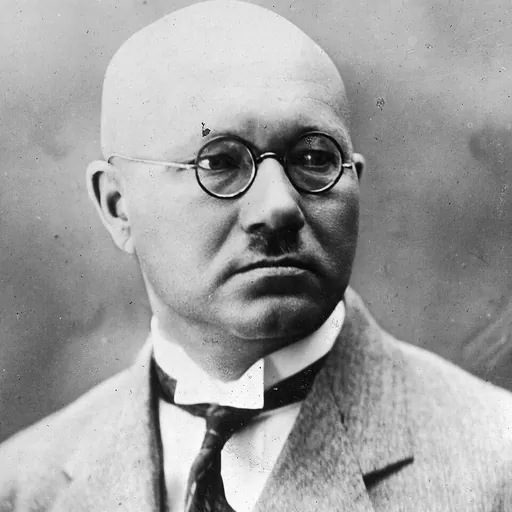
About Otto Strandman
Lived 1875 – 1941 (aged 65). Otto Strandman was a Russian and Estonian politician, diplomat, jurist, lawyer, judge and statesperson.
Otto August Strandman (; – 5 February 1941) was an Estonian politician, who served as Prime Minister and State Elder of Estonia (1929–1931).
Strandman was one of the leaders of the centre-left Estonian Labour Party, that saw its biggest support after the 1919 and 1920 elections. Strandman was a key figure in composing the radical land reform law and the 1920 Constitution. He also served as Minister of Agriculture (1918–1919), Minister of Justice (acting 1918; 1920–1921), Minister of Finance (1924), Minister of Foreign Affairs (1918, 1920–1921 and 1924) and Minister of War (1919). During his tenure Minister of Finance, having been a critic of the previous government's policies, he pursued an anti-inflationary policy, seeing it as a method of avoiding hyperinflation and crisis. He was aiming at a 'Danish' model of a modern agricultural economy rather than indsutrialization, Strandman served as the speaker of the Estonian Provincial Assembly in 1917–1918, and as speaker of the newly independent country's parliament (Riigikogu) in 1921. He was also a diplomat, serving as the Estonian envoy in Warsaw, Poland (1927–1929), and in Paris, France (1933–1939).
After the Soviet Union invaded and occupied Estonia and the other Baltic states in June 1940, Strandman committed suicide in February 1941, after being called to appear at the local headquarters of the NKVD.
Early life Strandman was born in the village of Vandu, Undla Parish (now Kadrina Parish). His father, Hans Strandman, was a schoolteacher, and Otto was his third child.
Strandman was first educated by his father, until he began his studies at the municipal school of Rakvere in 1886, and later at Emperor Alexander State High School in Tallinn and the 5th and the 7th High School in Saint Petersburg. He graduated as an extern in 1896 after his exams in the Estonian Governorate High School of Tallinn.
After graduation, Strandman served as an official at the Tallinn Office of the State Bank of the Russian Empire until he went on to study law at the University of Tartu in 1899. In 1901 he continued his studies at the Saint Petersburg Imperial University, graduating in 1903.
Career Early career After graduating, Strandman worked as a lawyer in Narva and Tallinn. He became known for his eloquence and was elected to be a member of Tallinn city council from 1904 to 1905. As a lawyer, he defended Estonians against Baltic Germans and state officials. but in the course of the 1905 Revolution, Strandman, like many other Estonian activists, was forced to flee abroad. At the time of the revolution, he supported radical socialist political positions, but later in his life moved towards the centre-left.
During his exile years, Strandman lived in Switzerland and other European countries. In Switzerland, Strandman and other Estonian exiles eventually did form the draft of self-government reform, but it was never implemented. Strandman returned to the Russian Empire in 1906, but he was banned from living in the Baltic governorates for three years, forcing him to live in Narva and Saint Petersburg. Strandman was again elected to the Tallinn City Council and, in the summer of 1917, to the Estonian Provincial Assembly, where he was part of the leftist Estonian Radical Socialist Party, led by Jüri Vilms.
Leader of the centre-left After Jüri Vilms was mysteriously executed in Finland in 1918, Otto Strandman took over as acting Minister of Court. He also became one of the leaders of the Estonian Radical Socialist Party, which in 1919 would merge with the Social Travaillist Party to form the centre-left Estonian Labour Party. Strandman was however arrested by Germans in the summer of 1918. when he also served as a deputy for Minister of Foreign Affairs Jaan Poska. As Minister of Agriculture, Strandman became the key person in composing and implementing a new land reform law. Being one of the leaders of the Labour Party, he fought hard to make the land reform as radical as possible. The Estonian Labour Party's Ants Piip then headed a one-party minority government between 26 October 1920 and 25 January 1921, where Otto Strandman served as both Minister of Foreign Affairs and Minister of Justice. As Minister of Foreign Affairs, he established diplomatic relations between Estonia and Soviet Russia, making Estonia one of the first countries to do so.
The 1920 elections made the Estonian Labour Party the biggest party in Estonia with 22 of the 100 seats in Riigikogu, the first constitutional parliament, but the centre-right parties had also gained strength. The Estonian Labour Party remained in the coalition, headed by State Elder Konstantin Päts of Farmers' Assemblies. Strandman went on to serve as the first speaker of the Riigikogu between 4 January and 18 November 1921.
Juhan Kukk headed another Estonian Labour Party cabinet in 1922–1923, but without Strandman. In the following cabinet of Christian Democrat Friedrich Karl Akel, he returned as Minister of Foreign Affairs between 26 and 14 March May 1924 and then Minister of Finance until 16 December 1924.
Economic policies Strandman figured several times in financial affairs. On 7 and 19 December 1923, he accused long-term inflationist Minister of Finance Georg Vestel in the parliament for incorrect spending of the state treasury. It was Strandman's criticism that eventually led to the fall of Konstantin Päts's cabinet and caused him to stay away from power from 1924 to 1931. He also supported building the economy on agriculture rather than transit between Russia and Europe, regarding Denmark as a model agricultural country.
From 1927 to 1929, Strandman served as Estonian envoy to Poland, with additional accreditation to Czechoslovakia and Romania, residing in Warsaw. In June 1929, he unexpectedly resigned and returned to Estonian politics to head his second cabinet, starting from 9 July 1929. It was a coalition between his Labour Party, People's Party, Christian People's Party, Farmers' Assemblies and the Settlers' Party, combining almost all political parties from the centre-left to right. Before taking office, he criticized the parliament for becoming a "factory of inadequate laws".
During his time in office, he made a state visit to Poland in February 1930, where he met both President Ignacy Mościcki and Marshal Józef Piłsudski to propose the formation of a Baltic Entente, something which however didn't find Polish support. On his return home, he visited Vilnius, which was controlled by Poland at the time. The visit damaged the relations between Estonia and Lithuania, with Dovas Zaunius, Lithuania's Minister of Foreign Affairs, protesting the visit as a breach of neutrality in the Vilnius disputeBy 1931, Estonian-Lithuanian relations had somewhat healed. In August 1930, Strandman hosted President Mościcki in Estonia.
Membership in the parliament: 1917–1919 Estonian Provincial Assembly (Maapäev) 1919–1920 Estonian Constituent Assembly (Asutav kogu) 1920–1923 I Riigikogu 1923–1926 II Riigikogu 1926–1927 III Riigikogu 1929–1932 IV Riigikogu 1932 V Riigikogu
Later diplomatic career and death
From 1933 to 1939 Strandman was envoy of Estonia to France, Belgium, Spain and the Holy See, residing in Paris. In 1936 he supported Juhan Kukk, Ants Piip, Jaan Teemant, and Jaan Tõnisson, who signed a memorandum addressed to Prime Minister in duties of the State Elder Konstantin Päts, demanding civil freedoms and an end to his authoritarian rule. In 1938, Strandman became a judge at the Permanent Court of International Justice in The Hague.
In 1939, Strandman returned to Estonia, but retired from public life due to ill health. As he was not active in politics, he was initially left alone after the Soviet occupation in 1940. In 1941 however, Strandman received a formal notice to appear at the local headquarters of the NKVD. Realizing his fate, he shot himself to death in his home in Kadrina on 5 February 1941. He was buried in Tallinn's Sisekalmistu Cemetery.
Honours National Honours Cross of Liberty, III class, 1st degree (1920) Order of the Estonian Red Cross, 3rd class (1921) Order of the Estonian Red Cross, 2nd class (1928) Order of the Estonian Red Cross, 1st class (1929) Order of the Cross of the Eagle, 1st class (1930)
Don’t just read it —
keep it.
Full-length biographies made to live with: read them, listen on the way to work, watch them tonight.
- E-book
- Audio
- Video
Instant download · yours to keep · every purchase keeps this site free
Important facts
People in Otto Strandman's life
Named in this biography and alive at the same time




Related people
Same field, nearest in time




Contemporaries
People whose lives overlapped Otto Strandman's

Frequently asked questions
Who was Otto Strandman?
Estonian politician (1875–1941)
When was Otto Strandman born?
Otto Strandman was born on 30 November 1875 in Undla Rural Municipality.
When did Otto Strandman die?
Otto Strandman died on 5 February 1941 in Kadrina.
What was Otto Strandman's occupation?
Otto Strandman was a politician, diplomat, jurist, lawyer, judge and statesperson.
What nationality was Otto Strandman?
Otto Strandman was Russian and Estonian.
Sources & further reading
Cite this page
APA: Biography.guide. (2026). Otto Strandman. https://biography.guide/otto-strandman/
MLA: "Otto Strandman." Biography.guide, https://biography.guide/otto-strandman/.
Chicago: "Otto Strandman." Biography.guide. https://biography.guide/otto-strandman/.
Data last updated: 2026-09-20 · Spot an error? Report a correction.
Page generated 2026-09-27 05:10 UTC