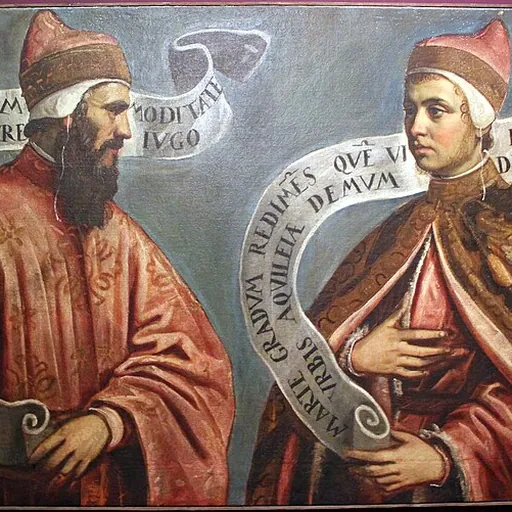
About Otto Orseolo
Lived 993 – 1032 (aged 38–39). Otto Orseolo was an Italian politician and military personnel.
Otto Orseolo (, 993−1032) born Pietro Orseolo, was the Doge of Venice from 1009 to 1026 and again from 1030 to 1032. He was the third son of doge Pietro II Orseolo and Maria Candiano, whom he succeeded at the age of sixteen, becoming the youngest doge in Venetian history.
During his dogeship, Otto strengthened the influence of the House of Orseolo within Venice and continued his father's policy of expanding Venetian authority in Dalmatia. His rule was marked by tensions with the Holy Roman Empire over the dispute between the patriarchates of Grado and Aquileia, as well as by internal opposition to his family's dominance of Venetian politics. Deposed in 1026 by a revolt led by Domenico Flabanico, Otto was banished and went into exile in Constantinople. In 1030, his brother Orso, Patriarch of Grado, overthrew doge Pietro Barbolano in a coup and assumed control of Venice as regent, recalling Otto to reclaim the dogeship. Otto, however, died on his journey back to Venice in 1032.
Biography
Early life Born in Venice in 993, he was the third son of doge Pietro II Orseolo and his wife Maria Candiano, daughter of doge Vitale Candiano. His original name was Pietro, but in 996, while Emperor Otto III was residing in Verona and granting privileges to Venice in the March of Verona, he requested that Pietro II Orseolo send his third son to Verona, where he acted as the boy's sponsor at his confirmation. In the Emperor's honour, Pietro took the name Otto. In 1004, Otto, in the company of his eldest brother and co-doge Giovanni, traveled to Constantinople, where Giovanni married the niece of Basil II, Maria Argyra, and Otto received several honorific titles.
After Giovanni's sudden death in 1007, Pietro raised Otto to the dogeship with him. Pietro himself died soon afterward. He bequeathed his possessions to the poor and to the clergy and left Otto sole doge at the meager age of sixteen.
Dogeship Soon after the death of his father, in 1009, Otto married Grimelda, a daughter of the newly Christian Géza of Hungary and Adelaide. Because the Chronicon Venetum of John the Deacon ends in Otto's reign, it is necessary to rely on later chronicles. , married to Nicolò Bembo, a member of the House of Bembo. Their daughter Elena Bembo married to Giovanni Vitale Michiel, son of Vitale Michiel of the House of Michiel, and Felicia Elena Cornaro, member of the House of Cornaro. Their son Domenico Michiel became the 35th Doge of Venice. Some sources suggest that Otto may have had another son, Orso, though this remains unclear. The scroll held by Otto Orseolo contains the following inscription in latin:
Don’t just read it —
keep it.
Full-length biographies made to live with: read them, listen on the way to work, watch them tonight.
- E-book
- Audio
- Video
Instant download · yours to keep · every purchase keeps this site free
Important facts
Family & relationships
People in Otto Orseolo's life
Named in this biography and alive at the same time



Related people
Same field, nearest in time


Contemporaries
People whose lives overlapped Otto Orseolo's



Frequently asked questions
Who was Otto Orseolo?
Doge of Venice (992-1032)
When was Otto Orseolo born?
Otto Orseolo was born in 993 in Venice.
When did Otto Orseolo die?
Otto Orseolo died in 1032 in Constantinople.
What was Otto Orseolo's occupation?
Otto Orseolo was a politician and military personnel.
What nationality was Otto Orseolo?
Otto Orseolo was Italian.
Sources & further reading
Cite this page
APA: Biography.guide. (2026). Otto Orseolo. https://biography.guide/otto-orseolo/
MLA: "Otto Orseolo." Biography.guide, https://biography.guide/otto-orseolo/.
Chicago: "Otto Orseolo." Biography.guide. https://biography.guide/otto-orseolo/.
Data last updated: 2026-09-22 · Spot an error? Report a correction.
Portrait: Wikimedia Commons · author & licence
Page generated 2026-09-27 05:04 UTC