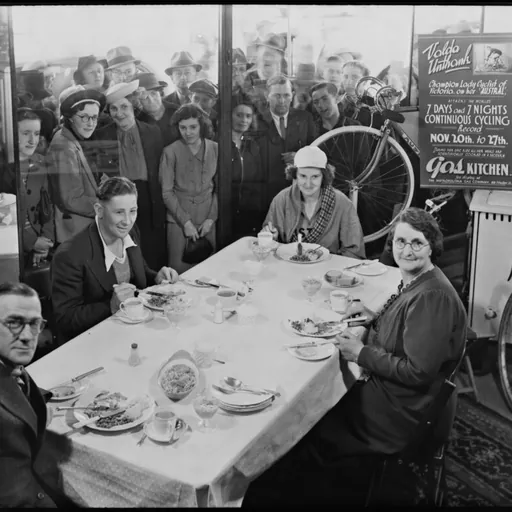
About Ossie Nicholson
Lived 1906 – 1965 (aged 58–59). Ossie Nicholson was an Australian sport cyclist.
Oserick Bernard "Ossie" Nicholson (1910 – 9 November 1965) was an Australian cyclist who twice held the World Endurance record for distance in a calendar year.
Australian cycling career Nicholson was a professional cyclist in the years before World War II. He competed on both road and track, as was typical of Australian cyclists of the era such as Hubert Opperman and Richard Lamb.
Nicholson was third in the 1929 Warrnambool to Melbourne Classic, behind Opperman and Horrie Marshall and won the 1929 Wangaratta to Melbourne race. In February 1930 Nicholson rode to break the Australian one hour motor-paced cycling record, previously held by Opperman. The following week Opperman narrowly defeated Nicholson in a motor-paced match race. In September 1930 Nicholson broke the record for Canberra to Melbourne completing the in 26 hours 19 minutes. A week later Nicholson set the fastest time in the Tour of Gippsland.
In 1934 Nicholson was training Billie Samuel to break records. In the same year he was suspended for six months for interfering with E Waterford who was making a record attempt from Adelaide to Melbourne. The suspension was extended to 12 months as Nicholson unsuccessfully appealed. Nicholson was able to have the suspension lifted in time to ride in the Centenary 1000. The Centenary 1000 was a one-week race over seven stages covering . The race was run in as part of the celebrations of the Centenary of Victoria. In stage 2 there was a crash at a railway crossing a few miles from Penshurst involving Nicholson, Joe Buckley and Bill Brewer. Nicholson suffered a severe head injury, completing the stage despite suffering from concussion, but abandoning the race at Stawell.
In 1938 Nicholsen set the Australian men's seven day record, riding .
1931 Tour de France Nicholson rode in the 1931 Tour de France in a combined Australia/Switzerland team including Opperman, Lamb and Frankie Thomas. In the third stage Nicholson's crank broke. The 18 km walk for a new crank meant Nicholson finished outside the time limit and was eliminated.
World endurance record for distance cycled in a single year In 1911 the weekly magazine Cycling began a competition for the highest number of 100 mile rides or "centuries" in a single year. The winner was Marcel Planes with 332 centuries in which he covered . A.R. Peebles of England had the highest number of consecutive centuries with 268.
In 1932 the record for the greatest distance cycled in a single year was set by Arthur Humbles of Great Britain with .
Malvern Star was a sponsor of Nicholson, so when he agreed to undertake the record attempt in 1933 with Bruce Small as his manager and promoter, Malvern Star supplied the bicycle with the latest equipment, the first derailleur to be available in Australia, a 3-speed made by the Cyclo Gear Company. Nicholson was a tyre tester for Dunlop Rubber who supplied his tyres. In 1937 the League of Victorian Wheelmen declined a request by Nicholson for patronage for his attempt on the record. Nicholson's response was to appoint a committee to supervise his attempt. Nicholson's initial target was for a total of . He predominantly rode from Melbourne to Portsea. A car collided with Nicholson on 12 December 1933, but despite a trip to hospital Nicholson was able to continue his rides without interruption. Nicholson raised the record to .
Nicholson rode more than on every day and in doing so broke the record for the highest number of consecutive centuries, held by A.R. Peebles. It appears that Nicholson's record was unmatched until 2017.
For his efforts, Nicholson received £25 from Cyclo and a gold watch from Dunlop. Nicholson is reported to have received an unspecified honorarium from an unnamed "English sportsman" for the period he held the record.
Nicholson's record was broken in 1936 by Walter Greaves of Great Britain with .
On New Year's Day 1937, Nicholson rode off on the difficult journey to wrest back the record. Bernard Bennett and René Menzies were also attempting to break the record. Nicholson's initial target was per day for a total of . Nicholson developed a lead however Menzies had drawn level in October 1937, as both passed Greaves' distance. Each of the three riders beat Greaves' mark with Bennett riding and Menzies riding . Nicholson regained the record with . The record was broken in 1939 by Tommy Godwin with .
He died in November 1965 in Auckland, New Zealand from a heart attack.
Don’t just read it —
keep it.
Full-length biographies made to live with: read them, listen on the way to work, watch them tonight.
- E-book
- Audio
- Video
Instant download · yours to keep · every purchase keeps this site free
Important facts
People in Ossie Nicholson's life
Named in this biography and alive at the same time



Related people
Same field, nearest in time





Contemporaries
People whose lives overlapped Ossie Nicholson's

Frequently asked questions
Who was Ossie Nicholson?
Australian cyclist
When was Ossie Nicholson born?
Ossie Nicholson was born in 1906 in Tasmania.
When did Ossie Nicholson die?
Ossie Nicholson died on 9 November 1965 in Henderson, Auckland.
What was Ossie Nicholson's occupation?
Ossie Nicholson was a sport cyclist.
What nationality was Ossie Nicholson?
Ossie Nicholson was Australian.
Sources & further reading
Cite this page
APA: Biography.guide. (2026). Ossie Nicholson. https://biography.guide/ossie-nicholson/
MLA: "Ossie Nicholson." Biography.guide, https://biography.guide/ossie-nicholson/.
Chicago: "Ossie Nicholson." Biography.guide. https://biography.guide/ossie-nicholson/.
Data last updated: 2026-09-21 · Spot an error? Report a correction.
Portrait: Wikimedia Commons · author & licence
Page generated 2026-09-27 05:00 UTC