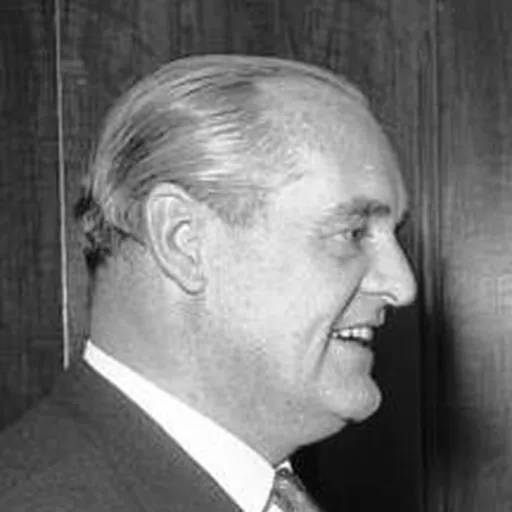
About Oskar Hermann Artur Schlitter
Lived 1904 – 1970 (aged 66). Oskar Hermann Artur Schlitter was a German diplomat.
Oskar Hermann Artur Schlitter (15 June 1904 – 12 November 1970) was a German diplomat. He was a Nazi Party member between 1934 and 1945 and excluded from the diplomatic service between 1945 and 1952, the year in which he returned to government service for what was now West Germany.
Between 1964 and 1970 he served as his country's ambassador in Athens.
Through his marriage to actress Daisy D'ora (Miss Germany 1931), he acquired a glamorous and publicity prone wife to whom diplomatic discretion did not always come naturally.
Life Provenance and early years Oskar Schlitter was born in Essen where his father, Oscar Schlitter (1868–1939), was the leading director at the .
He attended university in Munich and Berlin, Between 1932 and 1936, Schlitter was accredited to the German consulate in New York City.
Nazi years It was during this period, in January 1933, that régime change came to Germany, and the new government lost no time in transforming the country into a one-party dictatorship. Oskar Schlitter joined the Nazi Party in 1934.
In 1939 The Schlitters purchased the "schloss", together with the surrounding estate, at Offenstetten, in the hills east of Ingolstadt. The family moved to Offenstetten where Daisy and their two children lived during the World War II which resumed in September 1939, in his diplomatic bag to Copenhagen on 9 April 1940, the day of the invasion. The information Schlitter delivered equipped Himer and the embassy staffs in Copenhagen and Oslo to know what was going on.
Within the service he was promoted from the rank of Legationssekretär to that of Legationsrat in April 1942.
Until 1942 Schlitter and were seconded to work for Otto Abetz on the subjugation of the occupied part of France. From 1943 till 1944 he was accredited as the German consul in Lugano (in neutral Switzerland). Thereafter, from 1944 till the end of the war in May 1945, Schlitter was employed in the Italian section of the commercial department of the foreign office. The grand home at Offenstetten was commandeered for use as an officers' training academy During this period Prince Adalbert took a three-month leave of absence and Schlitter found himself, as Chargé d'affaires, working as West German ambassador to Madrid in all but title.
After this he was switched to London, where the West German embassy was accommodated in the same premises as the German embassy where he had served under Joachim von Ribbentrop during the 1930s. In the wake of the confusion the West German foreign office sent Oskar Schlitter, who also had a knowledge of agriculture along with his pre-war experience as a commercial attaché. Schlitter, accompanied by his distractingly glamorous wife, was nevertheless not the colleague his fellow West German diplomats in London had been expecting to welcome as their new chargé d'affaires.
There were about 100 guests and the event was held in the grand "reception hall" of the embassy. or "enemy territory" ("Wir sind im feindlichen Ausland"). Someone reported the remark to the press and an embassy spokesmen hastened to reassure anyone listening that she had intended to use the less offensive word "fremdlich" (foreign) and not the toxic word "Feind" (enemy). Accompanied by his wife, and without waiting to be summoned, Oskar Schlitter departed for Bonn on Sunday 2 January 1955, leaving the embassy not in an embassy car but driven to the station by their daughter in her small black car, and taking a late night channel crossing on the Belgian ferry "Prince Baudouin".
A helpful embassy spokesman was quoted as explaining that an enquiry had been set up concerning an indiscretion committed by a member of the chargé d'affaires's family. His offer to resign was communicated to Konrad Adenauer whose initial reaction was that any such resignation was out of the question. , the Foreign Office personnel chief, took a different view of the matter.
At this stage neither Schlitter's offer to resign nor Adenauer's instant dismissal of the idea had been communicated in writing, and having not been dismissed the Schlitters returned to the London embassy. Within the West German Foreign office, however, the matter was not so quickly laid to rest. British media interest rumbled on and the political establishment in London also appear to have remained resolutely unimpressed by the Schlitters' continued presence in their city.
Back in London an agitated James Pettigrew, the Daily Sketch reporter who had given the affair such prominence since the beginning of January, attempted and failed to discuss the affair with the West German ambassador.
In February 1964, Schlitter was appointed West German ambassador to Athens. The posting was a sensitive one partly because the Civil War had ended in 1949 with Greece on the frontline in a politically divided Europe and because of raw memories dating back two decades to the German occupation of Greece. On 18 April 1966 Schlitter signed a double taxation treaty with the Greek government.
Schlitter was still in office as ambassador on 21 April 1967 when democracy in Greece formally ended, supplanted by dictatorship. The development did nothing to diminish the diplomatic sensitivity of the posting. On 27 June 1969 Schlitter found himself in negotiation with Georgios Papadopoulos and other members of Greece's ruling junta over a possible friendship agreement between their two countries. He tried to persuade the junta to loosen certain repressive measured on the home front in order that Bonn might persuade the Council of Europe against expelling Greece. As matters turned out, the junta were not prepared to compromise, however, and the Greek government anticipated expulsion by withdrawing from the Council of Europe in December 1969.
Schlitter's 1932 marriage to Daisy D'ora (1913–2010) resulted in the birth of two children, both of whom were still alive in 1970, but would predecease their mother.
Don’t just read it —
keep it.
Full-length biographies made to live with: read them, listen on the way to work, watch them tonight.
- E-book
- Audio
- Video
Instant download · yours to keep · every purchase keeps this site free
Important facts
Family & relationships
People in Oskar Hermann Artur Schlitter's life
Named in this biography and alive at the same time


Related people
Same field, nearest in time

Contemporaries
People whose lives overlapped Oskar Hermann Artur Schlitter's


Frequently asked questions
Who was Oskar Hermann Artur Schlitter?
German diplomat (1904–1970)
When was Oskar Hermann Artur Schlitter born?
Oskar Hermann Artur Schlitter was born on 15 June 1904 in Essen.
When did Oskar Hermann Artur Schlitter die?
Oskar Hermann Artur Schlitter died on 12 November 1970 in Offenstetten.
What was Oskar Hermann Artur Schlitter's occupation?
Oskar Hermann Artur Schlitter was a diplomat.
What nationality was Oskar Hermann Artur Schlitter?
Oskar Hermann Artur Schlitter was German.
Sources & further reading
· Wikipedia: Oskar Hermann Artur Schlitter
Cite this page
APA: Biography.guide. (2026). Oskar Hermann Artur Schlitter. https://biography.guide/oskar-hermann-artur-schlitter/
MLA: "Oskar Hermann Artur Schlitter." Biography.guide, https://biography.guide/oskar-hermann-artur-schlitter/.
Chicago: "Oskar Hermann Artur Schlitter." Biography.guide. https://biography.guide/oskar-hermann-artur-schlitter/.
Data last updated: 2026-09-22 · Spot an error? Report a correction.
Page generated 2026-09-27 05:10 UTC