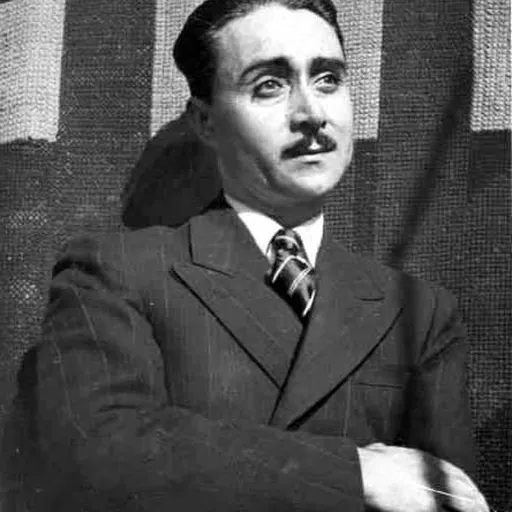
About Óscar Nicolás Castro
Lived 1910 – 1947 (aged 37). Óscar Nicolás Castro was a Chilean writer, poet, librarian and novelist.
Óscar Castro Zúñiga (March 25, 1910 – November 1, 1947) was a Chilean writer and poet. His literary work covered both the lyrical genre and the narrative genre, much more realistic and closer to the Criollismo movement.
Youth and studies (1910 – early 1930s) Óscar Castro Zúñiga was born in Rancagua on March 25, 1910, son of Francisco Castro and María Esperanza Zúñiga, being the third of five brothers: Graciela, Javier, Elba, and Irma.
In 1917 he entered as a regular student at Escuela Superior № 3, an important public school in Rancagua, however, he became ill with a convulsive cough and had to temporarily abandon his studies. In 1923, the family, after being abandoned by the father, received the support of Julio Valenzuela, an uncle close to the family, who enrolled Oscar at Instituto O'Higgins, a private school, where he would have stayed for at least one year. For various reasons that are unknown, he did not allow his uncle to continue helping him, becoming a self-taught person. Things became harder for him and his family, due to the Great Depression and a wave of public unrest in Chile. Despite these difficulties, Julio Valenzuela was fundamental in his beginnings as a writer, even financing his first publications.
Career (1926–1947)
Beginnings as a poet and writer In 1926 he wrote his first poems that were published in the magazine Don Fausto, a local newspaper, under the pseudonym "Raúl Gris", in tribute to his younger brother. In 1929, he published his first poem under his real name titled Poema a su ausencia appeared in some local newspapers.
In 1934 his brother Javier died. On October 25, 1934, and after the dissolution of the Rancagua Journalists Circle due to several differences among their members after the end of Socialist Republic in Chile, Oscar Castro, some of his friends and a group of important intellectuals including Nicomedes Guzmán and Agustín Zumaeta Basalto, created the literary group " Los Inútiles ". At the same time, he began a relationship with Estela Sepúlveda with whom he would maintain for several years a long sentimental and epistolary relationship that would have remained until his death. In 1935 he joined the newspaper La Tribuna as editor.
At the end of the decade of 1930, he initiated a long-time relationship with actress and writer Ernestina Zúñiga, well known by her pseudonym Isolda Pradel. They would marry later. There are different versions about the circumstances of how they met for the first time and how this relationship was developed, related in some biographies and anthologies about the writer written by Pradel herself and other authors. According to Gonzalo Drago in an interview in 1979, it was he who had presented Pradel, who by 1935 was known as a storyteller and performer and participated in literary activities. Some versions indicate that due to his relationship with Pradel, he was disapproved by his mother, who would have expelled him from the home, facts that were never confirmed by Pradel In that public school he also worked as a journalist and teacher of Spanish language. That same year he created a public school for workers, the Escuela Nocturna de Rancagua along with other professors.
In 1942, he was included along with Nicanor Parra and Victoriano Vicario in the anthology Tres Poetas Chilenos edited by Tomás Lago.
In 1945 his daughter Leticia Esmeralda suddenly died due to unknown causes. Months later, he was diagnosed with severe tuberculosis, and was hospitalized for two months. In 1946 he accepted a position at the Liceo Juan Antonio Rios in Santiago, where he began his work on March 8, 1947, and traveled continuously to Rancagua. However, despite the support of his fellow writers, his health was severely impaired and he entered the Hospital del Salvador on September 12, dying in Santiago on November 1, 1947.
Most of his works were not published before his death.
At the end of the 1930s, Castro was considered in Chile as one of the representatives of the so-called "poetry of clarity ", a literary tendency partly inspired by the work of the recently deceased Federico García Lorca, and created as a response to the hermeticism and subjectivism of the historical avant - garde. The evolution of Castro's literary work covers two very specific segments and, at first sight, different styles. At first sight, a poetic language, of melancholy nuances, slight, transparent in its language, diaphanous and lyrical in its metaphors, an impeccable metric and a great mastery in the composition of romances, which is clearly seen in books such as Viaje del alba a la noche (1938), endorsed by a prologue by Augusto D'Halmar, or the posthumous glosario gongorino (1948).
On the other hand, his narrative, which in stories like Llampo de Sangre (1950) are more realistic, close to criollismo has been a fundamental influence in the contemporary Chilean literature, a raw vision that in the following decades would serve as a reference and inspire the work of Chilean writers of the late twentieth century and early twenty-first century such as Pedro Lemebel,
Reeditions 2016: Siete veces Lucero + versión original (ed. Claudia Apablaza)
Musical works based on Castro Zúñiga 1970: Homenaje a Óscar Castro Zúñiga: Los Cuatro de Chile, Hector y Humberto Duvauchelle (Music by Ariel Arancibia, Lyrics by Óscar Castro Zúñiga)
Don’t just read it —
keep it.
Full-length biographies made to live with: read them, listen on the way to work, watch them tonight.
- E-book
- Audio
- Video
Instant download · yours to keep · every purchase keeps this site free
Important facts
Family & relationships
People in Óscar Nicolás Castro's life
Named in this biography and alive at the same time



Related people
Same field, nearest in time




Contemporaries
People whose lives overlapped Óscar Nicolás Castro's




Frequently asked questions
Who was Óscar Nicolás Castro?
1910-1947 Chilean writer and poet
When was Óscar Nicolás Castro born?
Óscar Nicolás Castro was born on 25 March 1910 in Rancagua.
When did Óscar Nicolás Castro die?
Óscar Nicolás Castro died on 1 November 1947 in Santiago.
What was Óscar Nicolás Castro's occupation?
Óscar Nicolás Castro was a writer, poet, librarian and novelist.
What nationality was Óscar Nicolás Castro?
Óscar Nicolás Castro was Chilean.
Sources & further reading
· Wikipedia: Óscar Nicolás Castro
· DBpedia: Óscar Castro Zúñiga
Cite this page
APA: Biography.guide. (2026). Óscar Nicolás Castro. https://biography.guide/oscar-nicolas-castro/
MLA: "Óscar Nicolás Castro." Biography.guide, https://biography.guide/oscar-nicolas-castro/.
Chicago: "Óscar Nicolás Castro." Biography.guide. https://biography.guide/oscar-nicolas-castro/.
Data last updated: 2026-09-22 · Spot an error? Report a correction.
Portrait: Wikimedia Commons · author & licence
Page generated 2026-09-27 04:58 UTC