Öpir
Swedish runemaster
About Öpir
Lived 1000 – 1101. Öpir was a Swedish runemaster.
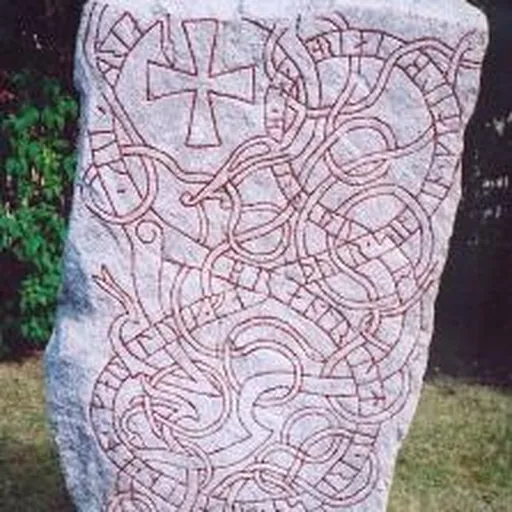
Uppland Rune Inscription Fv1976 107 showing Öpir's craftmanship. Öpir or Öper (Old Norse: Øpiʀ/Œpir, meaning "shouter") was a runemaster who flourished during the late 11th century and early 12th century in Uppland, Sweden. He was the most productive of all the old runemasters and his art is classified as being in the highly refined Urnes style.
Work During the 11th century, when most runestones were raised, the small number of professional runemasters and their apprentices were contracted to make runestones. When the work was finished, the stone was usually signed with the name of the runemaster.
Öpir had been an associate or an apprentice of the runemaster Visäte. He has signed about 50 runestones, and an additional 50 runestones were probably made by him. Moreover, the style is characterized by elegance and control in the complex intervolutions of the rune serpents. On one runestone, U 485 in Marma, he gives his full name: Ofæigʀ Øpiʀ. The loss of the initial h phoneme before vowels and its use in the beginning of words where it usually does not appear is a dialect trait still typical of Roslagen (eastern Uppland), where Öpir was active.
However, recent research presents him as a consistent and careful speller with very few language errors, Rundata lists three additional inscriptions: U 896 in Håga and U 940 in Uppsala, both of which have text stating that Öpir "arranged the runes," and U 1022 in Storvreta. It has been suggested that these three inscriptions represent works from the beginning of Öpir's career.
Another inscription that listed by Rundata, Sö 11 in Gryts, is indicated as being signed by a second person named Öpir.
Possible identification with Russian priest A record of Упирь (Upir′ ) appears in a document dated 1047 AD. It is a colophon in a manuscript of the Book of Psalms written by a priest who transcribed the book from Glagolitic into Cyrillic for the Novgorodian Prince Vladimir Yaroslavovich. The priest writes that his name is "Upir′ Likhyi " (Упирь Лихый), which would mean something like "Wicked Vampire" or "Foul Vampire." This apparently strange name has been cited as an example of surviving paganism and/or of the use of nicknames as personal names. However, in 1982 , Swedish Slavicist Anders Sjöberg suggested that "Upir′ likhyi" was in fact an Old Russian transcription and/or translation of the name of Ofeigr Öpir. Sjöberg argued that Öpir could possibly have lived in Novgorod before moving to Sweden, considering the connection between Eastern Scandinavia and Kievan Rus' at the time. This theory is still controversial, although at least one Swedish historian, Henrik Janson, has expressed support for it.
Gallery
Notes and references
Don’t just read it —
keep it.
Full-length biographies made to live with: read them, listen on the way to work, watch them tonight.
- E-book
- Audio
- Video
Instant download · yours to keep · every purchase keeps this site free
Important facts
Related people
Same field, nearest in time



Contemporaries
People whose lives overlapped Öpir's



Frequently asked questions
Who was Öpir?
Swedish runemaster
When was Öpir born?
Öpir was born in 1000.
When did Öpir die?
Öpir died in 1101.
What was Öpir's occupation?
Öpir was a runemaster.
What nationality was Öpir?
Öpir was Swedish.
Sources & further reading
Cite this page
APA: Biography.guide. (2026). Öpir. https://biography.guide/opir/
MLA: "Öpir." Biography.guide, https://biography.guide/opir/.
Chicago: "Öpir." Biography.guide. https://biography.guide/opir/.
Data last updated: 2026-09-22 · Spot an error? Report a correction.
Portrait: Wikimedia Commons · author & licence
Page generated 2026-09-27 05:03 UTC